
A research facility is selecting hardware for a new on-premises data center cluster dedicated to training large transformer-based language models. Which of the following NVIDIA GPUs is most suitable for this scale of deep learning training, based on VRAM capacity, memory bandwidth, and interconnect technology?
Select an answer to reveal the explanation.
Short Explanation
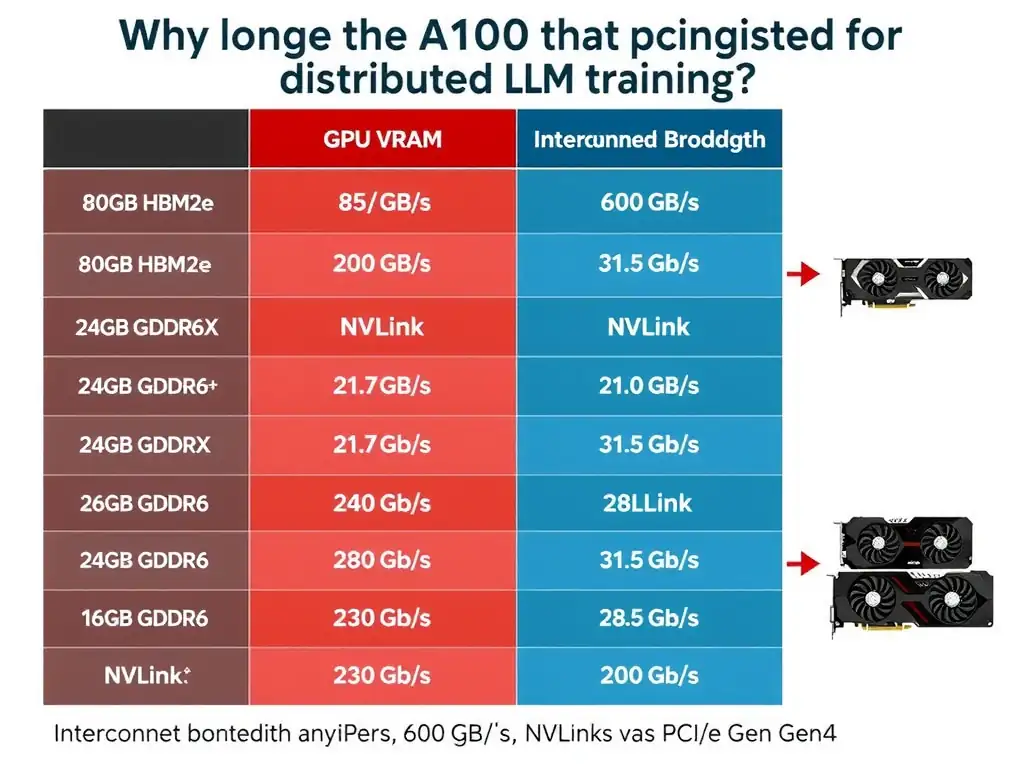
You need huge VRAM to fit billions of parameters and intermediate states, plus fast GPU-to-GPU links. The NVIDIA A100 Tensor Core GPU with 80GB HBM2e memory gives you the capacity, bandwidth, and NVLink support for large-scale training. The other cards are built for inference or consumer use, not data-center LLM training.
Full Explanation
For training large transformer-based language models, memory capacity and interconnect bandwidth are the key hardware bottlenecks. The NVIDIA A100 Tensor Core GPU with 80GB HBM2e memory is engineered specifically for scale-out data center training. It features high-speed HBM2e memory providing over 1.5 TB/s of bandwidth, and supports third-generation NVLink, enabling GPUs to communicate at up to 600 GB/s. This is critical for distributed training frameworks, such as Megatron-LM or DeepSpeed, that split model parameters across multiple GPUs. The NVIDIA T4 with 16GB GDDR6 memory is a low-power 70W GPU optimized for AI inference at scale, lacking the memory capacity and bandwidth for training. The NVIDIA L4 with 24GB GDDR6 memory is a mainstream accelerator designed for video processing and inference, not high-end LLM training. The NVIDIA RTX 4090 with 24GB GDDR6X memory is a consumer workstation GPU that lacks NVLink support, meaning inter-GPU scaling is restricted to slower PCIe lanes; it uses less bandwidth-efficient GDDR6X memory, and is restricted from enterprise data center deployments by its license terms.