
When sizing GPU resources for an enterprise AI deployment, you must account for different memory consumption profiles across the machine learning workflow. Which of the following phases demands the largest allocation of GPU memory (VRAM) for a given neural network model?
Select an answer to reveal the explanation.
Short Explanation
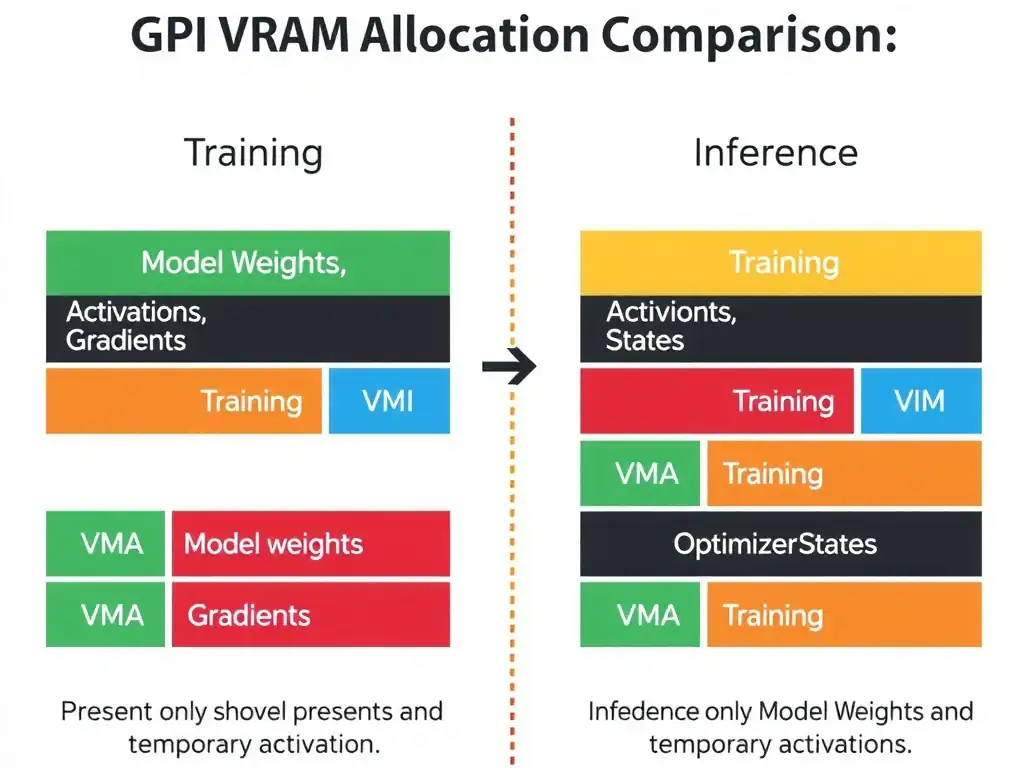
Here's the deal: you'll see model training with backpropagation demand the most VRAM because the GPU has to keep the model weights, the batch data, all forward-pass activations, gradients, and optimizer states in memory at once. Inference and validation only need the weights and a small forward-pass buffer, and preprocessing usually doesn't need much GPU memory.
Full Explanation
Model training with backpropagation demands the largest allocation of GPU memory for a given neural network model. During training, the GPU memory must store several data structures simultaneously: the model parameters, which are the weights and biases of the network; the gradients calculated for every trainable parameter; optimizer states, because optimizers such as Adam or RMSprop require tracking running averages of gradients and squared gradients for every parameter, multiplying the memory footprint; the activations, which are the intermediate outputs of every layer during the forward pass and must be retained because they are required to compute gradients during the backward pass; and the batch data, which includes the input features and labels for the current training batch.
In contrast, data preprocessing and feature engineering are typically handled on the CPU or require minimal GPU memory for basic operations. Model validation and evaluation, like model deployment and real-time inference, only require a forward pass, meaning intermediate activations can be discarded as soon as the next layer is executed, and no gradients or optimizer states are stored.