
When you deploy a CUDA kernel to run on an NVIDIA GPU, the programming model must organize parallel execution units so they can scale across any number of GPU cores. What is the fundamental hierarchical structure used by CUDA to group individual execution threads together, and how are those groups further organized to execute the kernel?
Select an answer to reveal the explanation.
Short Explanation
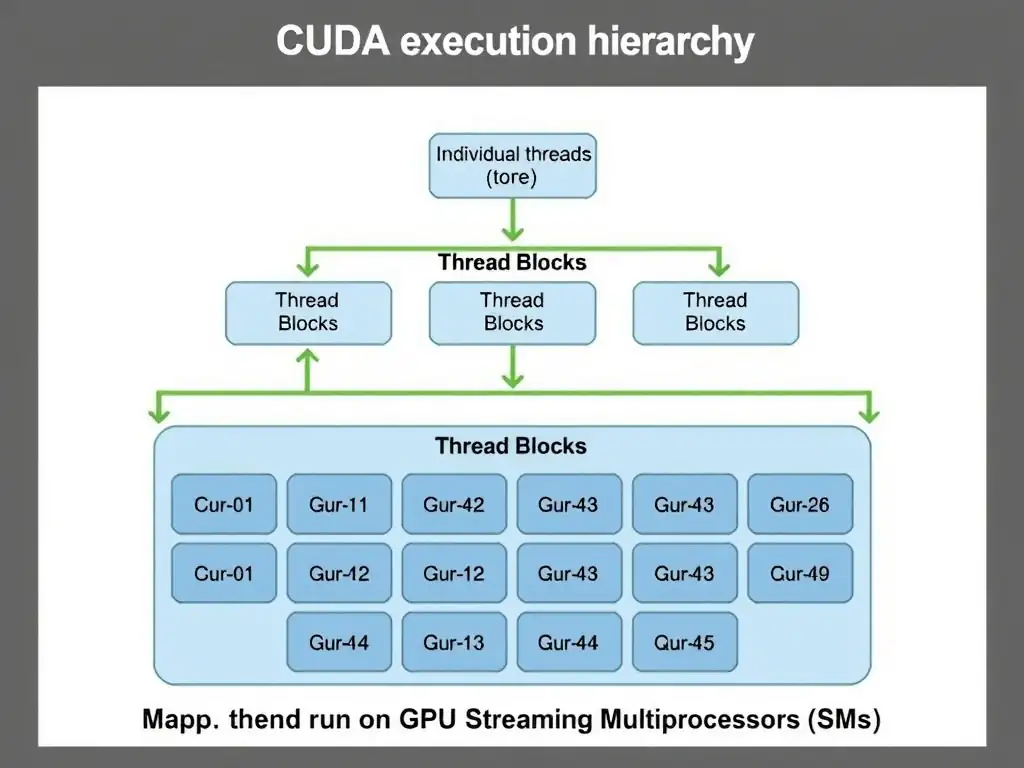
Think of CUDA like massive logistics. You bundle individual threads into thread blocks, then load those blocks into the grid to handle the whole job. That grid scales because bigger GPUs can run more thread blocks at once.
Full Explanation
The CUDA programming model uses the hierarchical execution model to abstract the GPU hardware and ensure transparent scalability across different generations of GPUs. At the lowest level, individual threads run the kernel code. These threads are grouped into thread blocks, which typically contain up to 1024 threads. All threads within one thread block run on one Streaming Multiprocessor, sharing fast on-chip shared memory and synchronization barriers. These thread blocks are then organized into grids. The grid represents the entire collection of thread blocks launched for the specific kernel. This abstraction is crucial for scalability: because thread blocks in the grid execute independently, the hardware scheduler can distribute them across any number of available Streaming Multiprocessors. Lower-end GPUs might execute thread blocks sequentially, while higher-end GPUs with many more Streaming Multiprocessors will run those same blocks concurrently, accelerating execution without requiring recompilation of the code. The compute blocks organized into processing units phrasing is incorrect because it borrows OpenCL-like terminology and describes grouping hierarchy that CUDA does not use for kernel launch. The processing warps organized into streaming multiprocessor domains phrasing is incorrect because warps are hardware-level scheduling units, not the fundamental software grouping used to organize kernel execution, and streaming multiprocessor domains are not the CUDA grid abstraction. The execution threads grouped into memory blocks phrasing is incorrect because memory blocks are not CUDA execution groups; CUDA groups threads into thread blocks, then organizes those thread blocks into grids.