
You are building a GPU-accelerated recommendation pipeline using the NVIDIA Merlin framework. Which of the following are core components of this ecosystem designed to optimize recommender systems? (Select all that apply.)
Select all correct answers, then click Submit.
Short Explanation
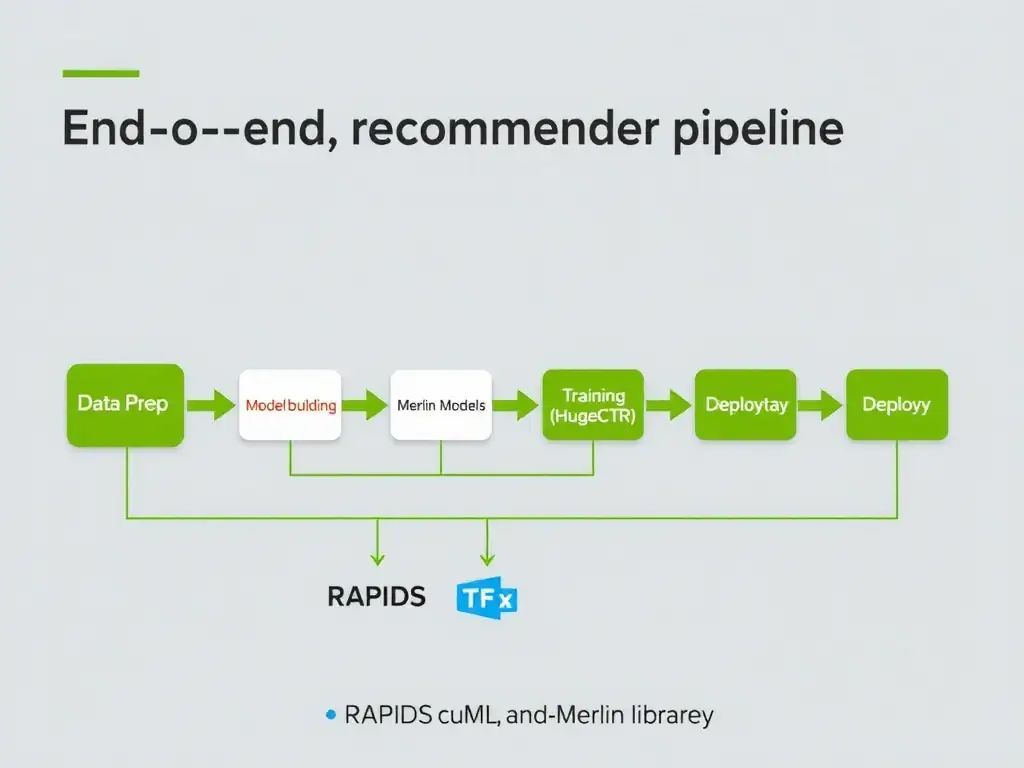
Check this out: recommender systems have unique problems, so NVIDIA Merlin gives you the core stack for them: NVTabular for GPU-scale preprocessing, Merlin Models for building recommender architectures, HugeCTR for multi-GPU training, and Merlin Systems for production deployment. TensorFlow Extended is Google's platform, and RAPIDS cuML is for traditional ML, so they're not Merlin core components.
Full Explanation
The NVIDIA Merlin framework is an open-source library and ecosystem designed to accelerate all stages of recommender system development on GPUs. Its core components include NVTabular, a library for processing tabular data at scale on GPUs, handling feature engineering and preparing inputs for deep learning models; Merlin Models, which offers pre-built recommender system architectures such as DLRM and DeepFM that can be easily customized and trained; HugeCTR, a dedicated C++ deep learning training engine for recommendation models featuring model-parallel embedding tables distributed across GPU memory; and Merlin Systems, which facilitates orchestration and deployment of recommendation pipelines to production, interfacing with Triton Inference Server. Conversely, TensorFlow Extended for end-to-end model validation pipelines is Google's end-to-end machine learning platform and is entirely separate from the NVIDIA software suite, while RAPIDS cuML for running GPU-accelerated traditional machine learning algorithms provides GPU-accelerated versions of traditional ML algorithms such as Random Forest and K-Means but is not a core component of the Merlin recommendation system framework.