
When deploying and managing AI workloads in cloud-native environments, what are the primary orchestration capabilities that Kubernetes directly provides to support your containerized machine learning pipelines? (Select all that apply.)
Select all correct answers, then click Submit.
Short Explanation
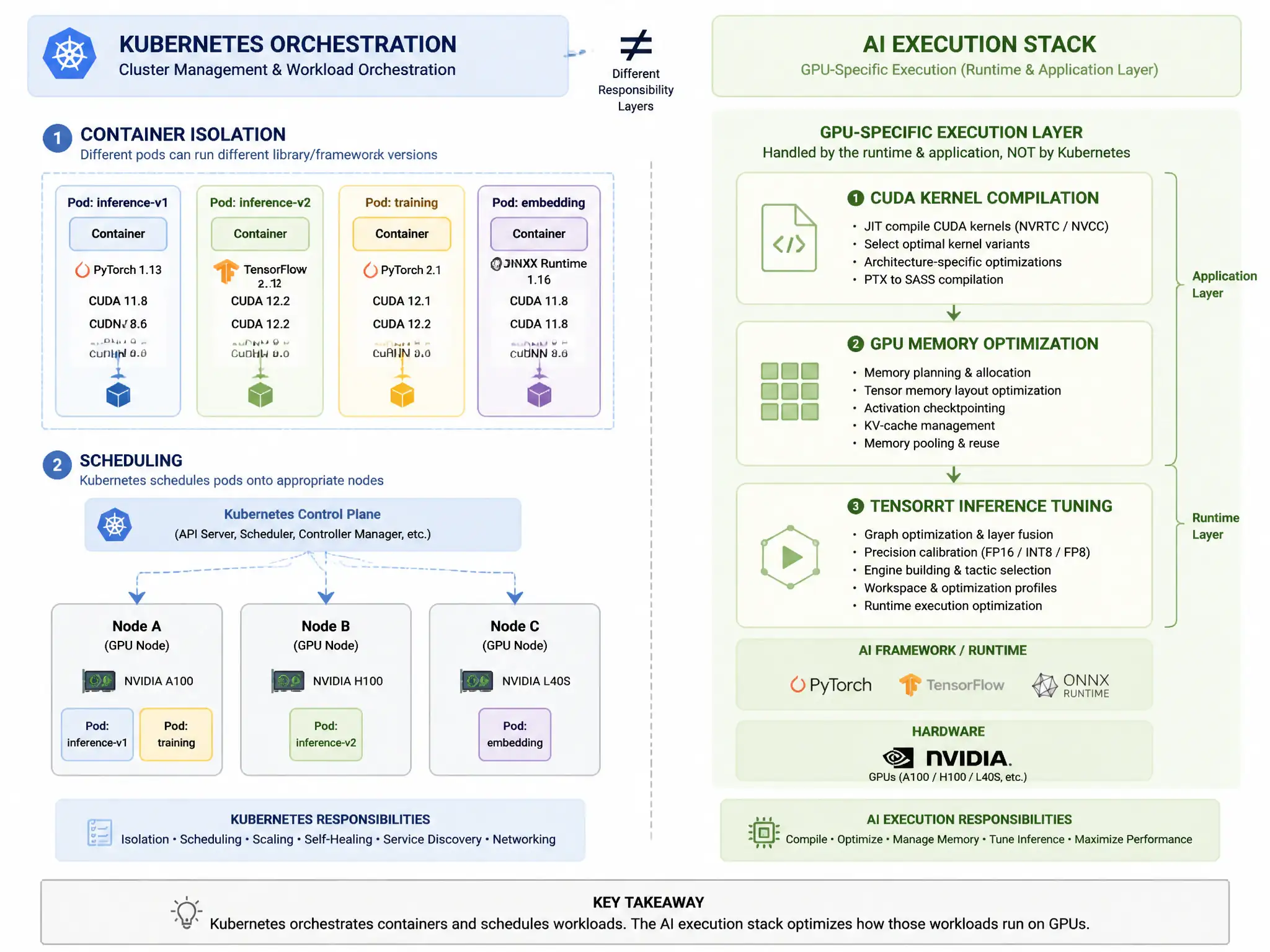
Here's the deal: Kubernetes is your cluster's project manager. It schedules pods to nodes with available resources, scales pods up and down when demand spikes, and keeps containerized AI models isolated so conflicting dependencies don't step on each other's toes. Don't expect it to compile CUDA kernels, accelerate training, or tune inference latency—that's the execution stack's job.
Full Explanation
Kubernetes is designed as a container orchestrator and excels at managing the lifecycle, placement, and scalability of containers. For AI workloads, it directly provides automated scheduling and resource allocation across cluster nodes based on user-defined CPU, memory, and GPU limits; horizontal scaling of pods to dynamically match workload demands and traffic fluctuations, including scaling application replicas in response to CPU utilization or custom metrics; and container isolation to prevent library dependency conflicts between different AI model pods, allowing teams to run models with conflicting CUDA, Python, or framework dependency versions on the same physical infrastructure.
The hardware-level GPU memory optimization and direct CUDA kernel compilation capability is wrong because those functions are handled at the runtime and driver level by the CUDA toolkit and drivers, not by the container orchestration layer. The direct neural network model training acceleration and optimizer updates capability is wrong because training acceleration and optimizer updates are performed by deep learning frameworks such as PyTorch and JAX and by specialized hardware accelerators, not by Kubernetes. The real-time optimization of deep learning model inference latency at the application layer capability is wrong because inference latency optimization is managed by dedicated model-serving software such as NVIDIA Triton Inference Server and compilation tools such as TensorRT rather than general-purpose container orchestration. Exam caveat: keep the infrastructure orchestration layer separated from the model execution stack in your mind, and you'll ace this on the exam.