
Which industry trends are major drivers for the evolution of modern AI infrastructure design and deployment models? (Select all that apply.)
Select all correct answers, then click Submit.
Short Explanation and Infographic
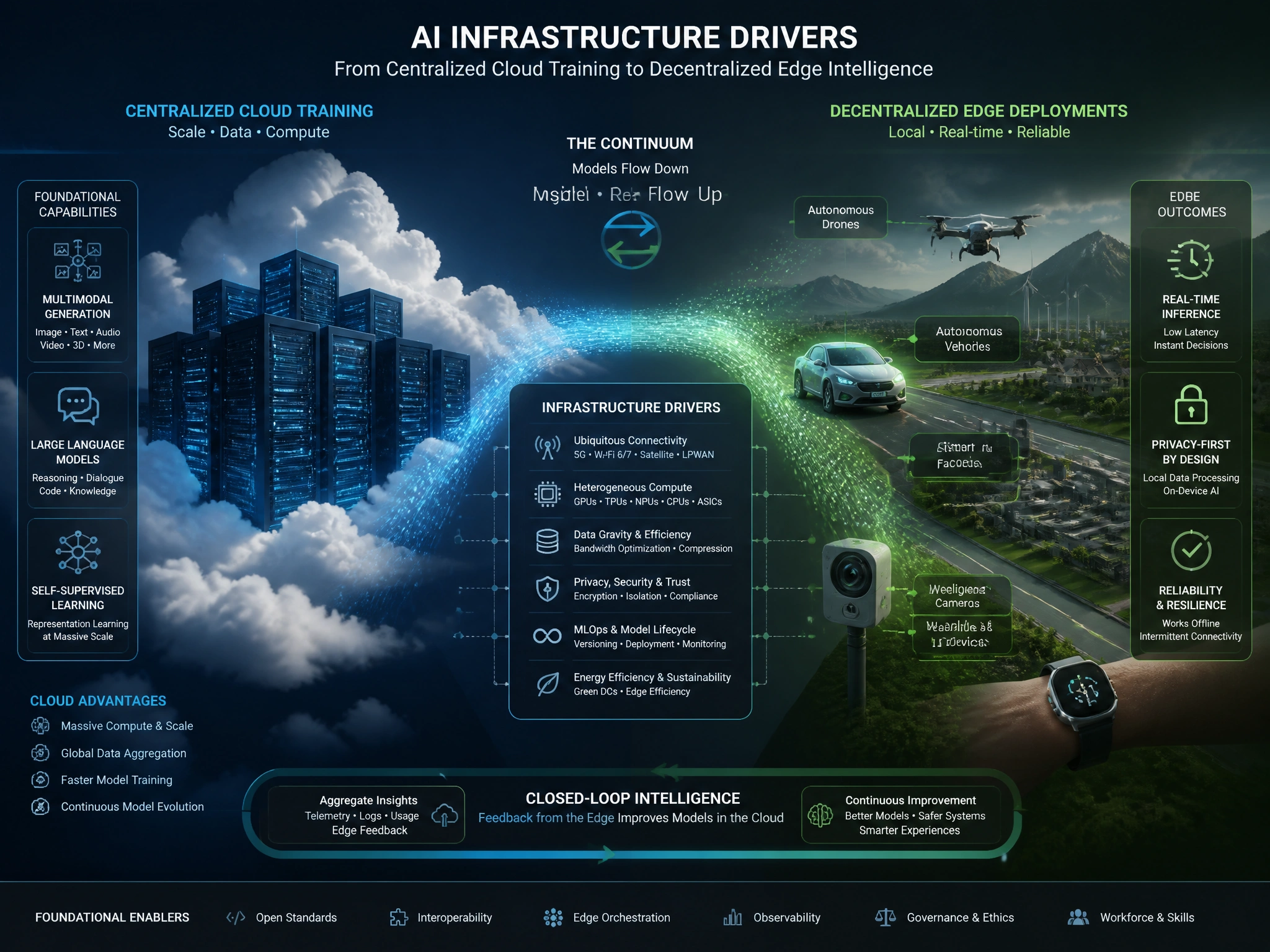
Let's look at what is driving the crazy growth in AI hardware requirements. First off, we've moved past simple text models. Generative AI is now handling massive video, audio, and 3D graphics datasets, which takes a ridiculous amount of processing power. Then you have NLP models with huge context windows that need fast memory access. At the same time, we're doing self-supervised learning on raw, unlabeled datasets, and pushing those trained models out to the edge on mobile devices and IoT gateways for low latency and privacy. But don't fall for the hype: edge AI isn't going to kill cloud computing—they work together. And automated software tools aren't magic; they still need powerful hardware underneath. Keep these trends straight, because they dictate how we design data centers.
Full explanation below image
Full Explanation
Modern AI infrastructure planning is driven by shifting model architectures and deployment paradigms. First, self-supervised learning (SSL) uses raw unlabeled data to pretrain models, requiring large-scale computing clusters to process massive uncurated datasets before fine-tuning. Second, advanced NLP models (such as large transformer networks) require vast computational and memory footprints to manage context-rich, long-form sequences. Third, multimodal generative models generate media formats like video, synthetic voice, and 3D graphics, demanding extreme parallel processing power for training and inference. Fourth, edge AI shifts execution closer to the user to reduce latency and protect sensitive data locally, driving the deployment of heterogeneous edge accelerators. Regarding the distractors: Automated feature engineering (Choice E) is a software-level pipeline step that optimizes data preparation but does not eliminate the need for high-performance training accelerators. Edge computing (Choice F) complements cloud-based resources in a hybrid model rather than replacing centralized data centers, which are still required to train large models.