
An enterprise data center needs to host high-throughput AI inference applications. The project constraints require a cost-effective accelerator solution that features low thermal design power (TDP) and optimized performance for scaling trained models. Which GPU option is best suited for this application?
Select an answer to reveal the explanation.
Short Explanation
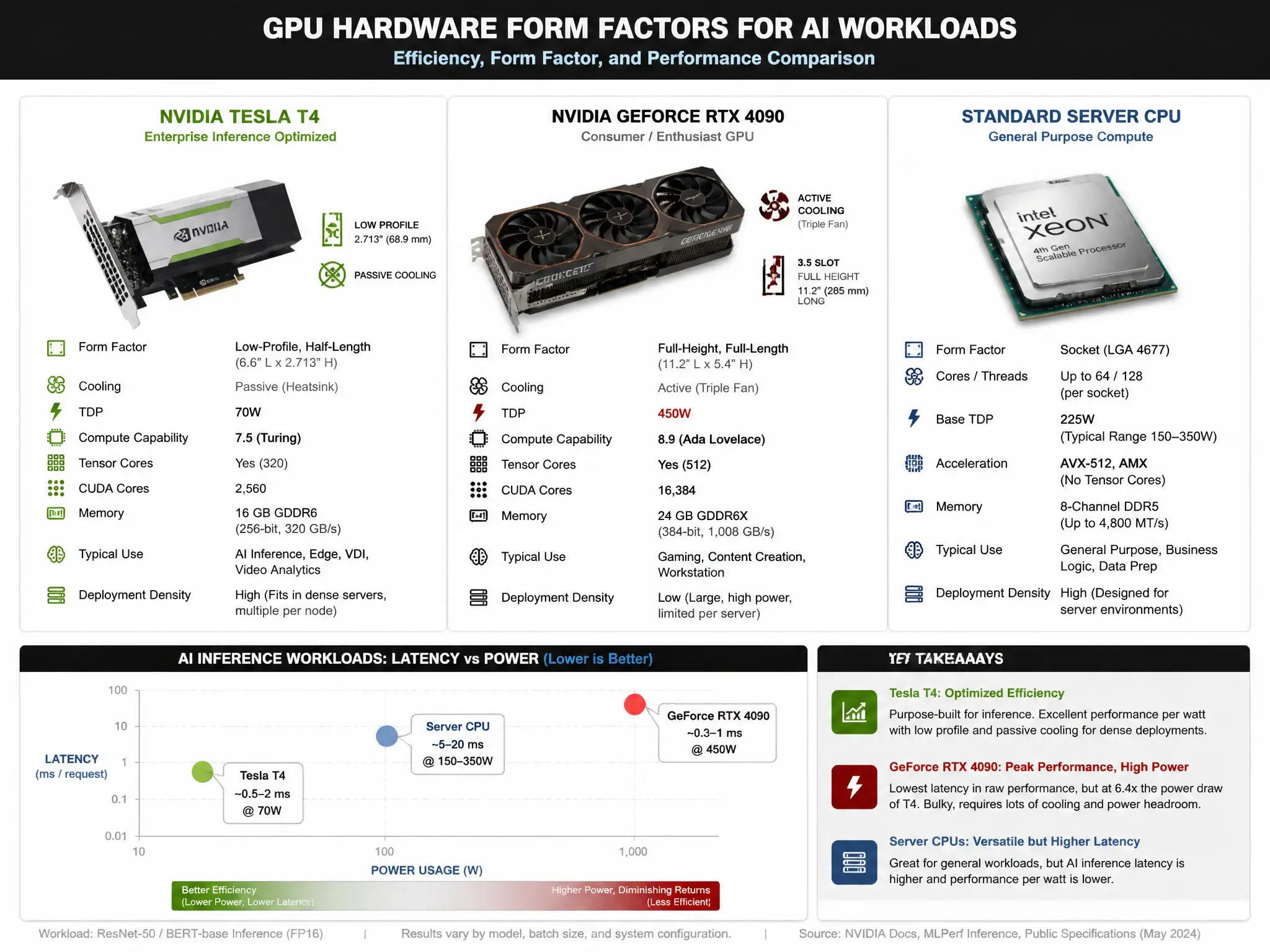
You need an enterprise accelerator that sips power and scales inference, so the Tesla T4 is the right call. Consumer GeForce cards burn too much power and aren't meant for data centers, and CPU-only racks won't keep up.
Full Explanation
Selecting the appropriate GPU accelerator requires balancing workload requirements (inference vs. training), power consumption, thermal limits, and enterprise support. The NVIDIA Tesla T4 enterprise GPU designed for low-power inference is explicitly engineered for scale-out database and AI inference workloads. Built on the Turing architecture, it features dedicated Tensor Cores and operates at a very low thermal design power (TDP) of only 70 watts. This makes it highly power-efficient and allows it to be passively cooled in dense multi-GPU server chassis, keeping operational and cooling costs low. The GeForce RTX 4090 gaming GPU option for peak raw single-precision computing and the budget-friendly GeForce RTX 4060 graphics card option are gaming-oriented GPUs. Aside from EULA restrictions prohibiting their deployment in commercial data centers, they have high power demands (the RTX 4090 can draw up to 450W) and utilize active cooling fans that are incompatible with standard front-to-back data center cooling designs. The high-end CPU-only rack server option to avoid GPU-specific licensing costs lacks the parallel architecture and specialized Tensor Cores required to meet high-throughput, low-latency requirements for modern AI inference models. Thus, the Tesla T4 provides the optimal balance of power efficiency, cost, and targeted performance.