
You're explaining the difference between training and inference phases to a stakeholder unfamiliar with deep learning workflows. How do these phases differ architecturally?
Select an answer to reveal the explanation.
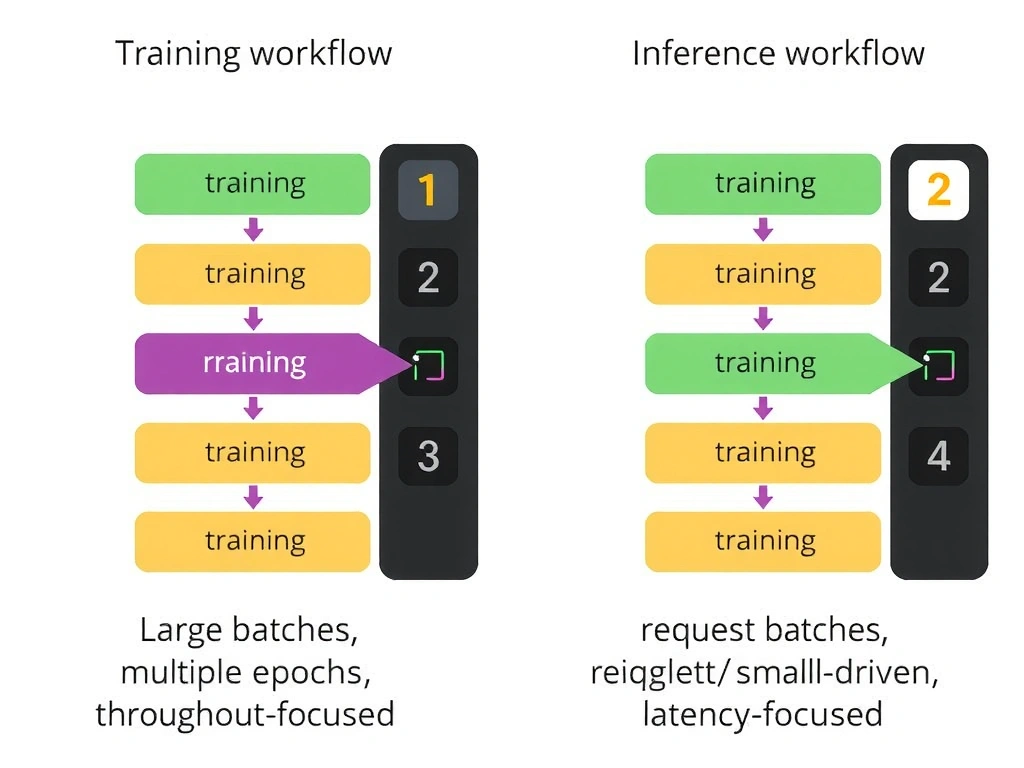
Short Explanation and Infographic
C is correct. Training is about processing massive datasets to create the model (throughput-optimized). Inference is about making fast predictions (latency-optimized). They're fundamentally different architecturally and operationally.
Full explanation below image
Full Explanation
Training and inference are distinct phases with different architectural requirements. During training, you're processing terabytes of data, doing forward passes, computing loss, backpropagating gradients, and updating weights. Throughput is king — how much data can you process per unit time? You want large batch sizes, high GPU utilization, and efficient distributed training. During inference, you have a trained model and you're making predictions. A customer query arrives, you feed it through the model, return the prediction. Latency matters — how fast can you respond? You might have a smaller batch size (sometimes batch size of 1) and tolerate slightly lower throughput if it means lower latency. They can share infrastructure (you can run both on H100 clusters), but you're making tradeoffs. If you optimize exclusively for training throughput, inference latency might be higher. If you optimize for inference latency, training might be slower. Large organizations often separate infrastructure: training clusters optimized for throughput, inference clusters optimized for latency. The question tests whether you understand the fundamental workload differences.