
You're managing an InfiniBand fabric deployed in your data center, and you need infrastructure software to discover devices, assign addresses, configure the topology, and manage the overall fabric health. Which component handles these subnet management functions?
Select an answer to reveal the explanation.
Short Explanation and Infographic
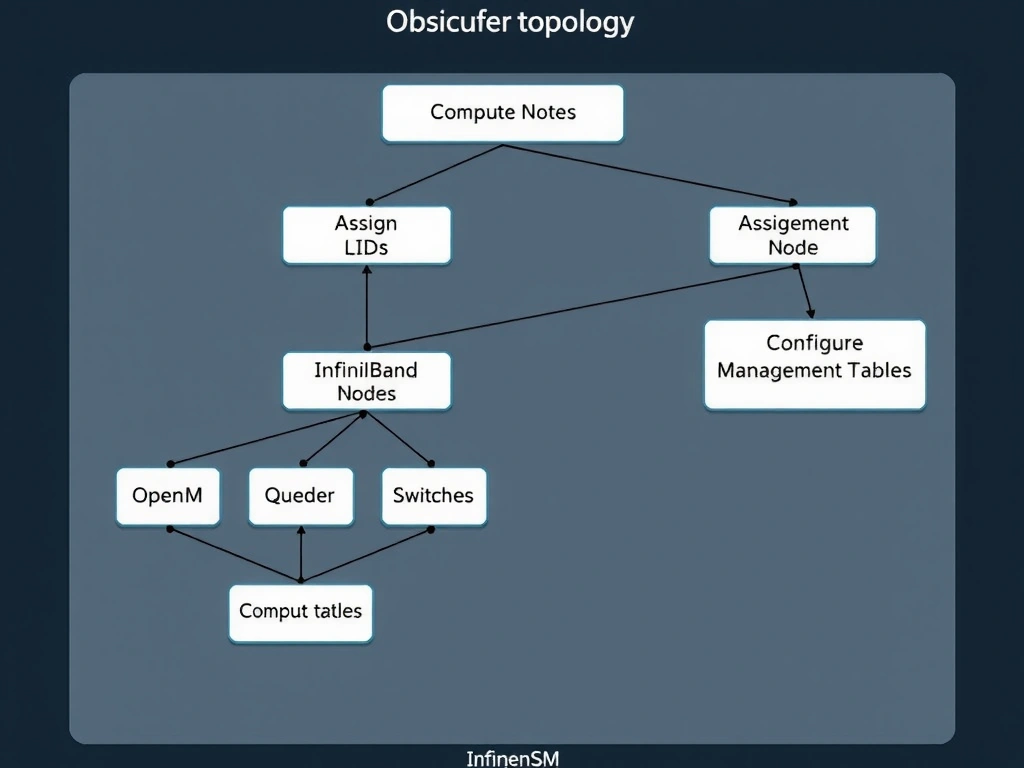
OpenSM is the subnet manager for InfiniBand. It discovers devices, assigns addresses, configures the topology, and manages fabric operations. Verbs is the low-level API, MPI is communication protocol, CUDA is unrelated to fabric management.
Full explanation below image
Full Explanation
An InfiniBand fabric is a complex interconnect with multiple switches, routers, and endpoints. Someone has to manage it: discover all devices, assign addresses (GUIDs, LIDs), configure routing tables, and monitor health. That's the Subnet Manager (SM). OpenSM is an open-source implementation of the SM. It runs on a dedicated management node and continuously: discovers InfiniBand devices, assigns Local IDs (LIDs) for routing, configures switch forwarding tables, and monitors link health. If a device fails or a link goes down, the SM reconfigures the fabric. Without a subnet manager, the InfiniBand fabric is inoperable — devices can't find each other or route packets. Verbs is the low-level API that applications use to access InfiniBand hardware capabilities. MPI (Message Passing Interface) is a communication protocol that can run on top of InfiniBand, but it's not fabric management. CUDA is NVIDIA's GPU compute platform, unrelated to InfiniBand. The question tests whether you understand InfiniBand architecture and the role of fabric management.