
You're analyzing storage access patterns during a typical deep learning training run. As the model iterates through batches of training data, what's the dominant I/O pattern you'd observe?
Select an answer to reveal the explanation.
Short Explanation and Infographic
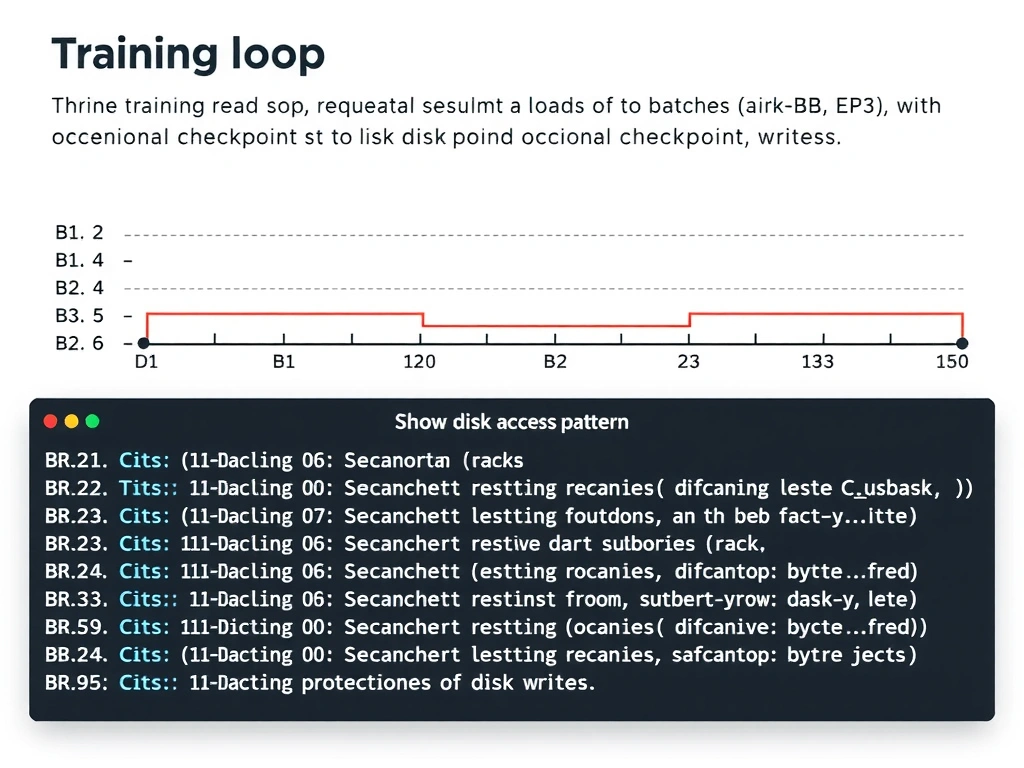
Training reads data sequentially in batches. The model goes through the training set epoch after epoch, reading batches one after another. It's sequential reads. Writes happen when you save checkpoints, but that's sporadic. Sequential reads dominate.
Full explanation below image
Full Explanation
Deep learning training has a predictable I/O pattern. The model processes the training dataset, typically in fixed-size batches (batch 0, batch 1, batch 2, etc.). These batches are usually stored sequentially in files or a parallel file system. The training loop reads batches sequentially: load batch 1, compute loss, backprop, update weights, load batch 2, repeat. This is sequential I/O. Occasional writes happen when you save model checkpoints (model weights to disk), but these are infrequent (maybe every 1000 iterations) compared to the constant stream of reads. Random I/O (reading scattered data from different parts of disk) would kill performance — storage subsystems are optimized for sequential access. If your training data is organized randomly on disk, performance tanks. This is why parallel file systems stripe data intelligently — they ensure sequential reads from the application's perspective become interleaved reads from different storage servers, maximizing aggregate throughput. The question tests whether you understand real I/O patterns in training workloads and why storage architecture matters.