
When you're building a Kubernetes cluster to run GPU workloads, you need certain foundational pieces in place before your pods can even talk to the GPUs. Think of it like building a house — you need the electrical system and the circuit breaker box before you can plug anything in. Which two of the following components does NVIDIA bundle into the GPU Operator to provide that essential plumbing?
Select all correct answers, then click Submit.
Short Explanation and Infographic
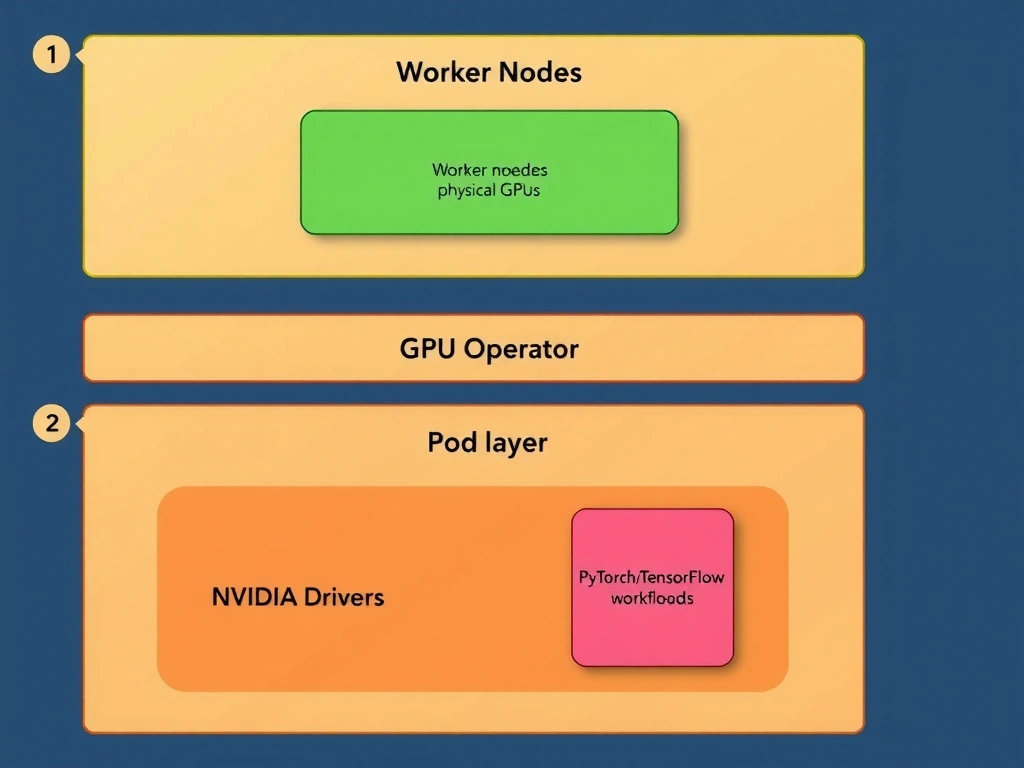
Here's the deal — the GPU Operator is NVIDIA's way of saying, "Let me handle the heavy lifting so you can focus on your workloads." It gives you two core pieces: the drivers (so Kubernetes nodes can actually see and use the GPUs) and DCGM (your monitoring and health-check system). TensorFlow and PyTorch? Those are applications that sit on top of what the operator provides, not part of the operator itself.
Full explanation below image
Full Explanation
The NVIDIA GPU Operator is a Kubernetes-native way to deploy and manage GPU drivers and monitoring at scale. When it runs, it automatically installs the NVIDIA drivers across your cluster nodes — without you having to SSH into each one and do it manually. That's huge in production. It also packages DCGM, which continuously watches your GPUs' health, temperature, power consumption, and performance metrics. Together, they give Kubernetes the foundation it needs to schedule GPU pods safely and efficiently.
Now, here's where people get confused: frameworks like PyTorch and TensorFlow are applications that run inside your containers. They depend on the driver and DCGM being there, but they're not part of the operator itself. If you tried to install PyTorch via the operator, you'd be mixing concerns — the operator's job is infrastructure, not application installation. This separation matters when you're troubleshooting or upgrading. You can swap TensorFlow for JAX without touching the operator; if the operator breaks, nothing works.
In production, I've seen teams forget DCGM is even there until a GPU starts thermally throttling or a memory error creeps in. Then they thank their lucky stars DCGM caught it and gave them the telemetry to act on. That's the monitoring piece earning its keep.