
Your enterprise AI team is building a massive data pipeline to ingest, store, and process petabytes of unstructured text, audio, and video data from various departments. This data must be accessible by hundreds of GPU training nodes simultaneously and preserved for future inference tasks. Which two storage architectural approaches will best scale to support these requirements? (Select two)
Select all correct answers, then click Submit.
Short Explanation and Infographic
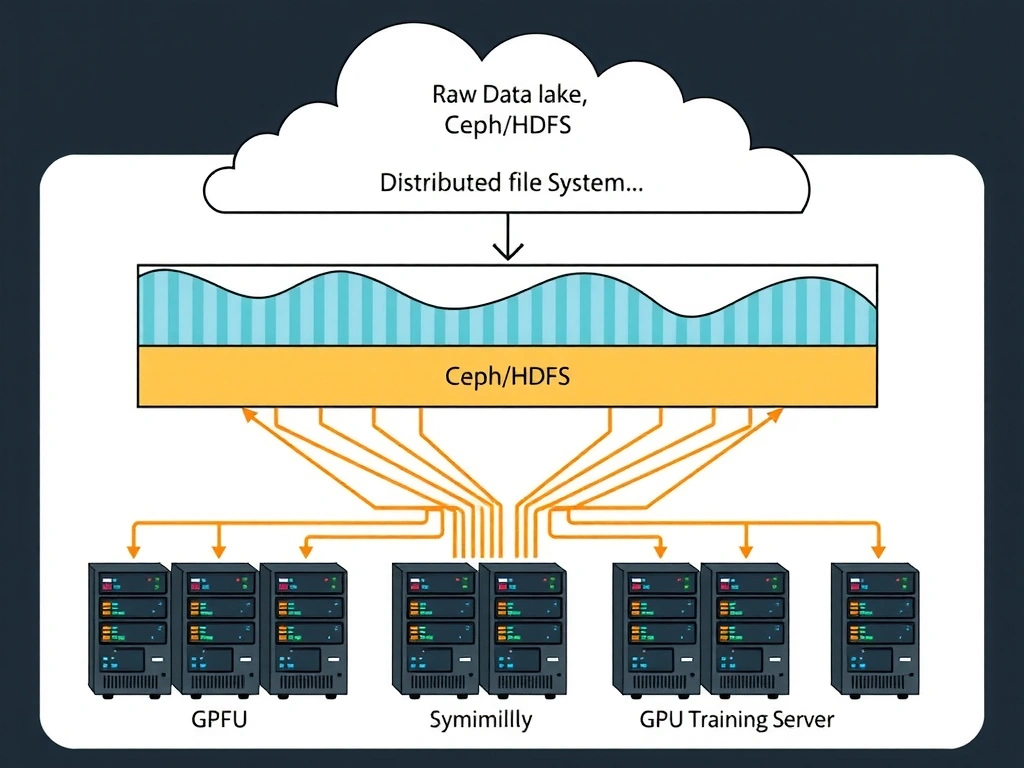
If you're dealing with petabytes of data for AI models, trying to stuff it all onto one giant local drive is a recipe for disaster. That drive will fill up, slow down, and eventually die, taking your whole project with it. Not very efficient! Instead, you need two things. First, get a distributed file system like Ceph or HDFS in place. Think of it like spreading your files across a team of assistants who can read them to your GPUs all at the same time—no more waiting in line! Second, build a data lake. This is a massive pool where you can dump raw, unstructured files (audio, video, text) without having to format them first. It keeps your data organized and ready for training and inference when you need it.
Full explanation below image
Full Explanation
Handling petabyte-scale data for modern deep learning models requires storage architectures that scale horizontally in both capacity and throughput. Traditional centralized storage architectures create physical bottlenecks when hundreds of GPU cores attempt to read massive datasets concurrently. To solve this, organizations deploy distributed file systems like Ceph or Hadoop HDFS. These systems break data into blocks and distribute them across multiple storage nodes. This architecture enables parallel data retrieval, meaning multiple GPU nodes can stream data simultaneously, eliminating read bottlenecks and accelerating training epochs.
In conjunction with a distributed file system, a data lake architecture is highly effective for AI pipelines. A data lake is a centralized repository that allows organizations to store structured, semi-structured, and unstructured data in its raw, native format at scale. Because deep learning models often ingest diverse data formats (such as raw images, sensor logs, and text files), a data lake allows data scientists to store these files immediately and apply schema-on-read when training models, providing immense architectural flexibility.
Other strategies fail to scale. Centralizing all data on a single local drive or routing requests sequentially through a single master node introduces a critical single point of failure and severe I/O bottlenecks. While data compression can save storage space, enforcing heavy compression that restricts active read access during training runs halts model training pipelines, reducing compute efficiency.