
A cloud-hosted AI cluster experiences severe performance variability and latency spikes during peak periods when multi-user workloads conflict. To stabilize throughput and ensure high availability across the enterprise, the systems administration team needs to optimize resource utilization and software upkeep. Which of the following operations management actions should they prioritize? (Choose two)
Select all correct answers, then click Submit.
Short Explanation
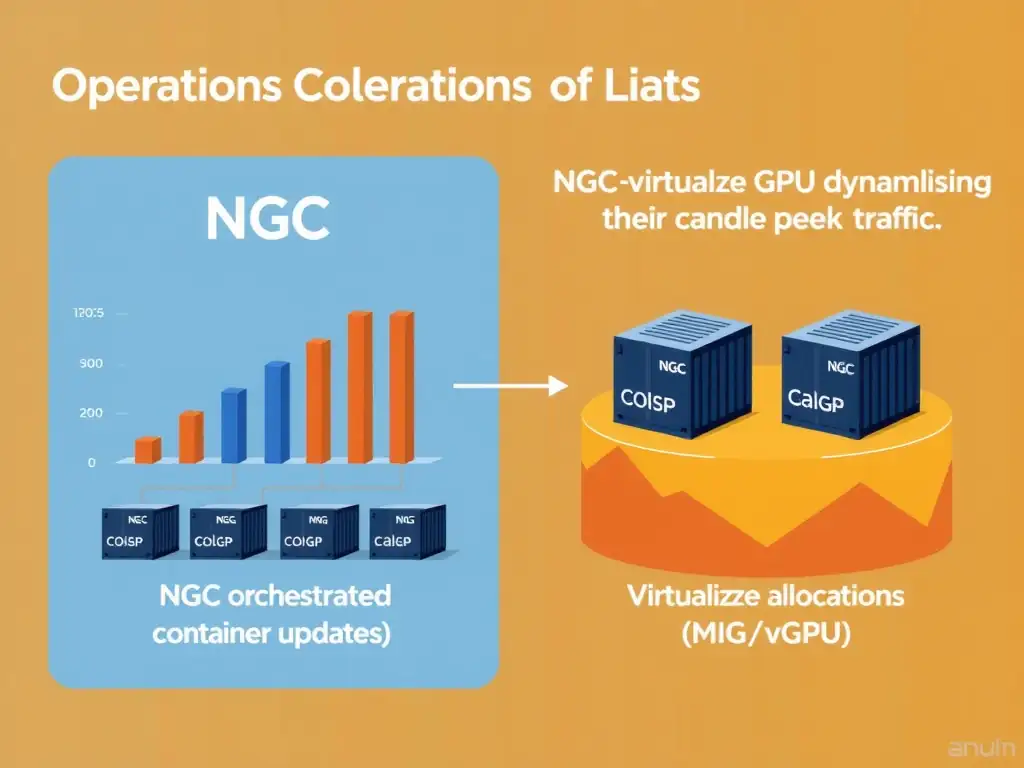
Check this out: when multi-user AI workloads collide, you need automated, optimized software stacks and dynamic GPU partitioning. Use NVIDIA NGC to deploy and update tuned containers, and use vGPU or MIG to slice GPUs so workloads stay isolated and predictable. Don't leave performance on the table by throttling clocks or watching CPU-only tools.
Full Explanation
Maintaining consistent performance in shared, multi-tenant AI data centers requires proactive management of both software layers and physical compute resources.
The recommended actions are: - Using the NVIDIA NGC (NVIDIA GPU Cloud) registry to automate deployment of optimized containerized stacks and updates. The NGC catalog provides the registry of GPU-optimized deep learning frameworks, pre-trained models, and helm charts. Utilizing NGC containers simplifies and automates software deployment and patch management. Since these containers are pre-tuned for maximum performance on NVIDIA hardware, deploying them ensures that applications run with optimized drivers, CUDA libraries, and communication interfaces, reducing software-induced performance anomalies. - Implementing NVIDIA virtual GPU (vGPU) or Multi-Instance GPU (MIG) technologies to enable dynamic, partitioned resource allocation. vGPU and MIG allow one physical GPU to be partitioned into multiple isolated virtual instances. MIG, available on architectures like Ampere and Hopper, provides hardware-level isolation for memory and compute cores, ensuring that workloads run with predictable latency and throughput without interfering with each other. This prevents one massive job from starving other concurrent processes, stabilizing performance during peak usage hours.
The other actions are ineffective: - Disabling GPU Boost clock settings across all nodes to minimize hardware thermals and conserve power is incorrect because it restricts the GPU from dynamically increasing its clock speed under load. This reduces the overall processing power of the cluster, degrading performance rather than stabilizing fluctuations. - Relying exclusively on standard OS-level CPU monitoring agents to extrapolate GPU utilization and memory bus metrics is incorrect because CPU-based monitoring tools lack visibility into GPU-specific metrics such as Tensor Core utilization, VRAM usage, PCIe bandwidth, NVLink errors, and memory bus behavior. Operations teams must use GPU-specific monitoring agents like NVIDIA DCGM (Data Center GPU Manager). - Requiring administrators to manually inspect individual log files on each host node during peak traffic hours is incorrect because manual log analysis is slow, error-prone, and reactive. It does not allow for real-time workload balancing or automated mitigation of performance bottlenecks.
Therefore, the recommended operational best practices are automating optimized container deployment through NGC and using vGPU or MIG for dynamic, isolated GPU partitioning.