
When configuring a high-performance cluster to train deep convolutional neural networks for computer vision, a systems architect must explain the hardware rationale for relying on GPUs rather than CPUs for the core mathematical workloads. Which of the following statements best describes the architectural advantage of GPUs for this task?
Select an answer to reveal the explanation.
Short Explanation and Infographic
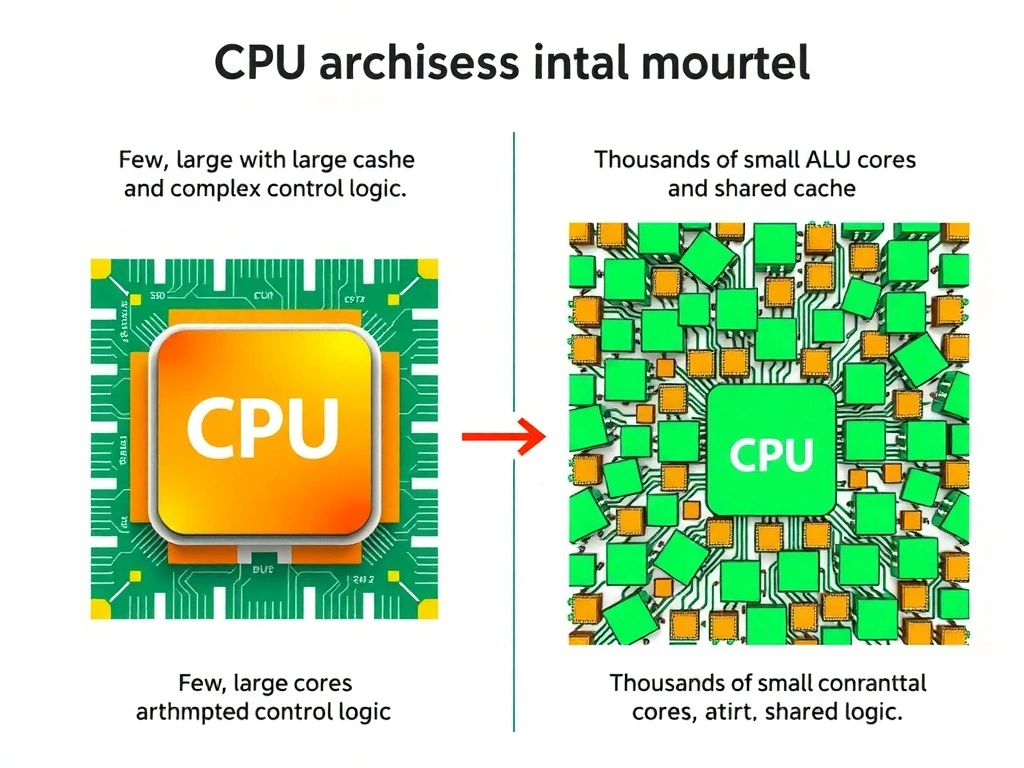
Let me show you how this works in the real world. Think of a CPU like a high-speed Ferrari. It's built to do one thing really fast—like handling complex, sequential logic and running a single task at lightning speed. A GPU, on the other hand, is like a massive fleet of dump trucks. Individually, they aren't as fast as the Ferrari, but they can move mountains of dirt all at the same time. Deep learning is basically just massive amounts of simple math—specifically, matrix multiplication. A CPU only has a handful of cores (maybe 16, 32, or 64) to do this math step-by-step. A GPU has thousands of smaller cores that can handle all these matrix operations in parallel. That's why GPUs leave CPUs in the dust when it comes to neural networks. It's not about single-thread speed; it's about sheer parallel throughput.
Full explanation below image
Full Explanation
The fundamental difference between Central Processing Units (CPUs) and Graphics Processing Units (GPUs) lies in their architectural design goals. CPUs are general-purpose processors designed for low-latency scalar execution. They utilize large cache systems and sophisticated instruction pipelines (including out-of-order execution and aggressive branch prediction) to run a single stream of complex, conditional instructions as fast as possible. Consequently, a modern enterprise CPU typically contains between 32 and 128 highly powerful physical cores.
Conversely, GPUs are designed for high-throughput parallel execution (specifically, Single Instruction, Multiple Data, or SIMD). A GPU contains thousands of simpler ALU cores that execute the same instruction simultaneously across different data points. Since deep learning workloads—such as convolutional layers and transformer attention heads—are mathematically composed of massive matrix multiplications and accumulations, they can be easily parallelized. A GPU can compute millions of these operations in parallel, significantly outperforming a CPU in floating-point operations per second (FLOPS).
Let's review the incorrect options: - Option B is incorrect because it describes a CPU's sequential, low-latency execution profile, which is the opposite of the parallel architecture required for deep learning. - Option C is incorrect because while GPUs rely heavily on High Bandwidth Memory (HBM) to feed their thousands of cores, modern high-end server CPUs can also interface with HBM; this is not the fundamental reason GPUs are preferred. - Option D is incorrect because GPUs actually perform poorly on complex branching logic and lack the sophisticated branch prediction hardware found in CPUs. GPUs are designed to minimize control logic overhead in favor of raw computational density.