
During an architecture planning meeting for a new retail personalization platform, stakeholders are using the terms Artificial Intelligence (AI), Machine Learning (ML), and Deep Learning (DL) interchangeably. As the lead systems engineer, you need to clarify the relationship between these concepts to guide hardware procurement. Which of the following statements correctly defines the taxonomy and relationship among these three fields?
Select an answer to reveal the explanation.
Short Explanation and Infographic
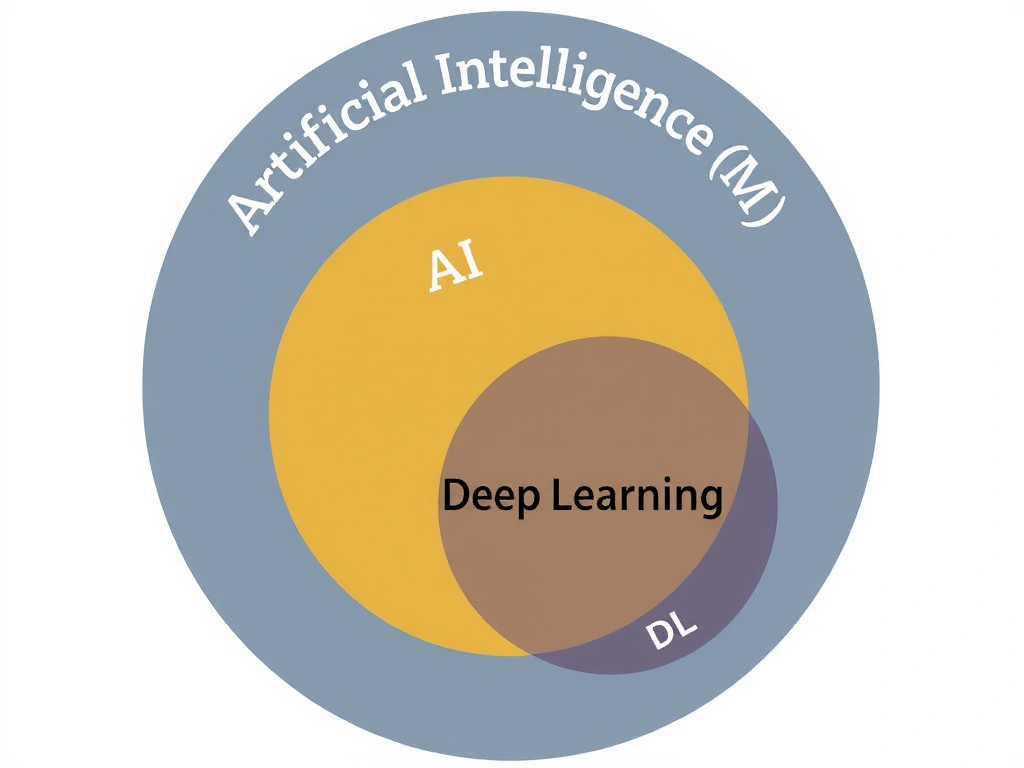
Okay, let's dive in. If I had a nickel for every time I heard people mix up AI, ML, and DL in a meeting, I'd be retired on a beach somewhere! Let's get the hierarchy straight. Think of AI as the big umbrella. It's the grand vision of making machines smart, which can even include old-school, rule-based if/then statements. Now, inside that umbrella, we have Machine Learning. Instead of writing rules by hand, we feed ML algorithms data and let them learn. And inside ML, we have Deep Learning. This is the specialized stuff that uses deep neural networks—lots of layers—to handle complex patterns like images or text. Don't let people tell you they're different, unrelated things, or that DL requires you to manually extract features. Deep learning does the heavy lifting of feature extraction automatically. Got it? Sweet. Let's keep rolling.
Full explanation below image
Full Explanation
Understanding the taxonomy of artificial intelligence is fundamental when planning infrastructure, as different tiers of this technology demand different compute resources. Artificial Intelligence (AI) is the broadest category, encompassing any technique that enables computers to mimic human intelligence, including rule-based expert systems, search algorithms, and heuristics. Machine Learning (ML) is a subset of AI defined by algorithms (such as random forests, support vector machines, and linear regression) that learn patterns directly from data to make predictions or decisions without being explicitly programmed. Deep Learning (DL) is a further subset of Machine Learning that utilizes artificial neural networks with multiple layers (hence "deep") to learn representations and features directly from data.
Let's look at why the other options are incorrect: - Option B is incorrect because deep learning is not an independent discipline. It is a subset of machine learning, and its application is not limited strictly to GPU programming, though GPUs are heavily utilized for training acceleration. Furthermore, machine learning and AI are not synonyms for CPU-bound rules. - Option C is incorrect because it reverses the hierarchy, claiming machine learning is the broadest domain and AI is a subset, which is taxonomically backward. - Option D is incorrect because machine learning and deep learning are not separate from AI; they are integral subsets of it. They do not bypass algorithm-based architectures; they rely entirely on complex algorithmic structures and mathematical optimization.
Additionally, a key distinction of Deep Learning is that it automatically extracts relevant features from raw data, whereas traditional Machine Learning often requires domain experts to manually perform feature engineering before training.