
An engineering team is running distributed training of a multi-billion parameter language model on a cluster of NVIDIA DGX A100 nodes. Although the individual GPU computations are fast, they notice that training progress is stalling and GPU utilization percentages are hovering in the low double digits. Telemetry indicates massive delays during gradient synchronization phases across the high-speed NVLink interconnects. Which action is the most direct and effective way to address this multi-GPU communication bottleneck and boost cluster performance?
Select an answer to reveal the explanation.
Short Explanation
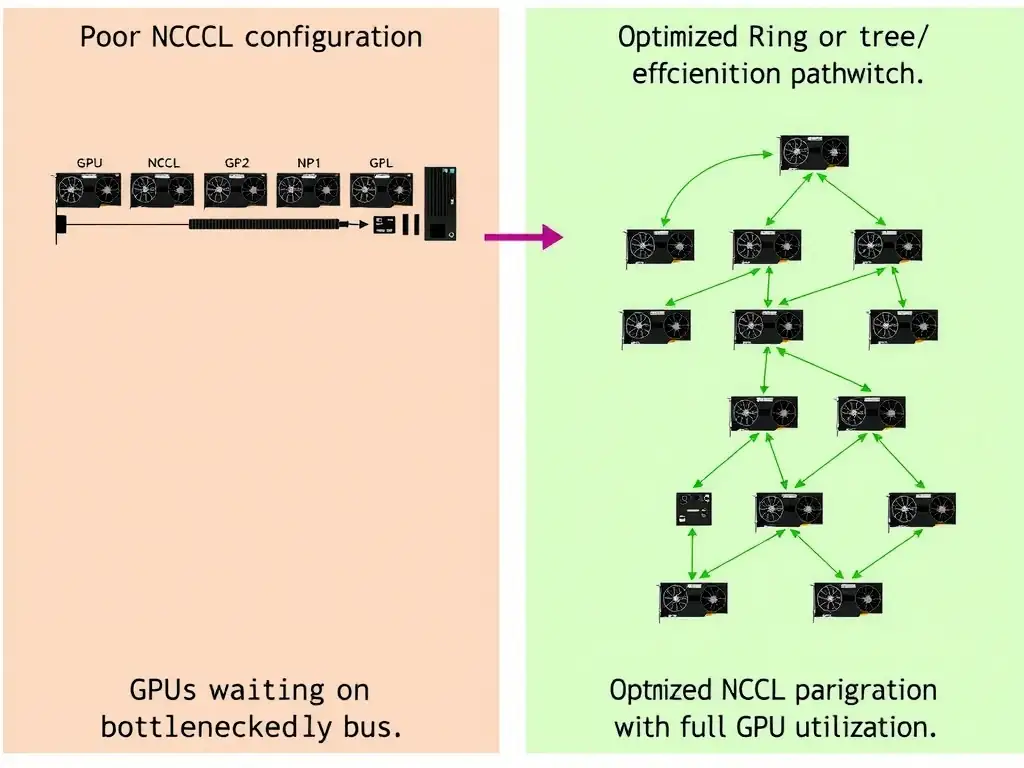
When your GPUs are idling and telemetry points to gradient synchronization delays, the bottleneck is collective communication. Tune NCCL so NVLink and the network paths can run at full speed. Disabling cuDNN or falling back to single-GPU jobs just cripples compute or scale.
Full Explanation
In multi-GPU and multi-node deep learning training pipelines, collective communication operations such as AllReduce, AllGather, and Broadcast are critical for synchronizing weights and gradients across devices. The NVIDIA Collective Communications Library, pronounced 'Nickel', is specifically designed and optimized to leverage hardware topologies like NVLink, NVSwitch, and PCIe, as well as inter-node technologies like InfiniBand and RoCE, which is RDMA over Converged Ethernet. When GPUs are underutilized and telemetry indicates that inter-GPU communication is a major bottleneck, verifying and tuning the NCCL configuration is the most direct solution. Tuning parameters such as NCCL buffer sizes, selecting the correct network interfaces via NCCL_IB_DISABLE or NCCL_SOCKET_IFNAME, and verifying topology detection allow the network to achieve near-peak bandwidth.
The other approaches fail to solve the problem. Turning off the cuDNN library entirely would disable highly optimized primitives for deep learning operations like convolutions, pooling, and activation functions. That would severely degrade individual GPU performance and compute speed, shifting the bottleneck rather than solving the communication issue. Partitioning the workload into independent, single-GPU training jobs completely defeats the purpose of distributed computing on high-performance infrastructure like a DGX A100. While it eliminates cross-GPU synchronization overhead, it severely limits model size and training speed because of memory and compute constraints. Increasing the batch size of concurrent data-parallel training processes until the CPU is fully saturated does not address the underlying communication inefficiency; it only increases network congestion. It creates more competition for limited inter-GPU bandwidth, leading to longer synchronization stalls and further reducing overall GPU utilization.
Therefore, ensuring NCCL is properly tuned and aligned with the physical network topology is the correct and most effective engineering approach.