
You are preparing a massive, multi-dimensional dataset containing millions of user behavioral logs for a deep learning model. The raw dataset has hundreds of features, making it highly complex and prone to the curse of dimensionality. You want to apply unsupervised data mining techniques to identify natural clusters of user profiles and reduce the feature space without losing critical variance. Which two techniques should you select to achieve these goals? (Select two)
Select all correct answers, then click Submit.
Short Explanation and Infographic
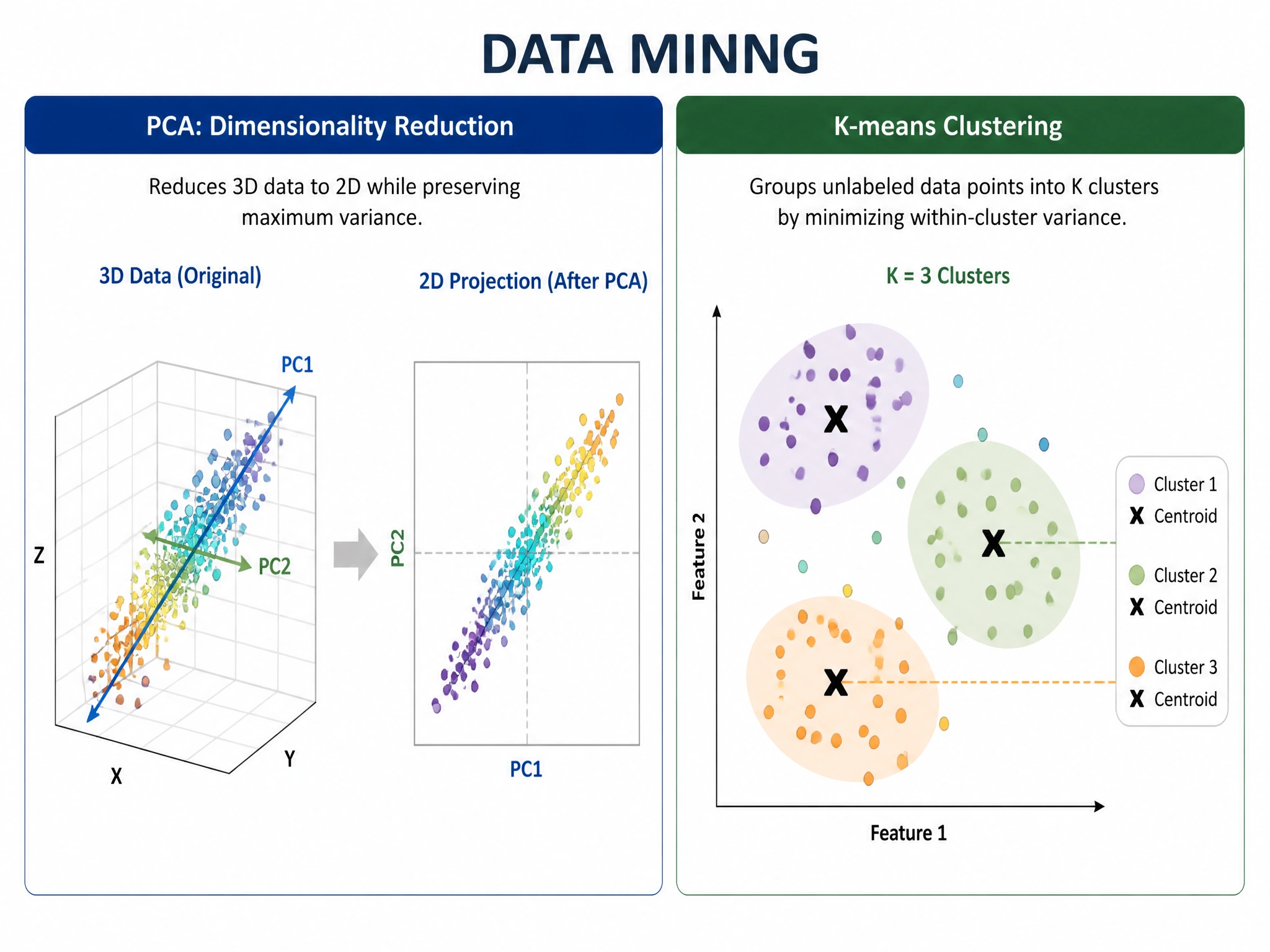
Okay, let's dive in. When you're dealing with millions of records and hundreds of features, you've got a classic problem: too much noise and too many dimensions. If you just dump all that raw data into your neural network, the model will struggle to learn anything useful. You need to clean it up and find patterns first. That's where two powerhouse data mining techniques come in: Principal Component Analysis (PCA) and K-means clustering. Think of PCA like taking a high-resolution 3D object and finding the perfect 2D shadow that still shows all the key details—it squashes your dimensions down to the most important features. Then, you run K-means clustering to group similar data points together into neat little buckets (or clusters). Now you've simplified your features and found the hidden structures. Got it? Sweet. Let's keep rolling.
Full explanation below image
Full Explanation
Preprocessing high-dimensional, large-scale datasets is a critical phase in AI pipelines. Principal Component Analysis (PCA) and K-means clustering are two fundamental unsupervised data mining techniques used to discover underlying patterns. PCA is a dimensionality reduction technique that transforms a set of correlated features into a smaller set of uncorrelated variables called principal components. By projecting the dataset onto the directions of maximum variance, PCA reduces the feature space complexity (addressing the curse of dimensionality) while retaining most of the essential information. K-means clustering is an unsupervised grouping algorithm that partitions data points into K clusters based on feature similarity (distance-based metrics). Together, these techniques help identify natural groupings within a dataset and simplify feature sets, facilitating faster and more accurate model training.
The other choices do not apply to data mining and preprocessing. Implementing dropout (Option A) is a regularization technique used during neural network training to prevent overfitting by randomly disabling nodes, but it does not analyze or preprocess raw datasets. Utilizing flat files (Option C) is a storage format decision (like CSV or raw text) and does not perform data mining or pattern discovery. Overfitting a model (Option E) is an undesirable modeling state where a neural network memorizes noise, which degrades generalizability, and is not a data mining technique.