
Your team has deployed a large transformer-based natural language processing (NLP) model to handle real-time customer queries. Although average response times are acceptable, you are seeing significant latency spikes during periods of unpredictable, bursty user traffic. Which deployment strategy will best stabilize response times and optimize GPU utilization under fluctuating request volumes?
Select an answer to reveal the explanation.
Short Explanation
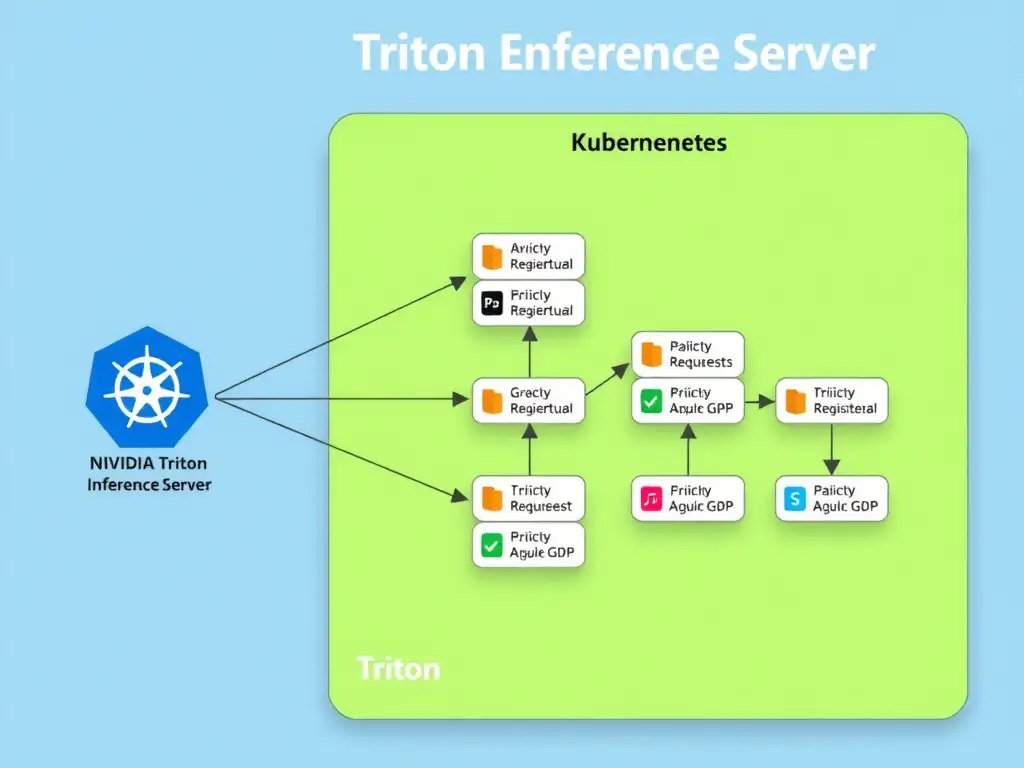
Here's the deal: bursty traffic means requests arrive unevenly, so you need to group them before hitting the GPU. Use NVIDIA Triton Inference Server with dynamic batching to collect requests in a tiny window and run them as one batch, which smooths latency and keeps the GPU busy.
Full Explanation
In production environments deploying large-scale AI models for real-time inference, managing latency spikes caused by bursty or unpredictable user traffic is a common challenge. When inference requests are processed individually, with a batch size of 1, the GPU is highly underutilized because the overhead of transferring data to the GPU dominates the execution time. To resolve this, the optimal solution is to standardize the serving layer on NVIDIA Triton Inference Server configured with dynamic batching.
Dynamic batching is a feature of Triton that allows the inference server to combine individual inference requests that arrive within a user-defined time window into a single, larger batch. This batch is then executed as a single operation on the GPU. By increasing the batch size dynamically, Triton maximizes GPU utilization and concurrency, resulting in higher throughput and significantly more stable latency profiles. This directly mitigates the latency spikes associated with queuing delays during traffic bursts.
Let's analyze the incorrect approaches. Partitioning the physical GPUs into smaller hardware instances using Multi-Instance GPU technology divides a single physical GPU into multiple independent hardware instances. While useful for isolation and running multiple distinct workloads, MIG reduces the raw compute power available to any single model instance, which can actually worsen latency for large models like NLP transformers. Increasing the Kubernetes Horizontal Pod Autoscaler replica limits to scale out pods reactively is a reactive scaling strategy; spin-up times for pods containing large models can take minutes, which is far too slow to address immediate latency spikes during sudden traffic bursts. Compressing the model weights through post-training INT8 quantization reduces model size and improves execution speed, but it does not address the fundamental queue management and underutilization issues caused by unpredictable arrival patterns of individual requests.