
When building systems for deep learning, engineers rely on GPUs rather than traditional CPUs to handle the heavy lifting of model training. Which two structural and functional characteristics of GPU architecture make them far superior to CPUs for training large-scale AI models? (Select two)
Select all correct answers, then click Submit.
Short Explanation and Infographic
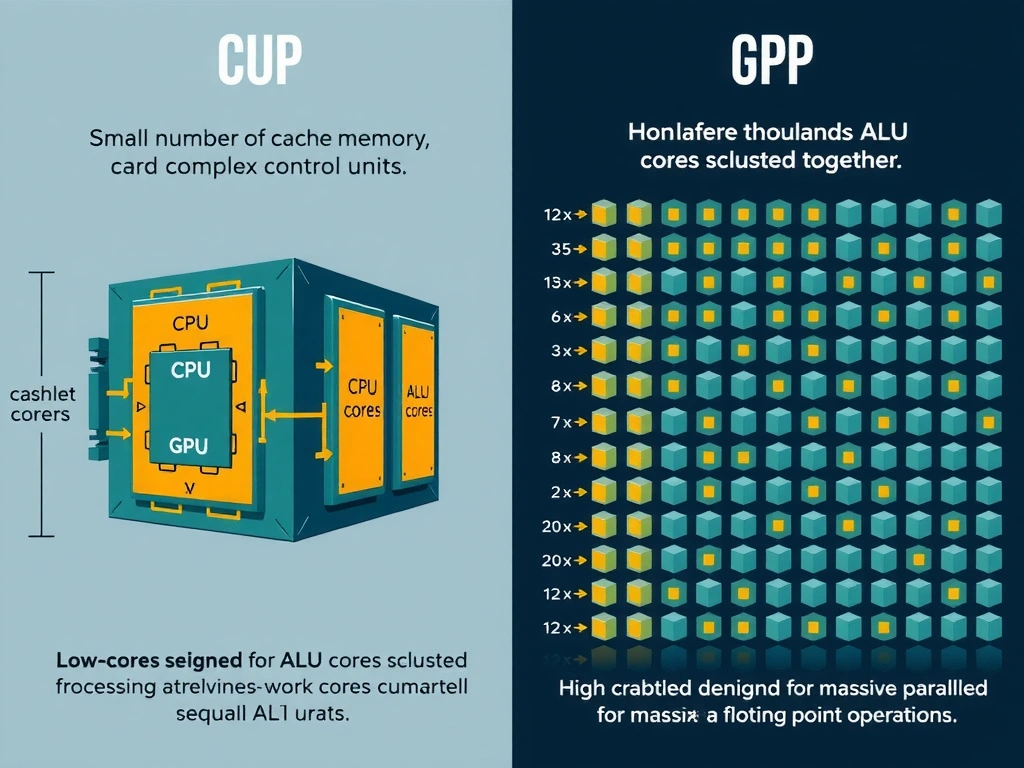
Check this out: a CPU is like a high-speed delivery van. It's fast, smart, and can handle all kinds of complex tasks one after the other. But when you need to move a million tiny packages at the exact same time, that van is useless—you need a fleet of thousands of scooters. That's your GPU. A GPU has a massive density of simple cores, allowing it to perform thousands of operations in parallel instead of waiting in line. On top of that, deep learning is basically just a giant pile of matrix math—billions of floating-point calculations. GPUs are built from the ground up to grind through these floating-point operations at blistering speeds. So, when you look at the architecture, high core density and floating-point optimization are the secret sauce that makes GPUs dominate the AI training world. Remember, CPUs are great for general tasks, but for raw parallel math power, GPUs win every day of the week. Got it? Sweet. Let's keep rolling.
Full explanation below image
Full Explanation
The fundamental difference between CPU and GPU architectures lies in their design philosophies. CPUs are latency-optimized processors designed to execute complex, sequential tasks quickly. In contrast, GPUs are throughput-optimized processors designed to handle massive volumes of simple, parallel tasks.
First, GPUs feature a high density of specialized, parallel processing cores (Option A). While a modern enterprise CPU may have dozens of powerful cores designed for rapid sequential execution, a GPU contains thousands of smaller, simpler cores. This massive core density enables the GPU to execute millions of operations simultaneously, which aligns perfectly with the parallel nature of deep learning operations, such as matrix multiplication and gradient descent during neural network training.
Second, GPU architectures are highly optimized for floating-point arithmetic (Option E). Deep learning workloads rely heavily on single-precision (FP32), half-precision (FP16), and specialized formats like TensorFloat-32 (TF32) or Bfloat16. GPUs are engineered with dedicated execution units, such as NVIDIA's Tensor Cores, specifically designed to accelerate these floating-point calculations, delivering teraflops or petaflops of mathematical performance.
Let's analyze the incorrect options. A complex, general-purpose instruction set (Option B) is a CPU characteristic. While it allows CPUs to run operating systems and manage diverse tasks, it adds architectural overhead that is unnecessary and inefficient for the repetitive math of AI training. High single-core clock frequencies (Option C) are also typical of CPUs; GPUs actually operate at lower clock speeds per core but compensate with parallel scale. Finally, while GPUs are efficient per operation under parallel loads, they consume significant total power and do not feature 'low TDP thresholds' (Option D) compared to CPUs; in fact, modern AI GPUs have TDPs exceeding 700 watts.