
While training a deep learning model, you plot the validation accuracy curve. You observe that the validation accuracy improves steadily during the first few epochs, reaches a plateau, and then starts to systematically decline as training continues. Which two factors are the most likely causes of this validation performance trend? (Select two)
Select all correct answers, then click Submit.
Short Explanation and Infographic
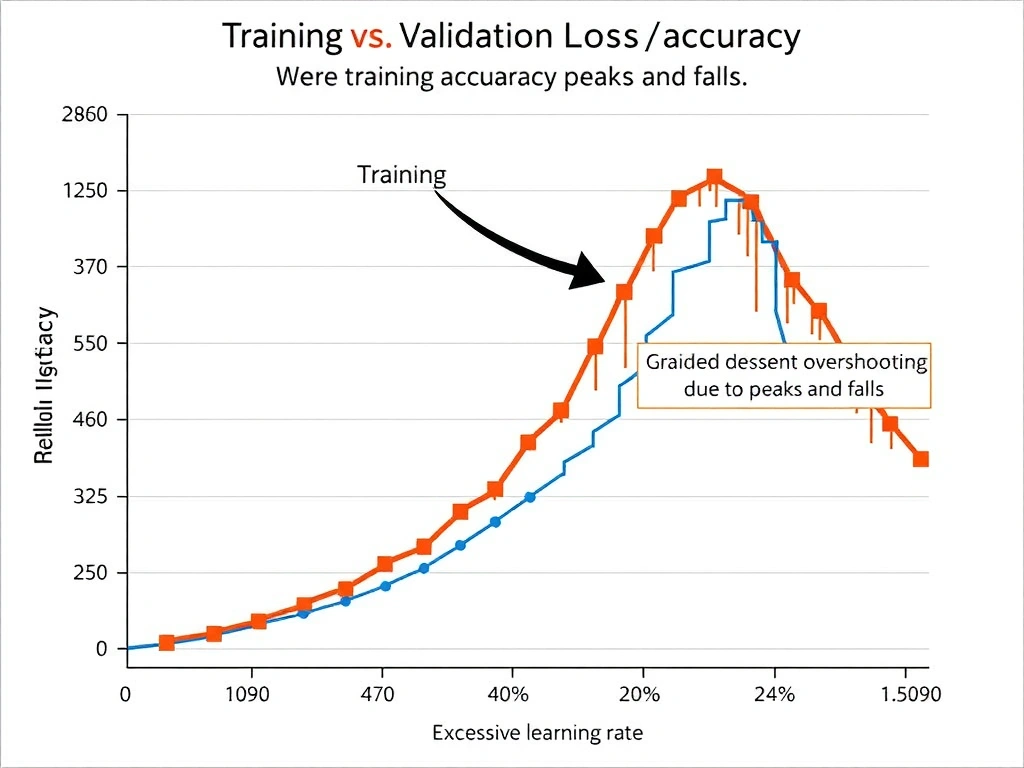
Okay, let's dive into this one because it's a classic machine learning trap. You're watching your model train, validation accuracy is climbing, and you're feeling good. But then, it stalls, and suddenly it starts getting worse! Here's the deal: this is usually caused by two main culprits. First, your model is getting too smart for its own good—it's memorizing the training data instead of learning the underlying patterns. That's overfitting, and when it happens, your validation accuracy will drop off a cliff. Second, check your learning rate. If the learning rate is too high, your optimizer is taking massive steps. It might start off fine, but as it gets close to the sweet spot (the local minimum), it just jumps right over it. It keeps overshooting, causing instability, and performance tanking. Trust me, finding that sweet spot for learning rate and adding some dropout or regularization is key to keeping your validation curve moving in the right direction!
Full explanation below image
Full Explanation
A validation accuracy curve that rises, plateaus, and then declines indicates issues with model convergence and generalization. The two most common causes of this specific behavior are overfitting and an excessively high learning rate.
1. Overfitting: Overfitting occurs when a neural network learns the noise and specific details of the training dataset to the point that it negatively impacts the model's performance on new, unseen data (the validation set). During the early phases of training, the model learns generalizable features, so both training and validation accuracy improve. However, as training progresses, the model begins to 'memorize' the training samples. Consequently, training accuracy continues to rise, but validation accuracy plateaus and eventually declines as the model's capacity to generalize degrades. 2. Excessively High Learning Rate: The learning rate controls how much the model weights are adjusted in response to the estimated error each time the weights are updated. If the learning rate is set too high, the optimizer will take steps that are too large. Initially, the large steps can lead to rapid progress toward the minimum. However, as the model approaches the optimal weights, the large step size causes the optimizer to overshoot the minimum. This leads to oscillation or divergence, preventing the loss from decreasing further and causing the accuracy on the validation set to plateau and then degrade due to weight instability.
Let's look at why the other options are incorrect: Correctly applied regularization: If regularization techniques like dropout, weight decay, or early stopping were applied correctly, they would prevent overfitting and keep the validation accuracy from declining. Small validation dataset: A small validation dataset might cause high variance (noisy fluctuations) in the validation accuracy curve, but it would not systematically cause the accuracy to first rise, plateau, and then steadily decline. * Batch size too small: While a small batch size introduces noise into the gradient estimates, it acts as a regularizer and often helps the model escape local minima; it does not typically cause a systematic late-stage decline in validation accuracy.