
Your team is scaling out deep learning training across multiple physical server nodes, each packed with NVIDIA H100 GPUs. During distributed training, the nodes must constantly share gradient updates using collective communication libraries like NCCL. Which networking technology should you implement to prevent inter-node network latency from bottlenecking the GPUs?
Select an answer to reveal the explanation.
Short Explanation
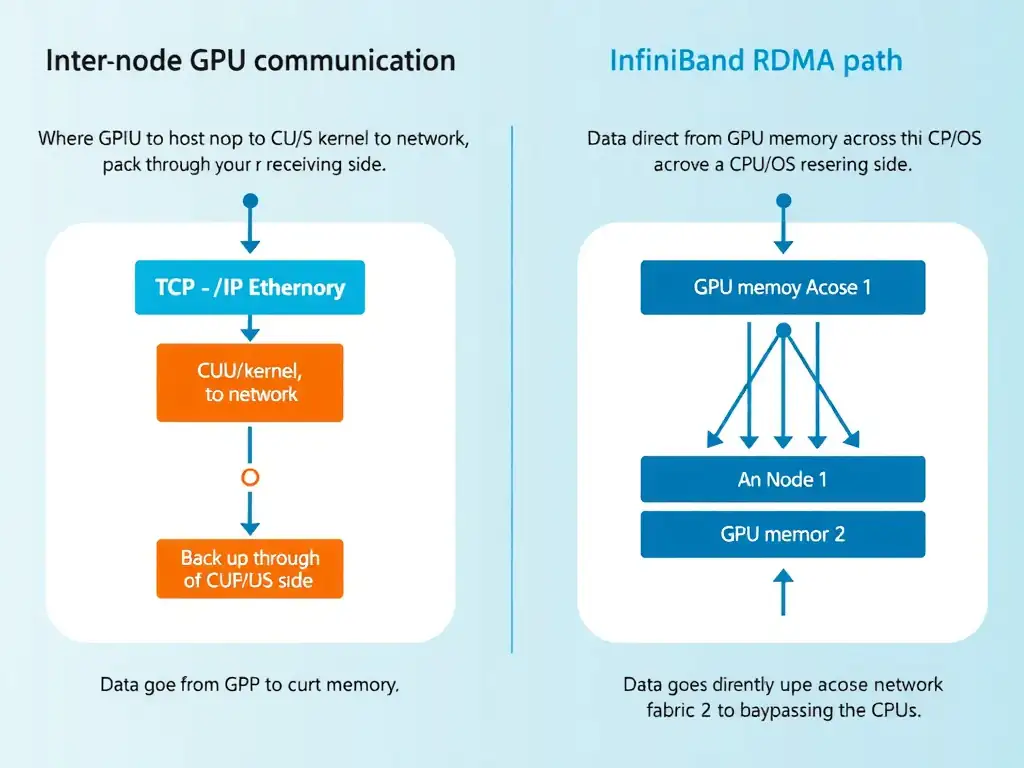
Pay close attention here, because this one bites people in production all the time. When you link multiple GPU servers together for distributed training, the network is almost always the bottleneck. To keep the GPUs fed, you need an InfiniBand fabric with RDMA so one GPU can read and write another server's GPU memory without CPU or kernel overhead.
Full Explanation
Distributed deep learning training across multiple nodes relies on frequent communication to synchronize model parameters (gradients) across all GPUs. This synchronization is usually managed by collective communication libraries like the NVIDIA Collective Communications Library (NCCL), which perform operations like AllReduce and AllGather. In a multi-node cluster, standard Ethernet and TCP/IP protocol stacks introduce significant latency and CPU overhead because data must be copied through multiple kernel and user-space buffers. To eliminate this bottleneck, high-performance computing infrastructures implement an InfiniBand network fabric with Remote Direct Memory Access (RDMA) support. RDMA allows a GPU on one node to read and write directly to the memory of a GPU on another node without involving either host operating system or CPU, resulting in extremely high bandwidth and sub-microsecond latency. Configuring multiple bonded Gigabit Ethernet connections on each host node increases bandwidth but does not solve the latency and CPU overhead caused by the TCP/IP stack. Implementing a software-defined networking controller to dynamically reroute TCP/IP traffic improves routing management but does not reduce protocol processing latency. Consolidating the workload onto fewer server nodes to reduce overall network routing complexity simplifies the network but defeats the purpose of scaling out compute capacity. Therefore, deploying an InfiniBand network fabric with RDMA support is the critical infrastructure component required.