
Imagine you are building an automated pipeline to monitor global canopy loss using high-resolution, multi-spectral satellite imagery. The incoming dataset is massive—petabytes of raw images—and needs pixel-level classification (image segmentation) to detect areas of logging. To handle this workload efficiently, you must scale the processing across a multi-node high-performance cluster. Which of the following approaches is the most viable strategy for scaling and executing this image segmentation task?
Select an answer to reveal the explanation.
Short Explanation
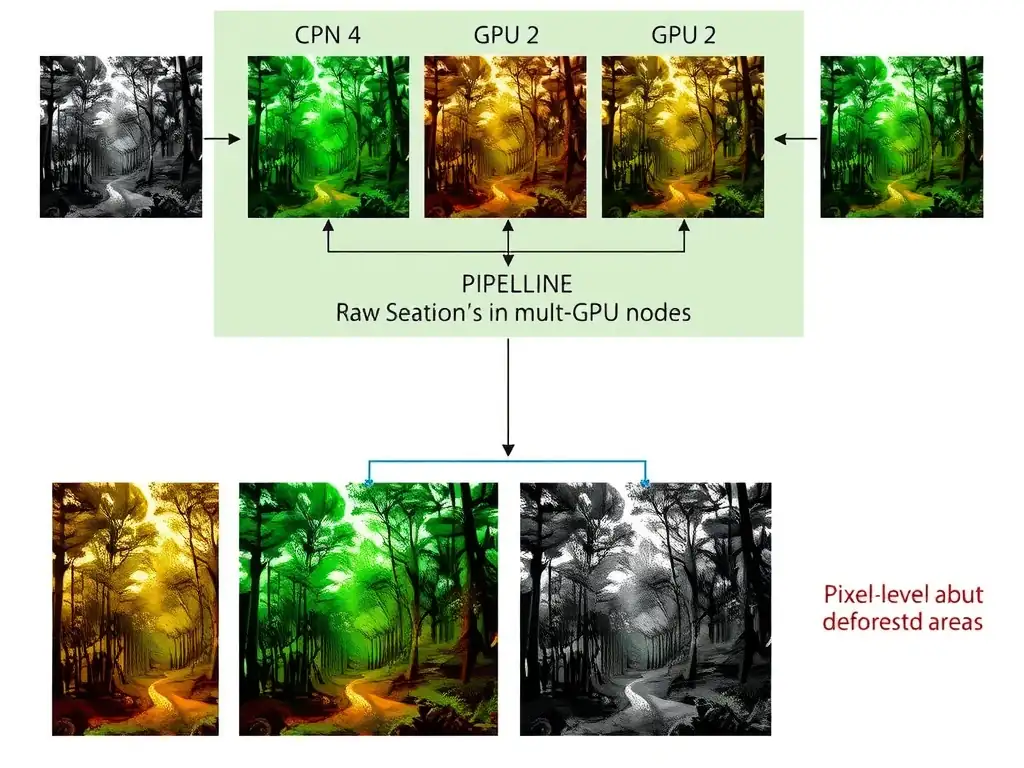
Check this out: if you're processing petabytes of high-res satellite imagery for pixel-level logging detection, you need a distributed, GPU-accelerated CNN. A multi-node GPU cluster gives the parallel power to segment images at scale. Anything else bottlenecks the pipeline.
Full Explanation
Analyzing massive geospatial datasets for tasks like deforestation detection requires both high-performance computing infrastructure and specialized deep learning architectures. The viable strategy is deploying a distributed, GPU-accelerated Convolutional Neural Network designed for semantic segmentation. Pixel-level classification, also known as semantic segmentation, involves labeling every individual pixel in an image, such as distinguishing forest canopy from cleared land. Convolutional Neural Networks, particularly architectures like U-Net or SegNet, are the industry standard for this because they excel at extracting spatial features and hierarchies. Because satellite datasets are incredibly large, often petabytes, a single GPU or node cannot process them in a reasonable timeframe due to memory and compute limitations. Distributing the training and inference workloads across a multi-node GPU cluster allows for data parallelism, where the dataset is partitioned and processed concurrently, and model state updates are synchronized. The SQL database approach is structurally inappropriate. Relational databases are designed for tabular, structured query operations and cannot handle the heavy tensor computations or unstructured binary data of high-resolution images efficiently. The CPU-based multithreading approach with traditional edge-detection algorithms lacks the computational throughput of GPU tensor cores and the feature-learning capability of deep learning. CPUs excel at sequential processing, not the massive matrix operations required for image segmentation. The crowdsourced manual annotation approach is completely unscalable for ongoing, real-time global monitoring, as the sheer volume of satellite imagery generated daily would easily outpace human capacity.