
A machine learning team is comparing two regression models to predict customer lifetime value. Model A has an R-squared ($R^2$) value of 0.88 and a Mean Absolute Error (MAE) of $120. Model B has an $R^2$ value of 0.79 and a MAE of $95. If the primary goal of the selection is to deploy the model that explains the greatest proportion of variability in the target variable, which model should be chosen and why?
Select an answer to reveal the explanation.
Short Explanation
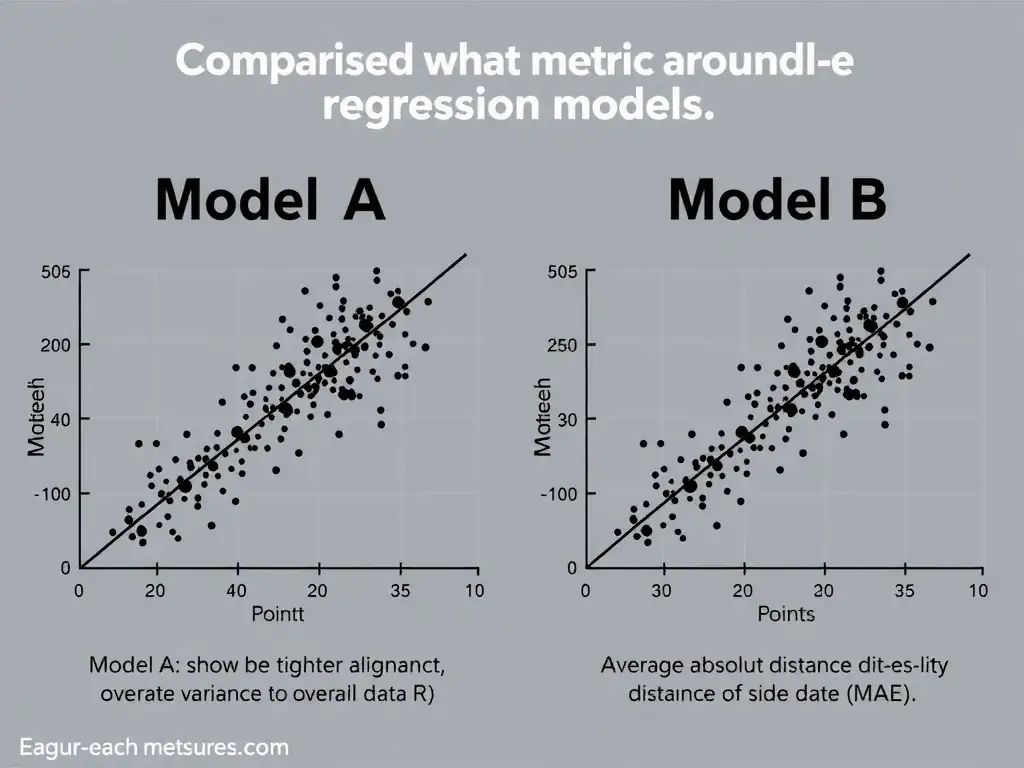
Here's the deal: R-squared tells you how much of the target variable's variance your model actually explains. If your goal is the greatest explained variability, pick the model with the 0.88 R-squared value, because it explains 88% of the variance versus 79% for the other model. MAE matters for average dollar error, but it doesn't answer the variance-explanation question.
Full Explanation
R-squared ($R^2$), also known as the coefficient of determination, measures the proportion of variance in the dependent variable that is predictable from the independent variables. An $R^2$ of 0.88 means that 88% of the variability in the target variable is explained by the model's features, while the remaining 12% is unexplained residual variance. Since the goal is to choose the model that explains the greatest proportion of variability, the model with the 0.88 $R^2$ value is the correct choice because its $R^2$ is higher than the 0.79 $R^2$ value. The recommendation to choose the model with the 0.79 $R^2$ value because a lower MAE indicates that it captures a higher percentage of the data's overall variance is incorrect because a lower MAE (Mean Absolute Error) indicates better average accuracy in terms of prediction units (e.g., dollars), but it does not measure the proportion of explained variance. The recommendation to choose the model with the 0.79 $R^2$ value because MAE is always a mathematically superior metric for measuring variance compared to R-squared is incorrect because MAE is a measure of absolute error magnitude, not variance explanation, and it is not mathematically superior; they are different metrics used for different purposes. The recommendation to choose the model with the 0.88 $R^2$ value because R-squared represents the average absolute prediction error across all data points is incorrect because R-squared does not represent the average absolute prediction error. That is the definition of Mean Absolute Error (MAE). R-squared is a relative metric representing the ratio of explained variance to total variance.