
Imagine you're designing an anomaly-detection pipeline that monitors real-time telemetry from thousands of wind turbines. The telemetry consists of continuous vibration, temperature, and rotational speed metrics, and you need to forecast gear failure before it happens. Given an enterprise AI cluster loaded with modern NVIDIA GPUs, which neural network architecture should you implement to model these long-term temporal dependencies and process the high-frequency stream at scale?
Select an answer to reveal the explanation.
Short Explanation
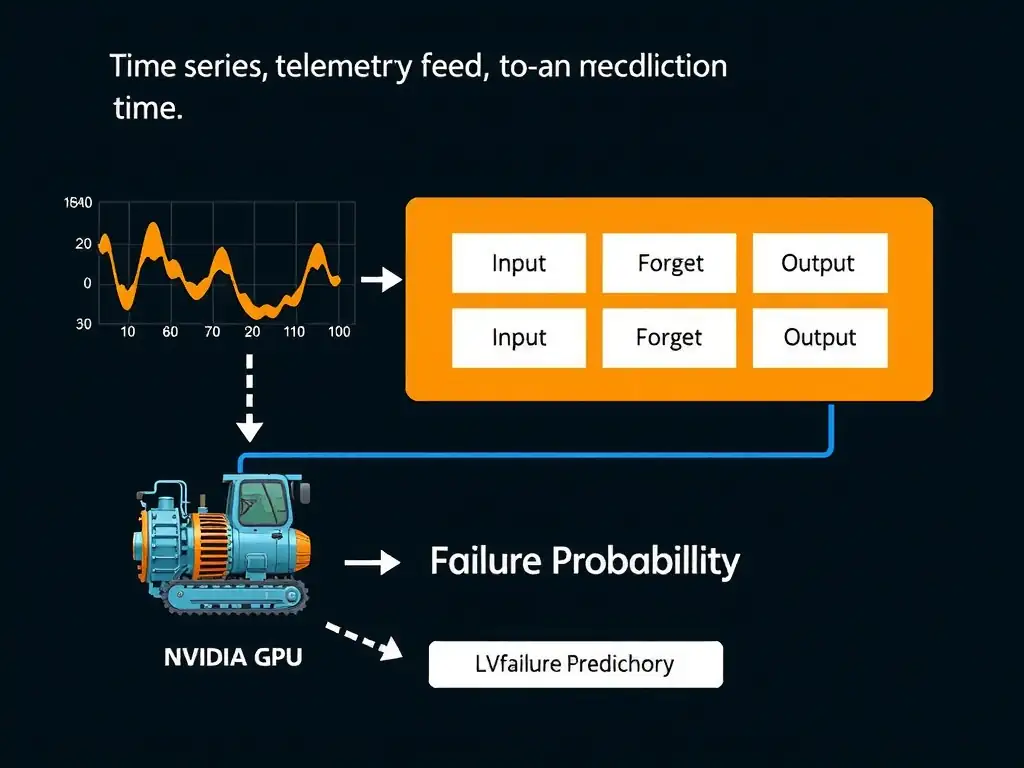
Here's the deal: wind turbine telemetry is time-series data, so you need a model that remembers what happened seconds, minutes, or longer ago. An accelerated LSTM network is built for sequential data because its gates retain important history and discard noise. On NVIDIA GPUs, that lets you process high-frequency streams from thousands of turbines in real time.
Full Explanation
In industrial predictive maintenance, sensor telemetry such as vibration, temperature, and rotational speed is inherently sequential and time-series in nature. Forecasting gear failure requires modeling temporal dependencies, meaning the model must understand how current readings relate to historical sequences rather than evaluating each sample in isolation.
An accelerated Long Short-Term Memory (LSTM) network is the appropriate architecture because LSTMs are a specialized type of Recurrent Neural Network engineered to address the vanishing gradient problem found in standard RNNs. This allows them to learn long-term dependencies across time steps. LSTMs use three gating mechanisms—the input gate, forget gate, and output gate—to regulate information flow and retain critical historical context over extended sequences. When deployed on NVIDIA GPUs, the matrix operations involved in LSTM gate computations can be parallelized, enabling real-time inference on massive, high-throughput streams of sensor data from thousands of devices.
The other approaches are unsuitable for this problem. A support vector machine parallelized via RAPIDS cuML to categorize instantaneous sensor thresholds is a static classifier approach; even with GPU acceleration, it does not natively capture temporal ordering or sequential structure without extensive feature engineering, making it less suitable for complex temporal pattern recognition. Plotting raw sensor parameters dynamically in Grafana for operators to flag anomalies manually does not scale because thousands of sensors emitting high-frequency data produce a volume that human operators cannot analyze reliably in real time, and it lacks automated predictive capability. Fitting a GPU-enabled multiple linear regression model to predict failures based on historical averages assumes a linear relationship and struggles with non-linear, high-dimensional temporal dynamics, so it cannot capture the complex, state-dependent sequences that often precede machine failures.
Therefore, a GPU-accelerated LSTM network is the most architecturally sound and scalable solution for real-time, sequential telemetry analysis in high-performance AI environments.