
You are designing the physical compute system for an autonomous delivery robot that needs to process real-time sensor streams (radar, cameras, and sonar) locally on the machine. The system must operate within a strict power budget and withstand mobile physical conditions. Which two NVIDIA hardware platforms are designed specifically for onboard edge AI and autonomous machine workloads? (Select two)
Select all correct answers, then click Submit.
Short Explanation and Infographic
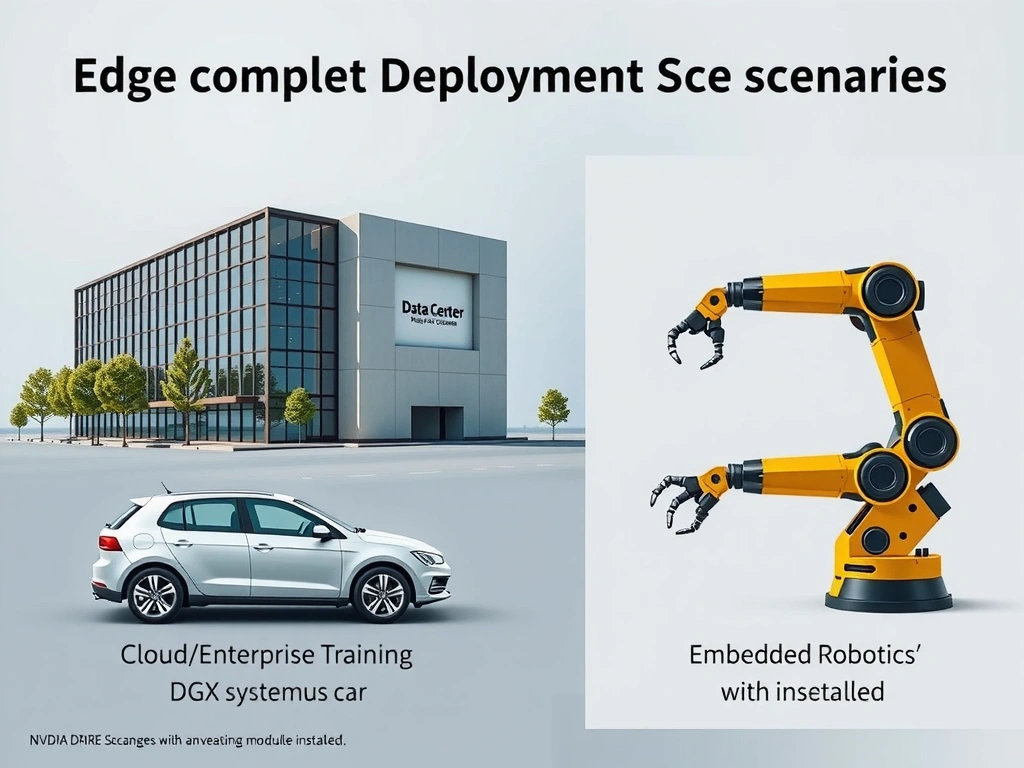
Let's dive in: when you're building an autonomous machine that moves around in the real world, you can't carry a massive, power-hungry data center rack with you! You need something compact, energy-efficient, and rugged enough to handle vibrations and heat. You also can't rely on the cloud for real-time split-second decisions—if the network drops, your robot crashes. That's why NVIDIA created the Jetson AGX and DRIVE AGX platforms. Jetson is the go-to system-on-module for embedded robotics and edge AI, giving you huge compute power on a tiny power budget. DRIVE AGX is specifically designed and safety-certified for autonomous vehicles. Trust me, you wouldn't put an A100 or a gaming card in a robot unless you want to drain the battery in five minutes!
Full explanation below image
Full Explanation
Onboard autonomous systems require computing hardware that balances performance, latency, power efficiency, and physical durability. Standard data center or consumer desktop GPUs are inappropriate for these environments due to high power consumption, reliance on active forced-air cooling, and lack of automotive/industrial safety certifications. 1. NVIDIA Jetson AGX: The Jetson platform consists of low-power, high-performance system-on-modules (SoMs) designed for embedded edge applications, robotics, and smart cities. Modules like Jetson AGX Xavier or Orin integrate a GPU, CPU, deep learning accelerators, and image signal processors (ISPs) into a compact form factor that consumes as little as 15W to 50W, making it ideal for autonomous machines and mobile robots. 2. NVIDIA DRIVE AGX: The DRIVE platform is a specialized, functional-safety-certified computing platform designed specifically for autonomous vehicles (AVs). It features redundant architectures, handles massive sensor aggregation (multiple high-resolution cameras, LiDARs, and radars), and provides the real-time processing capabilities required for safe autonomous driving operations (ASIL-D rating).
Why Distractors are Incorrect: A) NVIDIA DGX SuperPOD: This is a massive supercomputing cluster architecture designed for data centers to train foundational models. It requires thousands of watts of power, specialized cooling, and occupies multiple server racks, making it completely impossible to mount on an edge device or vehicle. C) NVIDIA GeForce RTX: This is NVIDIA's consumer-grade desktop GPU series designed for PC gaming and creative applications. These cards are not ruggedized, lack industrial/automotive environmental ratings, and consume too much power for battery-operated autonomous edge devices. * E) NVIDIA A100 Tensor Core GPU: This is a dedicated enterprise data center GPU. It has no video output ports, requires external host CPU servers, operates with high power consumption, and is cooled via data-center-grade airflow systems, making it unsuitable for onboard vehicular integration.