
You are optimization engineers tasked with speeding up both the training phase of a custom neural network and its subsequent deployment phase. Which two NVIDIA software stack components should you leverage—one to accelerate low-level deep learning mathematical operations during training, and another to optimize the final model for runtime inference? (Select two)
Select all correct answers, then click Submit.
Short Explanation and Infographic
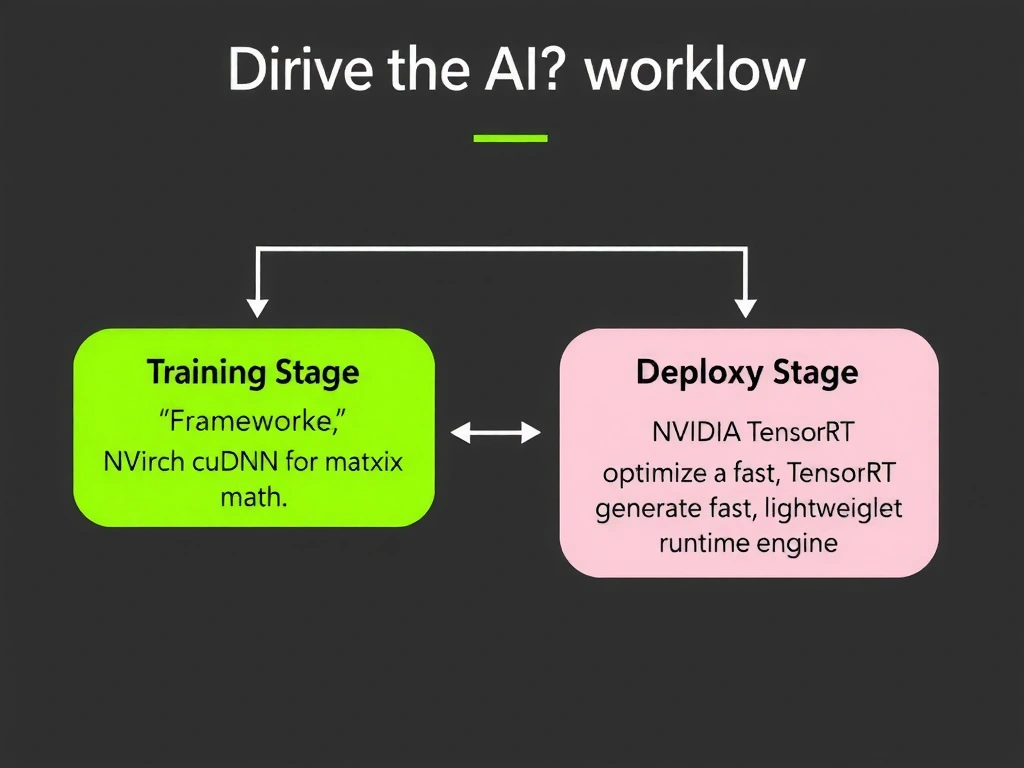
Check this out: deep learning is basically just a mountain of math—specifically convolutions, pooling, activation functions, and forward/backward passes. If you had to write the GPU kernel code for all of that from scratch, you'd never get anything done. That's why NVIDIA built cuDNN. It's a library of pre-optimized primitives that plugs right into frameworks like PyTorch and TensorFlow, making training run like the wind. But training is only half the battle. Once your model is ready to go to work in production, you need TensorRT. It takes that trained model, squashes the redundant math, and optimizes it for low-latency inference. Remember: cuDNN is your speed boost for training, and TensorRT is your speed boost for deployment!
Full explanation below image
Full Explanation
Accelerating the lifecycle of an AI model requires distinct software libraries for the training phase and the deployment (inference) phase. 1. NVIDIA cuDNN (CUDA Deep Neural Network library): This is a GPU-accelerated library of primitives for deep neural networks. It provides highly tuned implementations for common routines such as forward and backward passes for convolutions, pooling, normalization, and activation layers. Deep learning frameworks like PyTorch, TensorFlow, and JAX automatically leverage cuDNN to perform these fundamental mathematical operations on NVIDIA GPUs, drastically reducing training times. 2. NVIDIA TensorRT: Once training is complete, the model must be optimized for production deployment. TensorRT is an SDK for high-performance deep learning inference. It includes an inference optimizer and runtime that delivers low latency and high throughput. TensorRT optimizes models by parsing the trained network, fusing adjacent mathematical layers, removing unused nodes, and quantizing precision (e.g., converting FP32 weights to FP16 or INT8) to run optimally on the target hardware.
Why Distractors are Incorrect: B) NVIDIA Nsight: This is a suite of profiling tools (such as Nsight Systems and Nsight Compute) used by developers to analyze GPU performance, debug code, and find bottlenecks. It does not actively perform or accelerate deep learning calculations or runtime inference. C) NVIDIA DGX H100: This is an integrated hardware system (server) featuring NVIDIA H100 GPUs, high-speed networking, and CPU host compute. It is a hardware platform, not a software library or component of the software stack. * E) NVIDIA DeepStream SDK: This is a streaming analytics toolkit built on top of GStreamer for multi-sensor processing, video, and audio AI analysis. While it uses TensorRT for inference under the hood, it is a specialized application framework for intelligent video analytics, not a core library for general model training.