
Your engineering team is architecting a multi-node, multi-GPU cluster designed to train massive deep learning models. To ensure that the workload is efficiently parallelized and that GPUs can communicate directly with minimal latency during training runs, which two foundational NVIDIA software components must be part of the software stack? (Select two)
Select all correct answers, then click Submit.
Short Explanation and Infographic
Check this out: when you're running deep learning models across multiple GPUs, you can't just throw raw hardware at the problem and hope for the best. You need a way to compile and run that parallel code on the GPU cores—and that's exactly what CUDA does for you. But what happens when those GPUs need to talk to each other to sync up weights during a training run? If you send that data back and forth through the CPU host, you're going to hit a massive bottleneck that will leave your expensive GPUs sitting idle. That's where NCCL (pronounced 'Nickel') steps in. It bypasses the CPU and sets up lightning-fast collective communication patterns like AllReduce directly between the GPUs using NVLink or PCIe. Trust me, you need both of these in your stack if you want your cluster to scream.
Full explanation below image
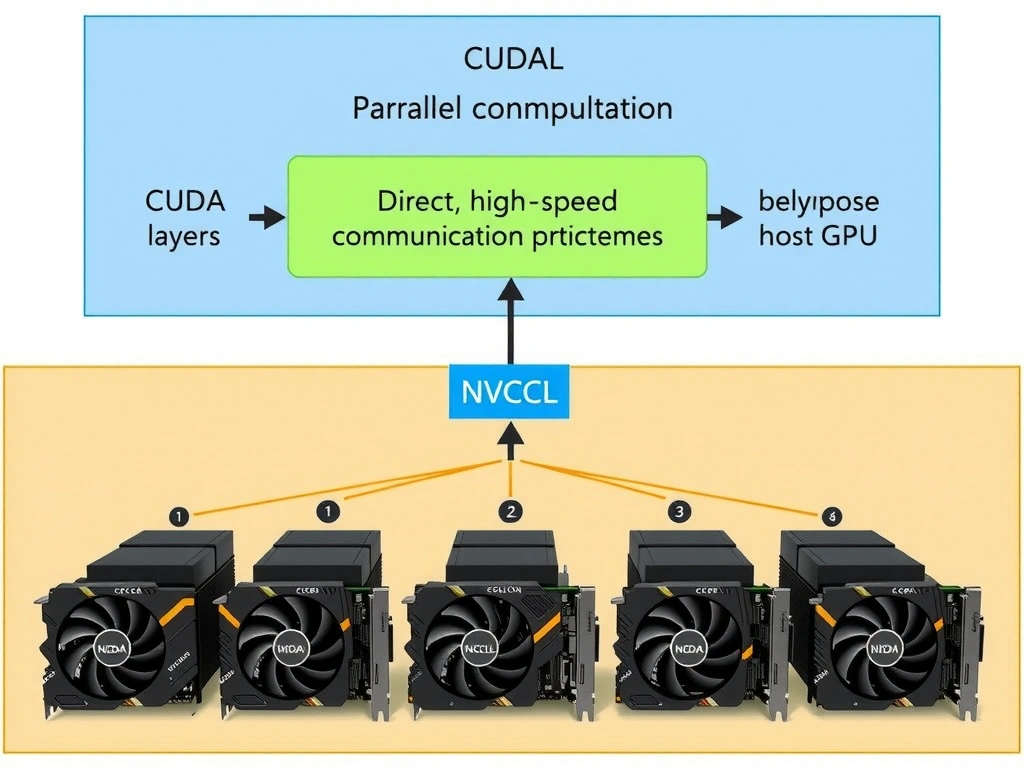
Full Explanation
To build a high-performance, distributed AI training environment, you must address both the local parallel compute capability and the inter-GPU communication bandwidth. 1. NVIDIA CUDA (Compute Unified Device Architecture): This is NVIDIA's parallel computing platform and programming model. It exposes the GPU's highly parallel architecture to developers, allowing software to execute general-purpose computations on the thousands of CUDA cores. Without CUDA, high-level deep learning frameworks cannot translate their operations into instructions that the GPU can execute, making it the most critical foundational component of any NVIDIA-based AI stack. 2. NVIDIA NCCL (NVIDIA Collective Communications Library): Distributed deep learning relies on synchronizing gradients and parameters across multiple GPUs (multi-GPU) and physical servers (multi-node). NCCL provides highly optimized collective communication routines—such as AllReduce, AllGather, Broadcast, and Reduce—that are aware of the system's topology. NCCL maximizes performance by leveraging high-speed interconnects like NVLink, NVSwitch, and InfiniBand, bypassing CPU overhead.
Why Distractors are Incorrect: A) NVIDIA TensorRT: This is a deep learning inference optimizer and runtime. While essential for maximizing throughput and minimizing latency when deploying trained models to production, it is not used for coordinating workloads or parallelizing computations during the training phase of a distributed cluster. D) Triton Inference Server: Similar to TensorRT, Triton is focused on model deployment (inference). It allows teams to serve models from multiple frameworks in production but does not manage multi-GPU communication or compile raw code for parallel execution during training. * E) PyTorch Lightning: This is a high-level wrapper framework built on top of PyTorch to simplify training loops. While it can utilize CUDA and NCCL under the hood, it is not an NVIDIA software stack component or a foundational driver/library.