
A pharmaceutical company is building a machine learning system to predict the clinical effectiveness of new drug compounds. The system must ingest and analyze vast, heterogeneous, high-dimensional datasets containing genetic profiles, molecular structures, and historical patient outcomes. Which AI approach is most appropriate for identifying the complex, non-linear relationships within this data?
Select an answer to reveal the explanation.
Short Explanation
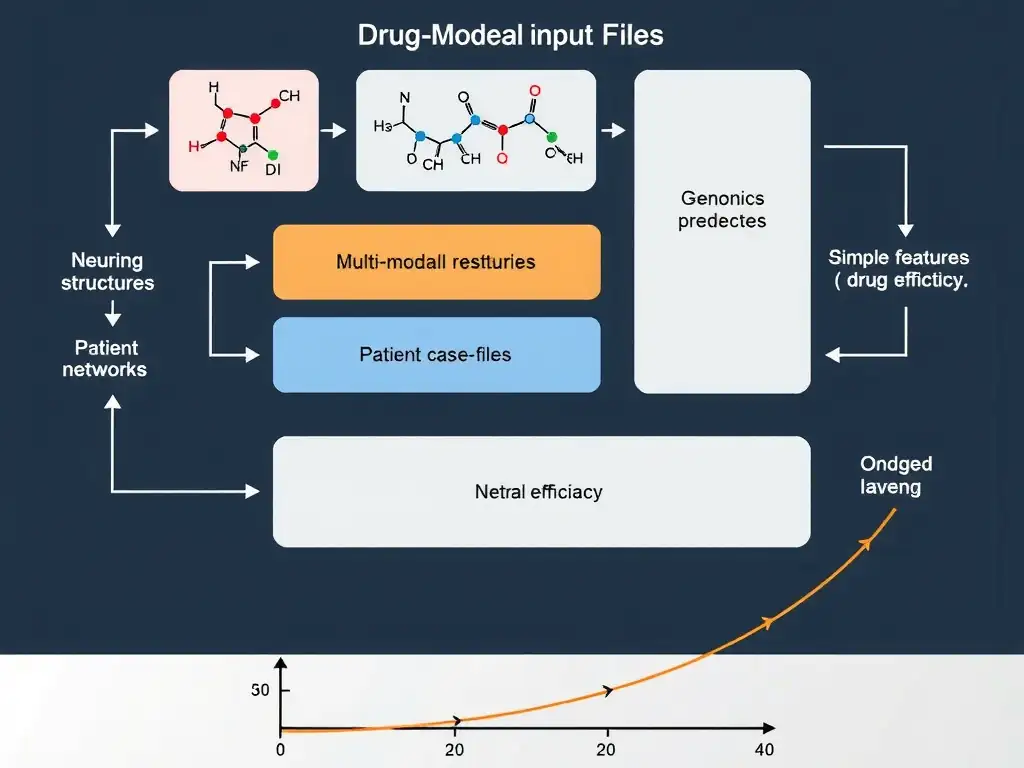
Here's the deal: when you're dealing with massive, messy, multi-modal data like molecular structures and genetic profiles, a deep learning model with a multi-layer neural network is the right tool. It can automatically learn complex, non-linear relationships instead of forcing you to write rules or assume straight-line patterns. Reinforcement learning is for decision-making in environments, not extracting hidden features from huge static datasets.
Full Explanation
Analyzing complex, high-dimensional, heterogeneous datasets—such as molecular structures, genomics, and clinical outcomes—requires algorithms capable of modeling highly non-linear and interactive relationships. The deep learning model with a multi-layer neural network is uniquely suited for this type of problem. Through representation learning, deep neural networks automatically extract hierarchy and features from raw inputs (such as graphs representing chemical bonds or sequences representing DNA) without requiring manual, domain-specific feature engineering. Each subsequent layer in the network represents the data at a higher level of abstraction, enabling the model to detect complex combinations of chemical properties and genetic markers that correlate with drug effectiveness. The rule-based AI system utilizing hardcoded conditional logic relies on hardcoded 'if-then' statements written by human experts. While useful for simple, well-defined workflows, it cannot scale to model millions of unknown genomic and molecular interactions. The simple linear regression model to map patient outcomes to drug success assumes a straight-line, linear relationship between input variables and the target variable, making it mathematically incapable of capturing the complex, multi-variable interactions present in biological data. The reinforcement learning agent that interacts with clinical environments in real time is an agent-based paradigm where a model learns to make sequences of decisions by interacting with an environment to maximize a reward. It is not designed for pattern extraction and classification from static, pre-existing multi-modal datasets. By using techniques like deep learning, researchers can leverage specialized architectures like Graph Neural Networks for chemical compounds and transformers for genetic sequences. These networks capture spatial and sequential context that traditional statistical methods ignore, leading to significantly higher predictive accuracy in drug discovery tasks. Therefore, the deep learning model with a multi-layer neural network is the most effective and appropriate approach for this scenario.