
Imagine you are training a large deep learning model on a distributed GPU cluster. During the backward pass (backpropagation), you notice that the GPU core utilization drops significantly, which slows down the entire training process. What optimization strategy should you use to resolve this specific bottleneck and maximize GPU throughput during backpropagation?
Select an answer to reveal the explanation.
Short Explanation
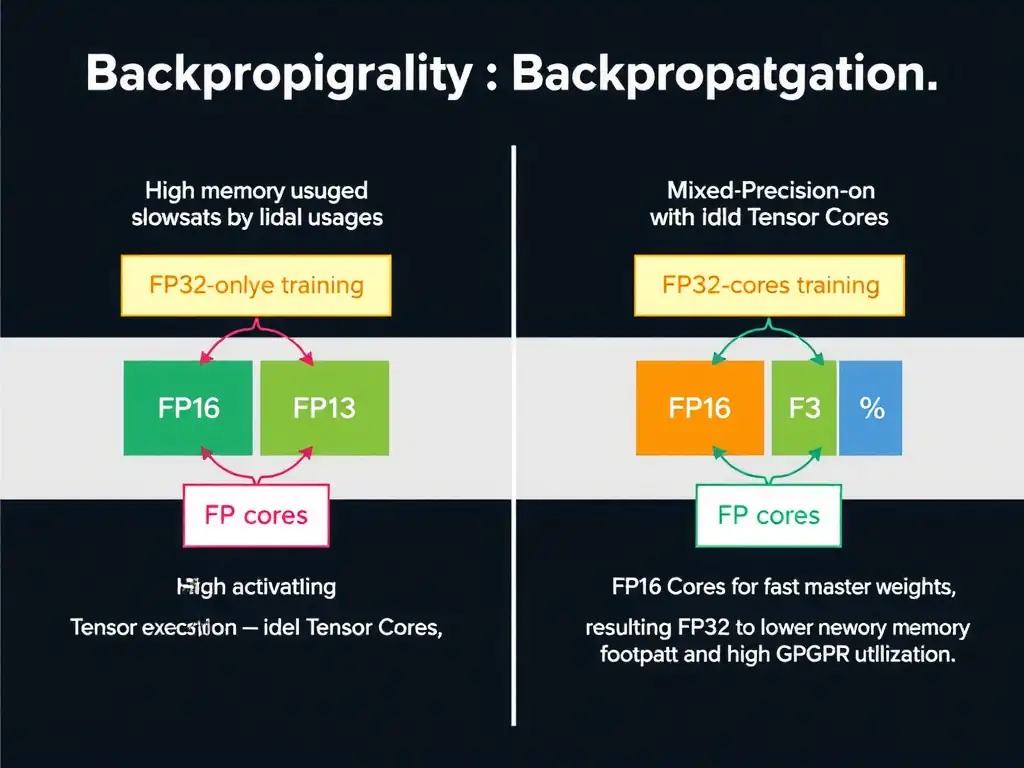
Here's the deal: backprop is matrix math chaos, and if your GPUs are grinding through FP32 they'll drag. Enable mixed-precision training with FP16 or BF16 so Tensor Cores can blast the heavy gradient math while FP32 keeps accumulation stable. That shrinks memory, speeds the backward pass, and keeps GPU utilization high.
Full Explanation
In large-scale distributed deep learning, backpropagation (the backward pass) is highly computation-intensive because it requires computing gradients for all parameters via chain-rule matrix multiplications. If these calculations are performed entirely in standard 32-bit single-precision floating-point (FP32), the computational workload and memory bandwidth limits can cause a drop in GPU utilization, extending overall training time. Mixed-precision training resolves this bottleneck by utilizing lower-precision formats like FP16 or BF16 for the majority of matrix multiplications and activations, while maintaining a master copy of weights in FP32 to preserve model convergence and numerical stability. By doing so, the GPUs can leverage hardware-accelerated Tensor Cores, which are optimized specifically for mixed-precision matrix multiply-accumulate operations. This decreases the data footprint in GPU memory, reduces memory bandwidth saturation, and dramatically increases throughput. Let's analyze the incorrect strategies: The strategy of dynamically increasing the training batch size during the backward pass is technically impractical and does not address the fundamental arithmetic efficiency of gradient calculations; instead, it would likely cause Out-Of-Memory (OOM) errors. The strategy of disabling gradient accumulation changes the training dynamics and frequency of optimizer updates but does not speed up the core matrix math of the backward pass; in fact, it might increase communication overhead in a distributed setup. The strategy of configuring the cluster to offload backpropagation calculations to the host CPU cores would severely slow down training because CPUs are designed for sequential processing and lack the parallel compute capacity required for high-dimensional matrix math, exacerbating the bottleneck rather than resolving it. Additionally, mixed-precision training helps reduce the interconnect bandwidth pressure in distributed setups. During backpropagation, GPUs must communicate gradients with each other (using operations like AllReduce) to synchronize weights. Lower precision means the size of the gradients transmitted over NVLink or InfiniBand networks is cut in half, which directly alleviates network congestion and further improves GPU utilization by reducing communication wait times. Implementing mixed-precision is therefore the most direct and effective way to accelerate the arithmetic of the backward pass, keeping GPU execution units saturated.