You are responsible for a medical AI platform that processes both critical, real-time diagnostic imaging queries and long-running genomic data analysis. The workload volume fluctuates throughout the day, but the system must maintain low latency for diagnostics and high availability overall. Which infrastructure management approach best maintains these service levels under varying demand?
Select an answer to reveal the explanation.
Short Explanation and Infographic
Here's the deal: in the real world, network and compute demands are never flat. If you've got critical workloads like real-time medical scans coming in alongside massive batch jobs like genomic sequencing, you can't just slice your resources down the middle or manually guess who needs what. If you do, you're either going to waste expensive GPU power or cause latency spikes that make users pull their hair out. The solution is auto-scaling. It dynamically watches your traffic and load, spinning up resources where they're needed and shrinking them when things quiet down. It keeps your latency low and your budget happy. Trust me on this, static allocation is a recipe for disaster in any production cluster. Let's keep rolling!
Full explanation below image
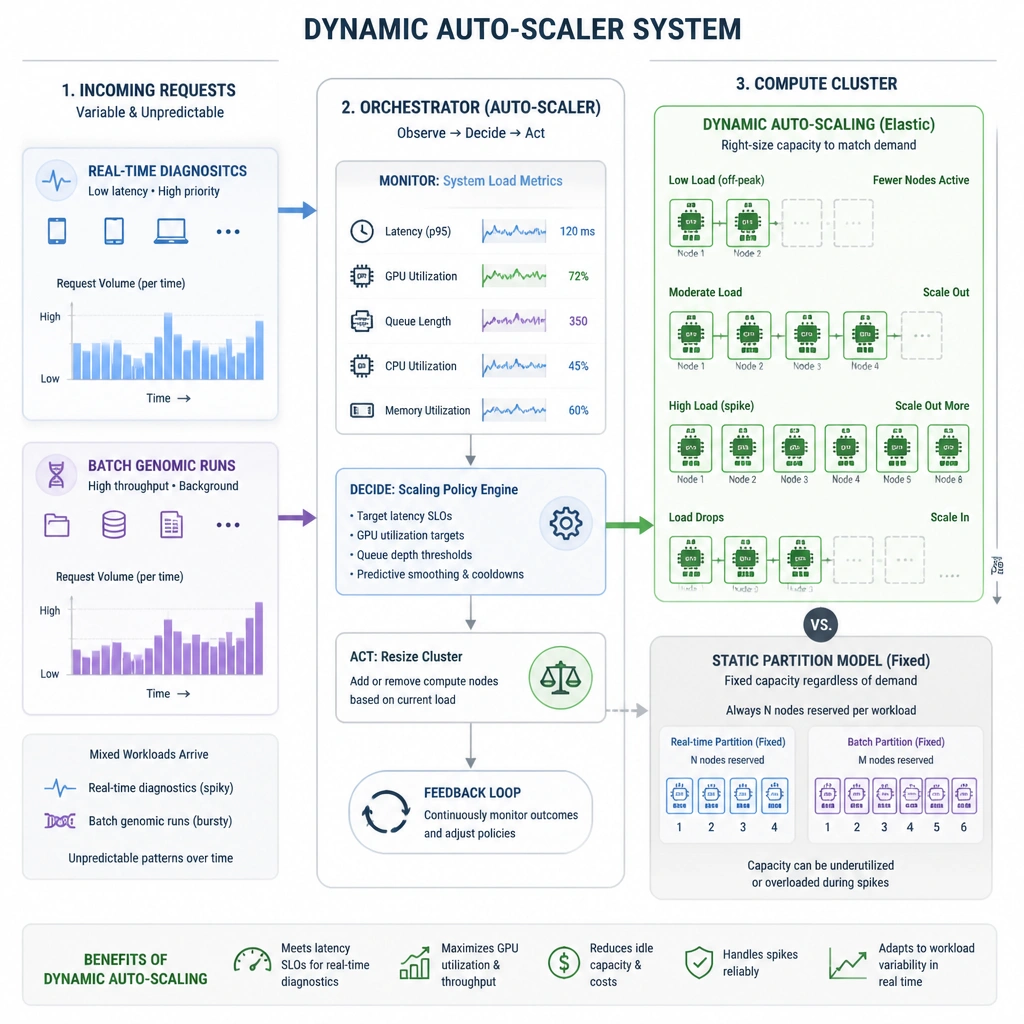
Full Explanation
Handling heterogeneous workloads with different latency and availability requirements requires a resource management system that can adapt to changing conditions in real time. An auto-scaling strategy dynamically adjusts compute and memory allocations based on active system load and incoming requests. This ensures that latency-sensitive tasks (like real-time diagnostics) receive immediate execution resources during traffic spikes, while batch processing tasks (like genomic modeling) can scale back or utilize spare capacity during low-demand periods.
Let's break down why the other options are suboptimal: - Fixed partitioning (Option A) leads to severe resource underutilization. If the diagnostic pipeline is idle, those GPUs sit wasted, while the genomic analysis remains bottlenecked. Conversely, a massive influx of diagnostics could exceed the fixed allocation, causing latency issues. - Equal resource allocation (Option B) ignores the distinct service-level agreements (SLAs) of different workloads. A real-time inference request requires low-latency execution and should not be throttled equally with a background batch job. - Manual partitioning (Option D) is administrative overhead that cannot react to sudden, unexpected traffic spikes. Real-time environments require programmatic, sub-second scaling adjustments that manual intervention cannot provide.
Modern AI orchestration platforms like Kubernetes use horizontal pod autoscalers (HPA) and cluster autoscalers to monitor GPU and CPU utilization, queue lengths, or custom API metrics to adjust resources dynamically. This ensures SLA compliance while maintaining cost efficiency.