A logistics company is pilot-testing a deep learning-based delivery routing engine. During rush hour, the engine frequently routes trucks into newly formed gridlocks because its predictions are based on traffic conditions that changed 15 minutes prior. How can the engineering team best improve the accuracy of the engine's route recommendations?
Select an answer to reveal the explanation.
Short Explanation and Infographic
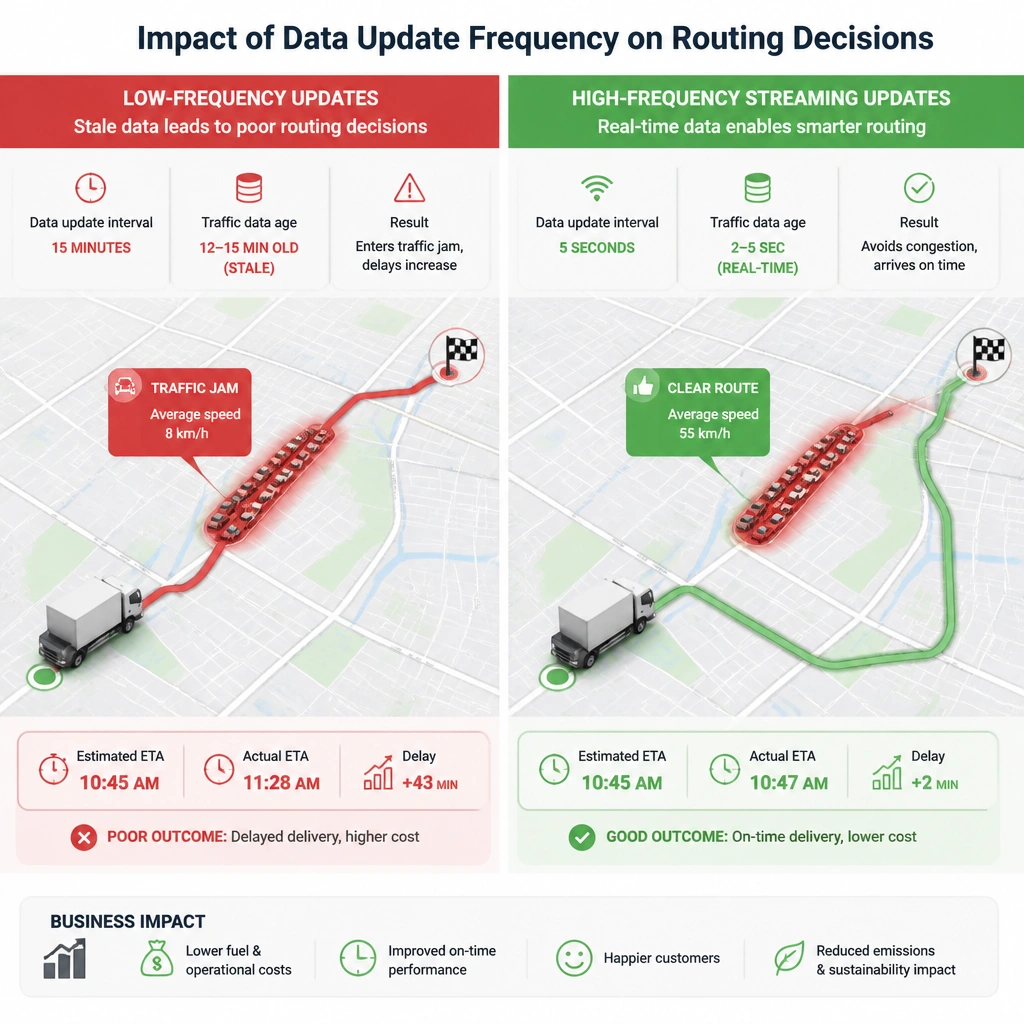
Think of it like this: you're driving down the highway using a GPS map that only updates once an hour. By the time it warns you about a massive pile-up ahead, you're already stuck in bumper-to-bumper traffic. Not very helpful, right? That's exactly what's happening to this routing engine. It's making decisions using stale data. In a fast-changing environment like rush hour, traffic patterns shift in minutes. If your model is only getting updates every 15 or 30 minutes, it's operating in the past. To fix this, you have to increase the frequency of your data feeds so the model has a fresh picture of the road. Simplifying the model or switching to CPUs won't solve the core problem of stale data, and ignoring real-time updates altogether is just going backward.
Full explanation below image
Full Explanation
Real-time predictive systems operating in highly dynamic environments depend heavily on the freshness of their input data. In route optimization, traffic conditions are extremely volatile, particularly during peak hours where accidents, lane closures, and sudden volume spikes can alter transit times in minutes. If a route optimization model suffers from stale input data (e.g., updates arriving every 15-30 minutes), its inference output will reflect outdated conditions, leading to suboptimal route generation. By increasing the frequency of the real-time data ingestion pipeline (such as streaming GPS coordinates and traffic sensor data via Apache Kafka or a similar event-streaming platform directly to the inference model), the routing engine can adjust its recommendations dynamically. This allows the system to react immediately to emerging road hazards and traffic build-ups, thereby reducing delivery times and costs. Analyzing the incorrect options: Reducing the number of input variables (Option A) simplifies the model but usually decreases accuracy, especially if critical features like weather or vehicle performance are removed. Relying exclusively on historical data (Option B) makes the system blind to real-time events, such as crashes or temporary construction, which are critical for dynamic route planning. Migrating workloads to a CPU-only cluster (Option D) does not solve the data freshness problem. In fact, CPUs generally process deep learning inference slower than GPUs, potentially increasing processing latency and worsening the problem.