A financial institution wants to detect credit card fraud using a dataset of 50 million historical transactions. Since fraud is extremely rare, the dataset is heavily skewed. The engineering team has access to an enterprise GPU cluster. How should they combine dataset preprocessing and GPU acceleration to train an accurate classifier in a reasonable time frame?
Select an answer to reveal the explanation.
Short Explanation and Infographic
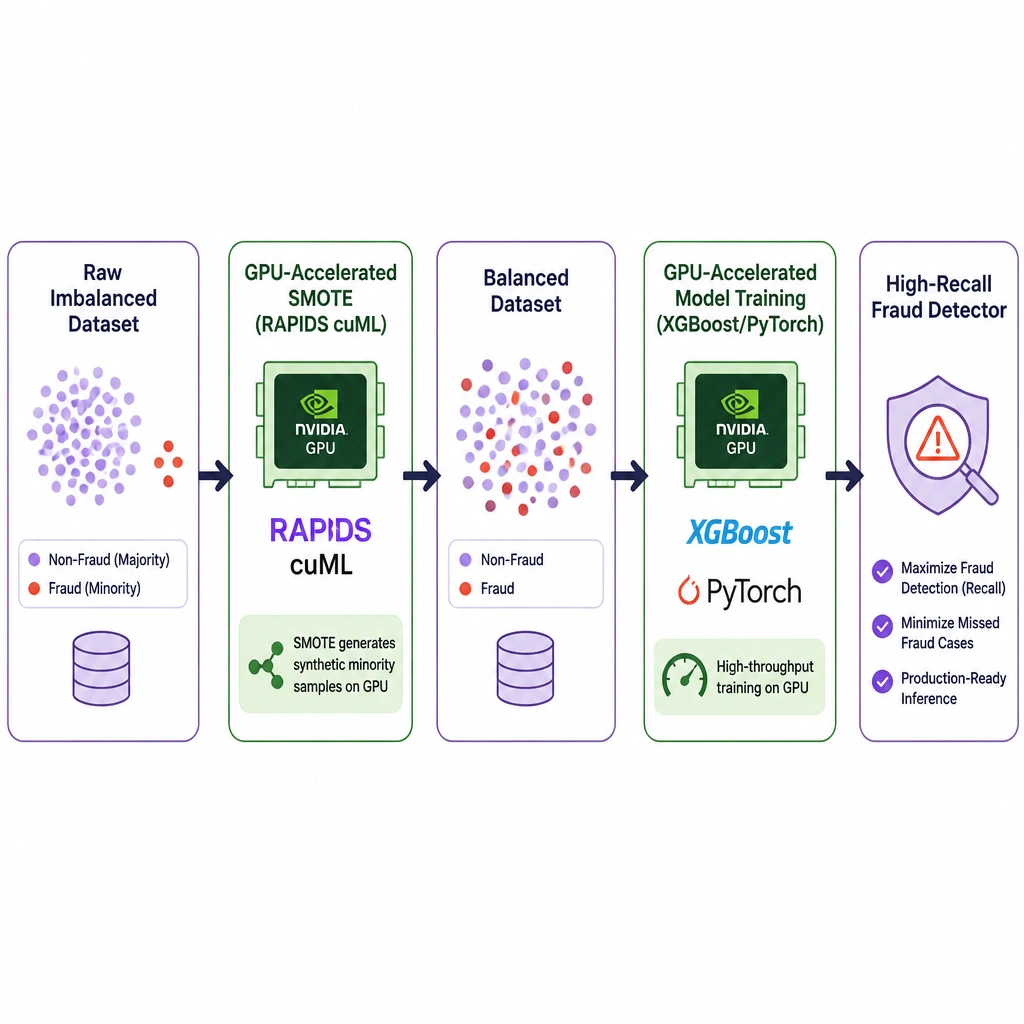
Alright, let's look at this. You have 50 million transactions, and you need to find the needle in the haystack. If you train a model on this heavily skewed data, it's just going to assume everything is fine and ignore the fraud. You've got to balance the dataset. But wait—generating synthetic samples for millions of records is going to take forever on a standard CPU. Since you have an enterprise GPU cluster, the smart move is to use a GPU-accelerated implementation of SMOTE (like the one in RAPIDS cuML). This gives you the best of both worlds: you fix the class imbalance so the model actually learns fraud patterns, and you leverage the GPU to get the job done in minutes instead of hours. Now that's what I call clean engineering!
Full explanation below image
Full Explanation
To successfully train a machine learning model on large, imbalanced datasets (such as 50 million financial transactions with rare fraud instances), two main challenges must be addressed: training bias due to class imbalance, and computational scaling due to data volume. Using Synthetic Minority Over-sampling Technique (SMOTE) addresses the training bias by generating synthetic examples of the minority class (fraud) along the line segments joining k-nearest neighbors of the minority class. However, running SMOTE and training models on millions of records is computationally expensive. Leveraging GPU-accelerated SMOTE (such as the implementation in the RAPIDS cuML library) utilizes parallel GPU threads to calculate nearest neighbors and generate synthetic samples orders of magnitude faster than CPU-based implementations. Following this with a GPU-accelerated classifier (like XGBoost or a Deep Neural Network) ensures the entire pipeline runs efficiently. Let's evaluate the distractors. Option B (downsampling and training on CPU) is poor because downsampling to match the minority class means discarding 99.9% of your data (e.g., throwing away millions of legitimate transactions), which strips the model of valuable patterns. Training on CPU also fails to leverage the available GPU cluster. Option C (Logistic Regression on raw data on CPU) does not address the class imbalance, lacks the capacity to model complex non-linear fraud patterns, and runs slowly on a single CPU thread. Option D (XGBoost on raw data on GPU) leverages GPU acceleration to train quickly, but because it doesn't address the severe class imbalance, the resulting model will still have very low sensitivity (recall) for fraud detection, misclassifying most fraud events as legitimate.