A cloud architect is presenting an AI implementation strategy to a group of executives who are using the terms Artificial Intelligence (AI), Machine Learning (ML), and Deep Learning (DL) interchangeably. To ensure alignment on budget and hardware procurement, the architect must clarify how these fields overlap and differ. Which of the following statements correctly describe the relationship and operational characteristics of AI, ML, and DL? (Choose two)
Select all correct answers, then click Submit.
Short Explanation and Infographic
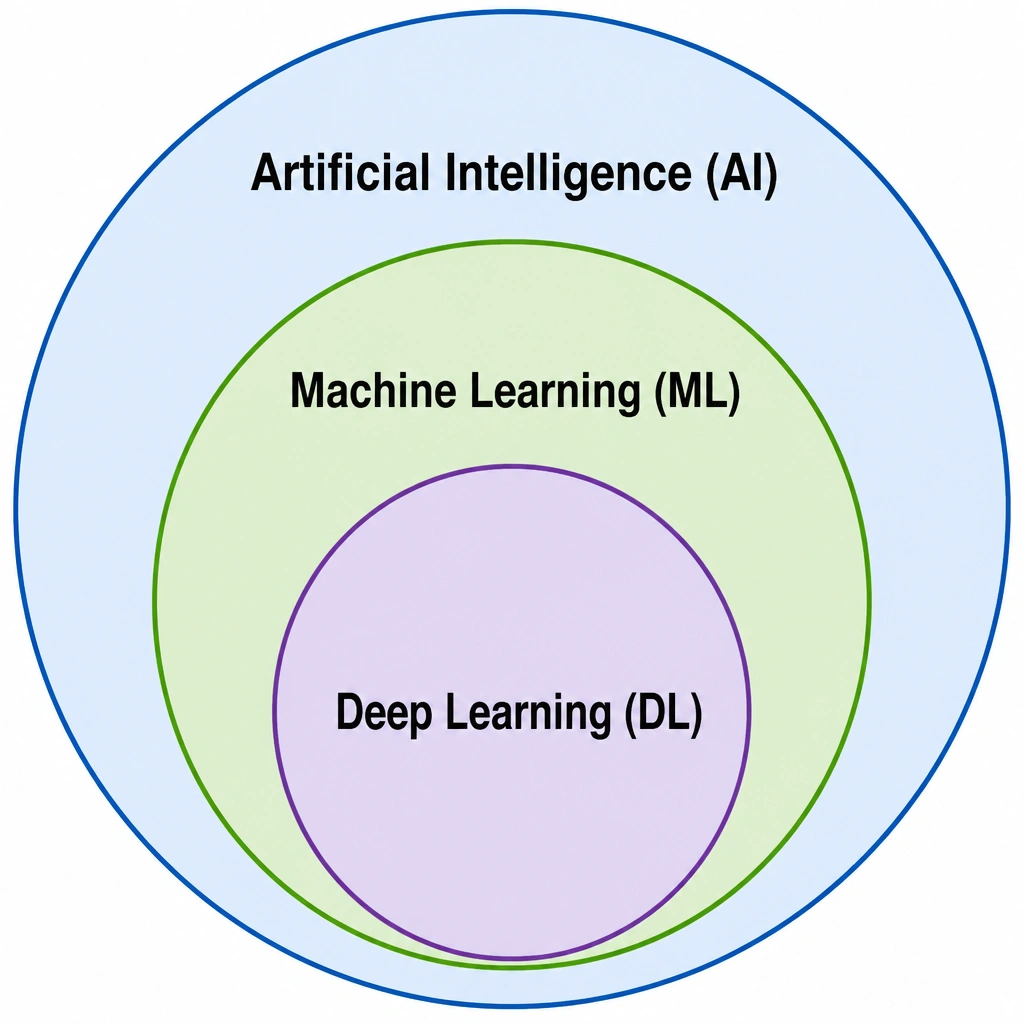
Check this out: in meetings, people throw around words like AI, Machine Learning, and Deep Learning like they're the exact same thing. They're not, and mixing them up can lead to major confusion when you start buying hardware. Think of AI as the big umbrella—it's any code that makes a machine act smart, even old-school rule-based programs. Now, inside that umbrella, we have Machine Learning. Instead of you writing a million 'if-then' statements, ML uses algorithms to look at data and learn the rules on its own. And inside ML, we have a specialized subset called Deep Learning. That's the stuff that uses deep neural networks with multiple layers to handle complex tasks like speech or image recognition, and the cool thing is it automatically extracts features without you having to hand-craft them. So remember: AI is the parent, ML is the child, and DL is the grandchild. Got it? Sweet. Let's keep rolling.
Full explanation below image
Full Explanation
Understanding the distinct scopes of Artificial Intelligence (AI), Machine Learning (ML), and Deep Learning (DL) is essential for aligning infrastructure, software stacks, and development efforts. - Artificial Intelligence (AI) is the broad, overarching field concerned with building systems capable of performing tasks that typically require human intelligence. This includes not only data-driven approaches but also symbolic logic, heuristic search trees, and rule-based expert systems that do not learn from data. - Machine Learning (ML) is a subset of AI. Instead of using hard-coded rules, ML systems rely on algorithms (such as linear regression, decision trees, and support vector machines) that learn patterns directly from datasets to make predictions or decisions. - Deep Learning (DL) is a specialized subset of Machine Learning. It utilizes multi-layered artificial neural networks (hence the term 'deep') to model complex, high-dimensional patterns. A key differentiator of deep learning is its ability to perform automatic feature extraction directly from raw input data (like pixels or audio waves), eliminating the intensive manual feature engineering required by traditional machine learning algorithms.
Let's break down why the incorrect options are incorrect: - Option A is incorrect because deep learning models do not require manual feature extraction; in fact, their primary advantage over traditional machine learning is that they automatically learn hierarchical features directly from raw data. - Option C is incorrect because AI is a broad field that includes non-deep learning systems. Many classic AI applications rely on deterministic, rule-based logic or simple statistical algorithms. - Option D is incorrect because deep learning is not a separate technology disjoint from AI and ML. It is a subset of both, and while it heavily leverages hardware accelerators like GPUs due to its mathematical complexity, its classification as DL is based on its architectural design (deep neural networks), not the underlying hardware.
Therefore, Options B and E are the correct choices.