When performing data mining and creating visualizations to extract business intelligence from raw corporate datasets, which practice is essential for preventing skewed results and incorrect conclusions?
Select an answer to reveal the explanation.
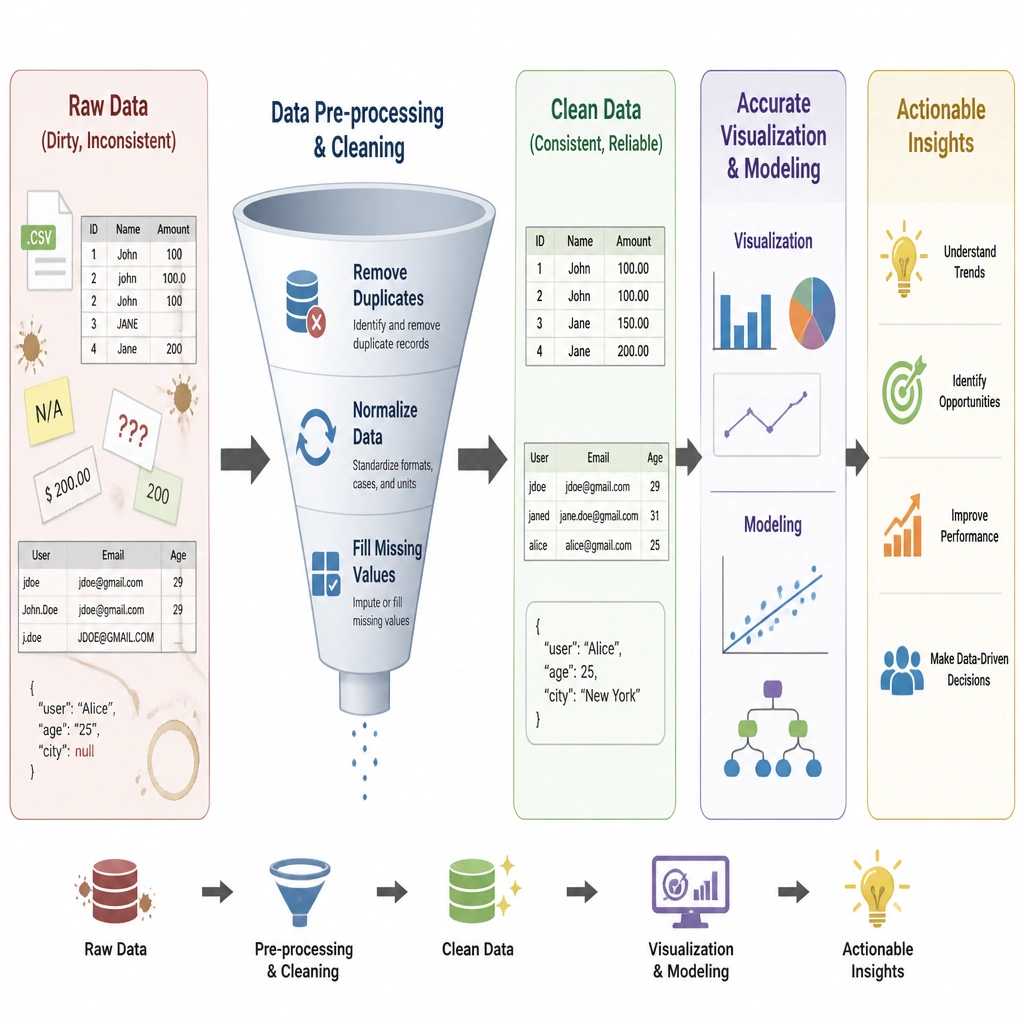
Short Explanation and Infographic
Here's a golden rule you must never forget: garbage in, garbage out! If your data is full of missing values, duplicate entries, or weird scale differences, it doesn't matter how fancy your machine learning model is or how pretty your charts look. Your results will be completely wrong. Before you run any data mining algorithms or build a single dashboard, you have to roll up your sleeves and clean that data. You've got to normalize it, handle the missing values, and throw out the duplicates. Trust me, spending time on data pre-processing is what actually separates the pros from the amateurs.
Full explanation below image
Full Explanation
Data quality is the foundational element of any data mining, visualization, or predictive modeling initiative. Raw datasets frequently contain noise, duplicate records, missing entries, outliers, and inconsistent scaling, which can distort statistical models and lead to incorrect conclusions. Data cleaning and pre-processing—which includes tasks such as imputation of missing values, deduplication, feature scaling (normalization/standardization), and outlier handling—ensures that the underlying data is accurate, consistent, and representative. Attempting to use complex algorithms or larger datasets without first performing clean-up operations will only propagate errors and yield inaccurate, non-actionable results.