You are conducting a training session for new developers joining your infrastructure team. To ensure everyone uses precise technical terminology, you want to clarify how Artificial Intelligence (AI), Machine Learning (ML), and Deep Learning (DL) relate to one another. Which of the following descriptions accurately depicts the hierarchical relationship among these concepts?
Select an answer to reveal the explanation.
Short Explanation and Infographic
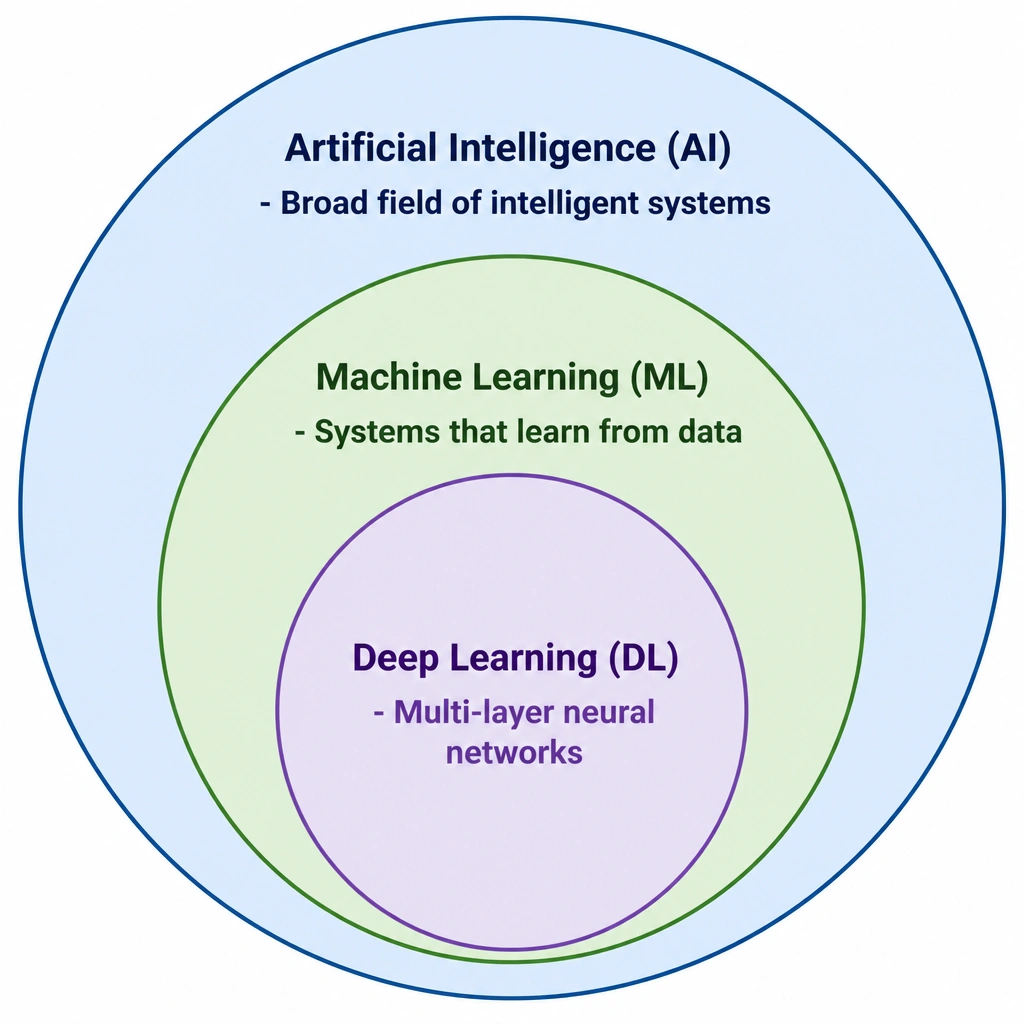
Let's get our terms straight right out of the gate. People throw these three acronyms around like they're the same thing, but they're not. Think of it like nested Russian nesting dolls. The biggest doll is Artificial Intelligence—that's the broad field of making computers act smart, whether it's through simple if/then rules, expert systems, or advanced math. Inside that doll, you've got Machine Learning. This is where we stop writing rules by hand and instead feed data to algorithms so they can learn the patterns themselves. And inside the ML doll is the smallest one: Deep Learning. DL is a very specific type of machine learning that uses multi-layered neural networks to mimic how the human brain processes information. So, AI is the parent, ML is the child, and DL is the grandchild. Got it? Sweet.
Full explanation below image
Full Explanation
The terms Artificial Intelligence (AI), Machine Learning (ML), and Deep Learning (DL) represent nested subsets within computer science. Artificial Intelligence is the broadest category and refers to the overall science and engineering of making intelligent machines that can simulate human cognitive functions, decision-making, or problem-solving. This includes non-learning approaches like expert systems, heuristic search algorithms, and symbol-based reasoning. Machine Learning is a specific subset of AI that focuses on building systems that can automatically learn patterns and make predictions from data without explicit, step-by-step programming. Deep Learning is a specialized subfield of Machine Learning that utilizes multi-layered artificial neural networks (deep neural networks) to model and learn high-level representations from complex, unstructured data.
Looking at the incorrect options: Option A is incorrect because it reverses the hierarchy, claiming machine learning is the overarching field and AI is the neural network subset. Option B is incorrect because deep learning is not independent of machine learning; it is a subset that inherits ML's fundamental concepts of optimization, training, and loss minimization. Option D is incorrect because AI and ML are not synonymous, as AI contains rule-based systems that do not learn from data. Furthermore, Deep Learning is an algorithmic architecture, not the physical hardware (such as GPUs or TPUs) used to accelerate its execution.