In an enterprise multi-GPU cluster running concurrent deep learning workloads, telemetry logs show that a subset of GPUs is constantly throttled at 100% compute and memory capacity, while other identical GPUs in the cluster sit idle or operate below 15% utilization. What is the most effective architectural solution to resolve this resource imbalance and optimize job completion times?
Select an answer to reveal the explanation.
Short Explanation and Infographic
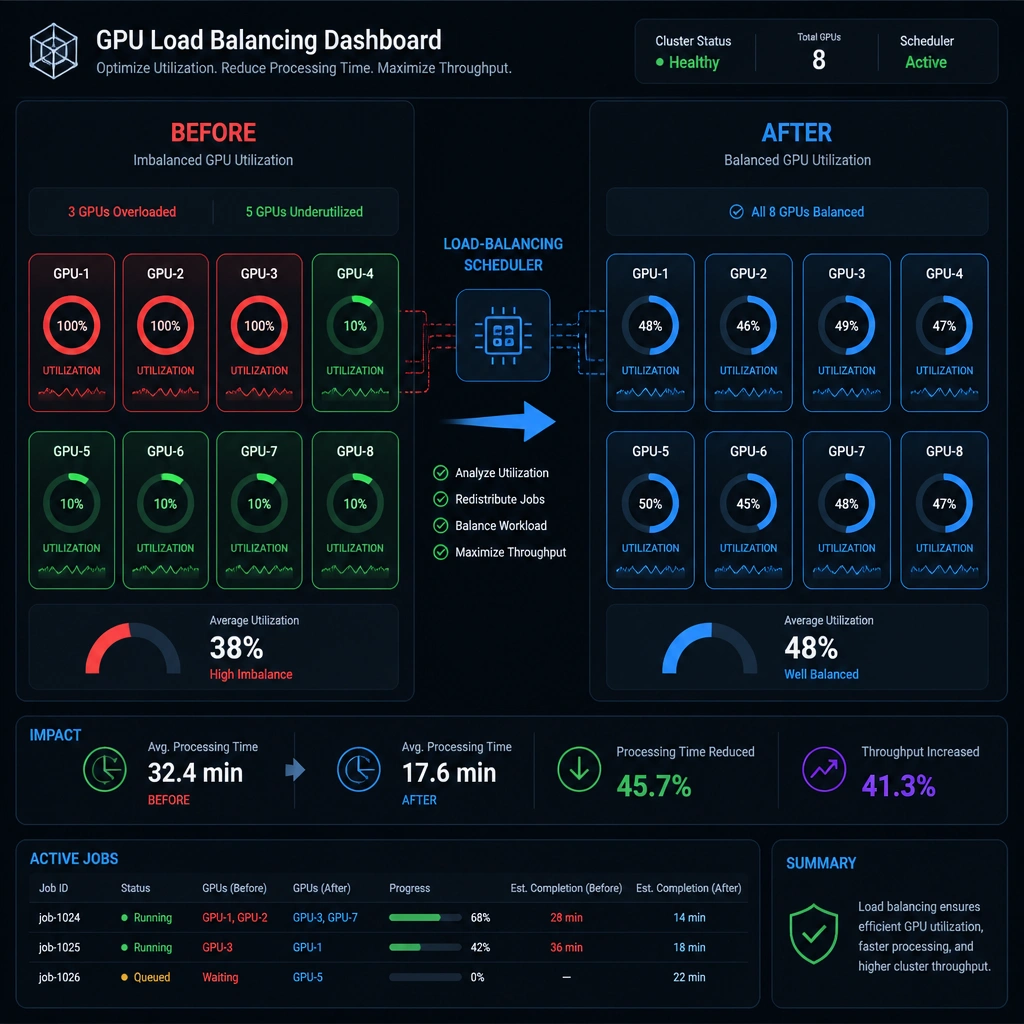
Here's the deal: if you're running a multi-GPU cluster and half your cards are screaming at 100% while the other half are basically taking a nap, you've got a serious scheduling problem. It's like having a restaurant where one waiter is swamped with ten tables and the other three waiters are standing around checking their phones. You don't fix that by feeding the lazy waiters more coffee (increasing power limits) or by telling all the customers to eat slower (reducing batch sizes). You fix it by redistributing the tables! In our world, that means implementing dynamic GPU load balancing. A smart scheduler monitors GPU metrics in real time and routes new workloads to the cards with the most free headroom. This levels out the load, speeds up your job times, and makes sure you're getting your money's worth out of every single GPU. Got it? Sweet. Let's keep rolling.
Full explanation below image
Full Explanation
In multi-node, multi-GPU environments, unequal workload distribution leads to resource fragmentation, thermal hotspots, and degraded job completion times. When some GPUs are overburdened while others remain underutilized, it indicates a failure in resource orchestration. The most effective solution to correct this imbalance is implementing dynamic GPU load balancing and resource scheduling (Option B).
Dynamic load balancing utilizes a centralized cluster scheduler (such as Kubernetes with specialized device plugins or Slurm) that continuously monitors real-time telemetry from each GPU—including GPU compute utilization, memory usage, temperature, and power consumption. When a new training or inference job is submitted, the scheduler dynamically routes the workload to the nodes and GPUs with the highest available capacity. Furthermore, advanced schedulers can migrate running tasks or scale instances dynamically to maintain an even distribution of compute stress, maximizing the return on infrastructure investment and reducing execution bottlenecks.
Let's examine the incorrect options. Increasing the power limit (Option A) on underutilized GPUs will not increase their usage if the scheduler is not routing workloads to them; power limits control the maximum wattage a GPU can draw under load, but do not generate work. Globally reducing the batch size (Option C) for all workloads is a poor workaround that reduces the throughput of the busy GPUs without addressing the fact that other GPUs are sitting idle, ultimately slowing down overall operations. Disabling GPU overclocking or boost clocks (Option D) reduces the performance of the busy GPUs to normalize them with the idle ones, which decreases the performance of the entire cluster rather than utilizing the idle capacity.