An industrial enterprise wants to use AI to monitor sensor telemetry (such as vibration, temperature, and acoustic data) from heavy machinery. The goal is to detect early signs of mechanical wear and perform maintenance before a critical failure occurs. Which industry stands to gain the most significant improvements in operational uptime and cost reduction from this specific application of predictive maintenance?
Select an answer to reveal the explanation.
Short Explanation and Infographic
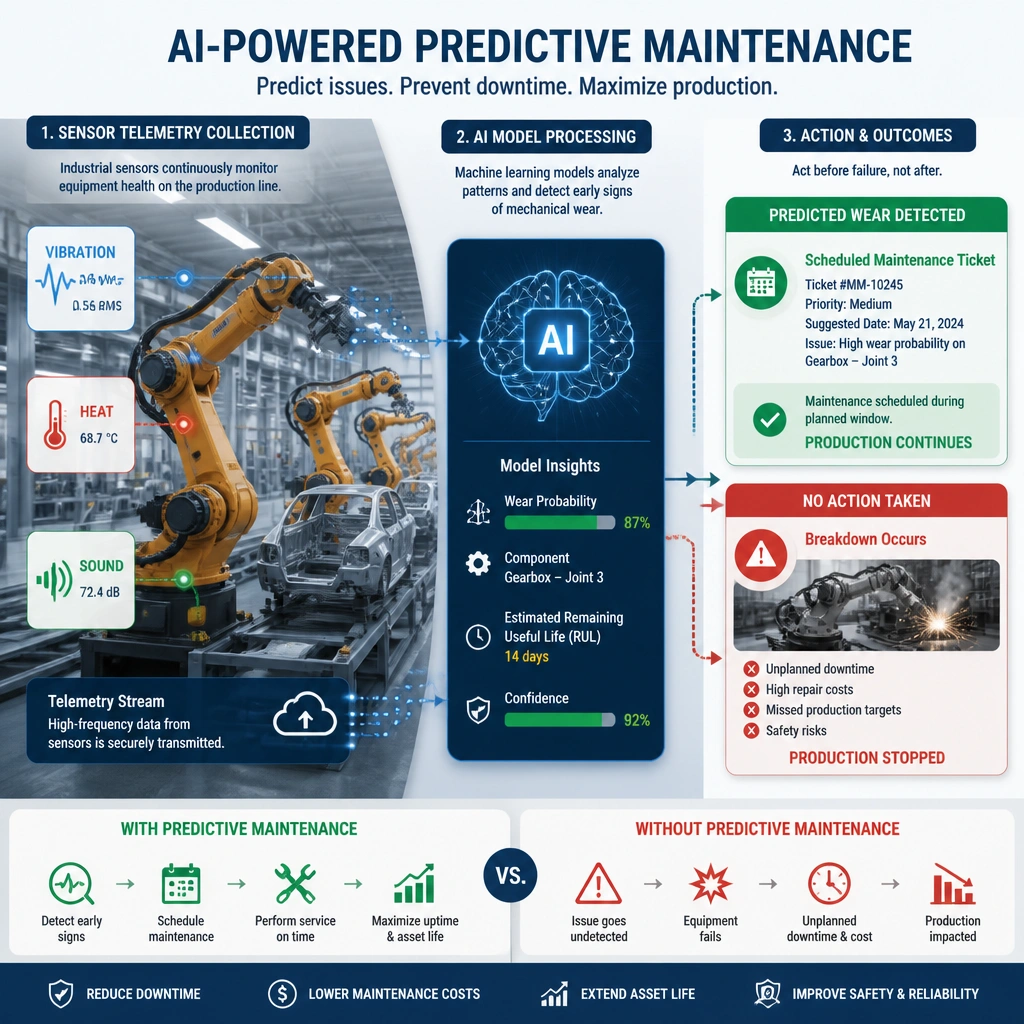
Think of it like this: if a machine on an assembly line breaks down unexpectedly, the whole factory grinds to a halt. Every minute that line is down, the company is losing thousands of dollars. In the real world of heavy manufacturing, waiting for something to break before you fix it is a recipe for disaster. That's why predictive maintenance is such a massive deal in manufacturing. By using AI to analyze data from sensors placed on the gear, we can spot tiny anomalies—like a slight increase in motor vibration—before the machine fails. This lets the maintenance crew fix it during a scheduled break rather than in the middle of a rush job. While retail, finance, and healthcare all use AI in cool ways, manufacturing is where predictive maintenance directly saves millions by keeping the machines running. Got it? Sweet. Let's keep rolling.
Full explanation below image
Full Explanation
Predictive maintenance is a key application of accelerated computing and AI in industrial settings. It involves collecting continuous time-series data from IoT sensors installed on machinery—such as vibration sensors, thermal cameras, and acoustic sensors—and using machine learning models to detect anomalies that precede equipment failure.
The manufacturing industry (Option C) experiences the most direct and substantial operational efficiency improvements and cost reductions from predictive maintenance. In modern manufacturing, production lines operate continuously. An unplanned breakdown of a single component can halt an entire factory floor, resulting in astronomical downtime costs, missed delivery deadlines, and expensive emergency repairs. By applying AI to predict when a component is nearing the end of its useful life, manufacturers can transition from reactive maintenance (fixing things after they break) or preventive maintenance (replacing parts on a rigid schedule regardless of wear) to predictive maintenance. This allows them to schedule repairs during planned downtime, optimizing spare parts inventory and extending the lifespan of expensive capital assets.
Let's evaluate the incorrect options. While finance (Option A), healthcare (Option B), and retail (Option D) utilize AI extensively, their primary use cases are different. Finance focuses on fraud detection, algorithmic trading, and risk assessment. Healthcare utilizes AI for medical imaging, drug discovery, and genomic sequencing. Retail uses AI for recommendation engines, demand forecasting, and inventory optimization. None of these sectors rely on mechanical machine telemetry for their core operations to the extent that manufacturing does, making manufacturing the primary beneficiary of AI-driven predictive maintenance.