When designing hardware infrastructures for training deep learning models, engineers consistently select GPUs over CPUs for the core workload. Which two architectural characteristics of GPUs explain their massive performance advantage in training large-scale AI networks? (Choose two)
Select all correct answers, then click Submit.
Short Explanation and Infographic
Think of it like this: a CPU is like a Ferrari. It has a super fast, highly sophisticated engine designed to get one or two passengers across town incredibly fast. A GPU, on the other hand, is like a massive fleet of school buses. Individually they aren't as fast, but they can transport thousands of kids at the exact same time. Since deep learning is basically just doing billions of simple math equations (like floating-point matrix multiplications) over and over, that massive parallel setup is exactly what we need. GPUs pack thousands of cores onto a single chip, allowing them to crunch all those numbers in parallel. If you tried to do that on a CPU, the CPU would have to process them mostly one by one, which would take forever. Trust me, understanding this core difference between sequential CPU processing and parallel GPU execution is absolute gold for the exam. Let's keep rolling!
Full explanation below image
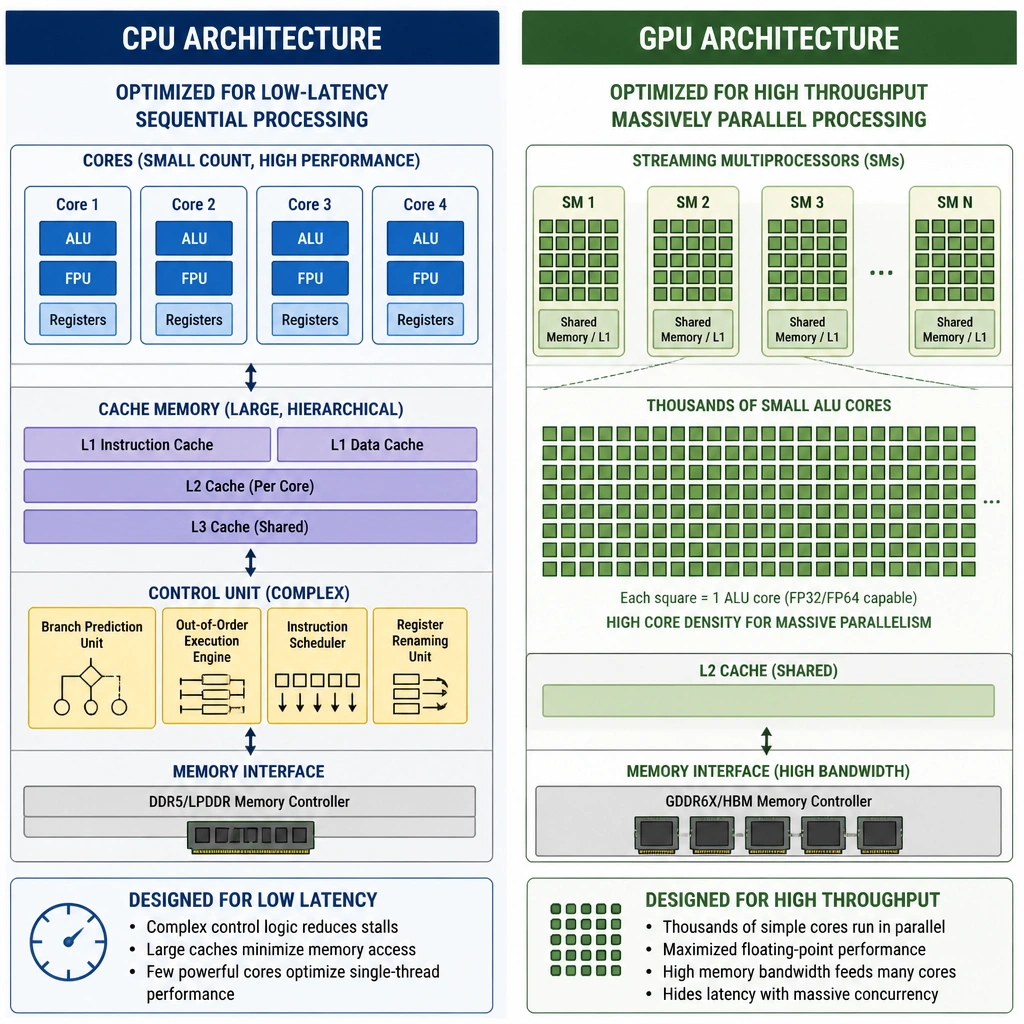
Full Explanation
Deep learning workloads are characterized by massive data parallelism and heavy mathematical computation, primarily consisting of large-scale matrix multiplications and additions (linear algebra) performed using floating-point representations (such as FP32, FP16, or BF16). A Central Processing Unit (CPU) is architected for low-latency sequential processing. It features a few highly complex cores with large caches and sophisticated control logic (like branch prediction) designed to run a single thread of instructions very quickly. This makes CPUs excellent for general-purpose computing but inefficient for training large-scale neural networks. In contrast, a Graphics Processing Unit (GPU) is designed for high-throughput parallel computing. It has a high core density (Option E), containing thousands of simpler cores that can execute the same instruction across multiple data points simultaneously (SIMD/SIMT architecture). Furthermore, GPU hardware is highly optimized for floating-point operations (Option B), often including specialized units like Tensor Cores designed specifically to accelerate matrix math. Option A is incorrect because CPU cores have much higher clock speeds than GPU cores. Option C describes CPU instruction sets, which are versatile but not optimal for the uniform math of neural networks. Option D is incorrect because high-performance GPUs consume substantial power under load and often require robust cooling solutions due to high system-level TDP.