Your organization is operating an edge-to-cloud AI system where hundreds of IoT sensors continuously stream telemetry data to a centralized processing facility. The hosted AI model requires consistent, low-latency, and high-throughput data streams to generate real-time predictive maintenance alerts. Recently, network congestion has caused packet loss and unpredictable transmission delays, leading to degraded model inference accuracy. Which of the following network infrastructure changes would be the most effective solution to restore telemetry stream reliability and performance?
Select an answer to reveal the explanation.
Short Explanation and Infographic
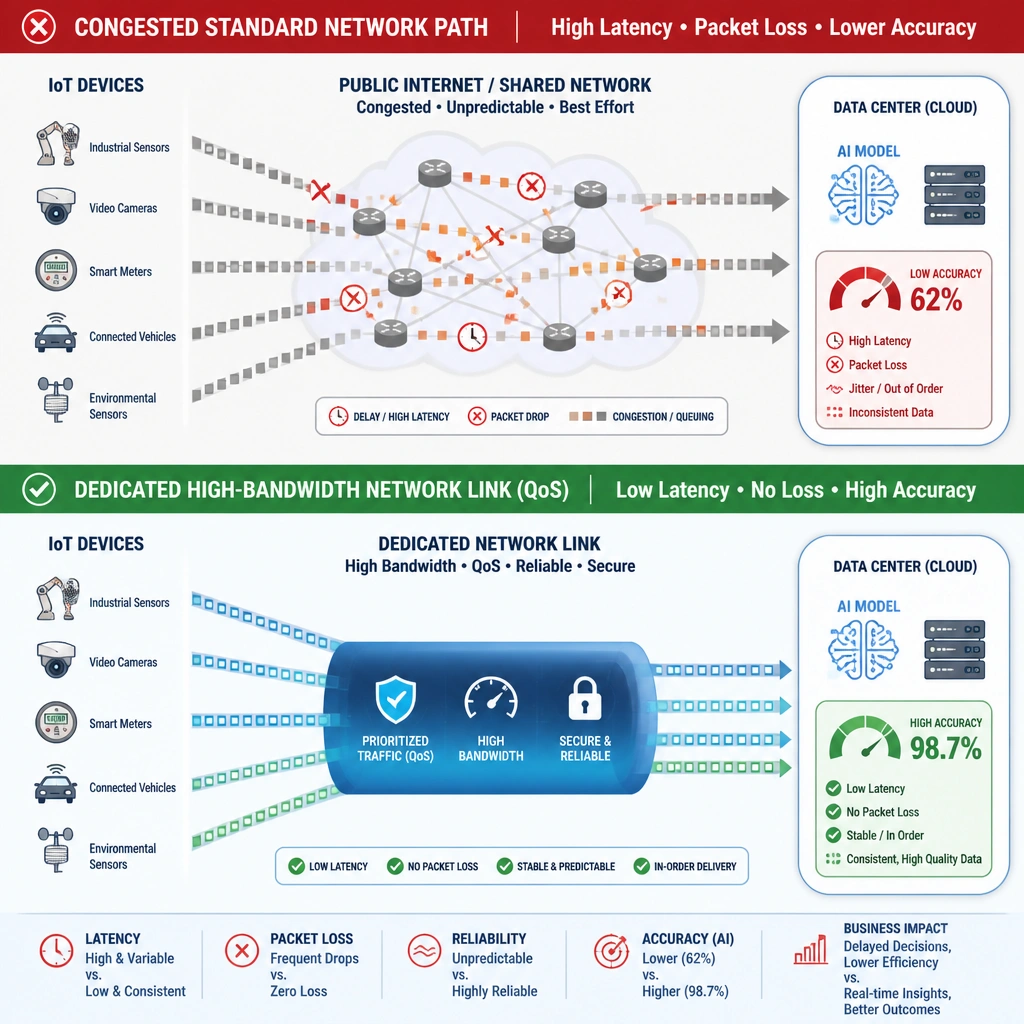
Here's the deal: if you are streaming real-time data from IoT sensors to a central AI engine, network congestion is your worst enemy. If packets start dropping or getting delayed, your model is working with stale or missing data, and its predictions will go off the rails. Imagine your boss walks in and asks why the predictive alerts are late—you can't just tell him the network was busy! You need a dedicated, high-bandwidth connection with guaranteed QoS. This keeps the data pipeline clean, fast, and reliable. CDNs won't help because caching static content is not the same as streaming live telemetry, and batching completely defeats the "real-time" requirement. Keep that pipeline dedicated and fast!
Full explanation below image
Full Explanation
In distributed AI environments where telemetry is gathered from edge devices (IoT sensors) and processed centrally, network reliability is paramount. Real-time inference pipelines depend on continuous, predictable data arrival. If the network experiences congestion, it introduces jitter (variable latency) and packet loss. Packet loss means the central AI model receives incomplete data states, directly hurting inference accuracy. Jitter means alerts are delayed, violating real-time SLA requirements. To resolve this, implementing a dedicated, high-bandwidth network link (such as a direct lease line, SD-WAN, or MPLS with strict Quality of Service policies) ensures that the critical AI telemetry traffic is prioritized over general traffic, guaranteeing the required bandwidth and low-latency metrics.
Let's review the distractors: Option A (CDN caching) is designed to cache static, read-heavy assets like images or videos near end-users. It does not facilitate real-time, low-latency upload streaming of dynamic telemetry data. Option B (batch uploads) would resolve network utilization issues but destroys the core requirement of real-time processing and immediate predictive alerting, converting a real-time system into a delayed historical reporting system. Option D (upgrading edge hardware) might allow for local processing if the models were deployed at the edge, but it does not address the transmission issues of the current centralized model architecture. Since the prompt states the data must be ingested centrally for the model to deliver insights, the network link remains the critical bottleneck.