A data center engineer deploys NVIDIA BlueField DPUs (Data Processing Units) in a GPU cluster to optimize infrastructure operations. However, the development team notices that when they offload neural network inference tasks directly to the DPU's general-purpose ARM cores, the inference latency spikes dramatically compared to running them on the host CPUs or GPUs. What is the underlying cause of this performance bottleneck?
Select an answer to reveal the explanation.
Short Explanation and Infographic
Here's the deal: DPUs—like the NVIDIA BlueField—are awesome at what they're built for. They offload infrastructure chores like network virtualization, firewall security, and storage tasks. That frees up your host CPU to do real work. But here's the trap: some folks think, 'Hey, it's a co-processor, let's run our deep learning inference models right on it!' Big mistake. The DPU's ARM cores are not designed to crunch heavy, parallel neural network math. If you dump inference tasks onto the DPU, they'll crawl. Keep inference where it belongs—on your GPUs or high-performance CPUs—and let the DPU handle the network traffic.
Full explanation below image
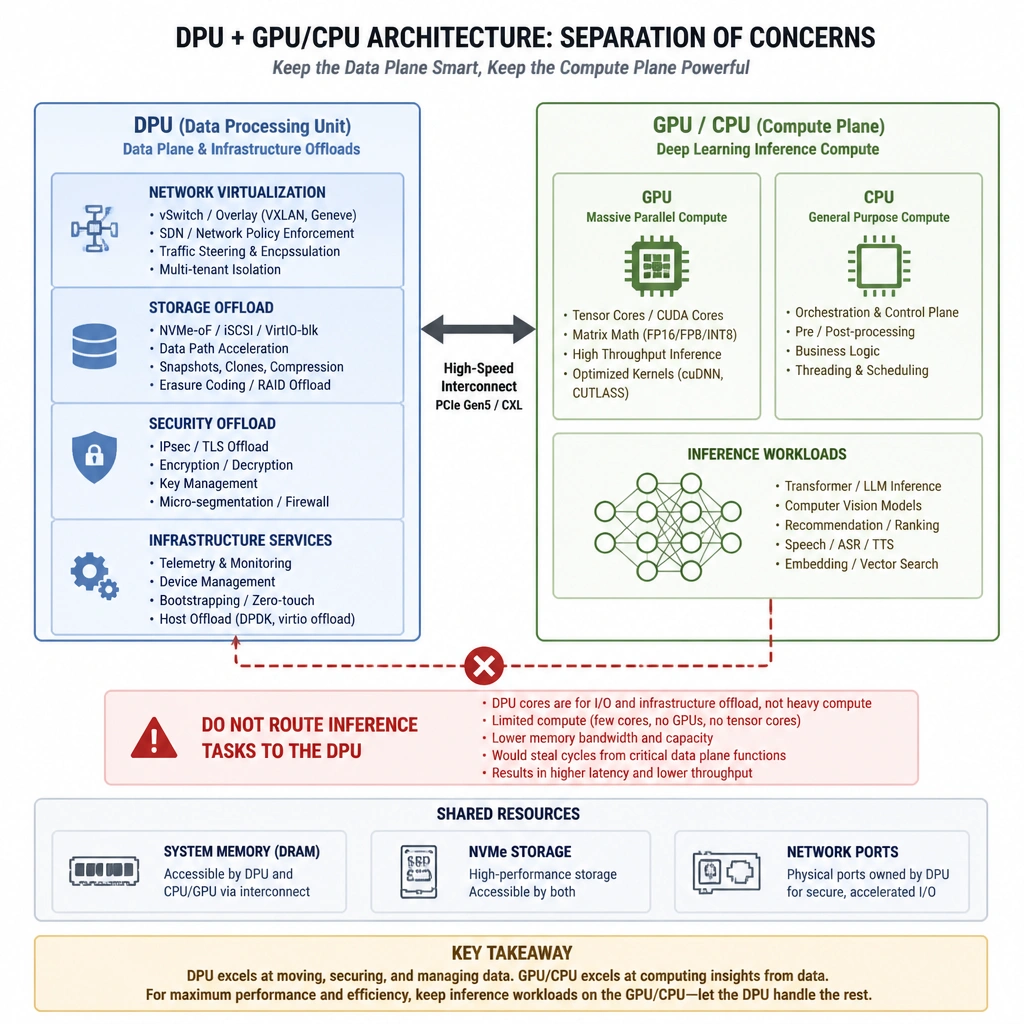
Full Explanation
NVIDIA BlueField DPUs (Data Processing Units) are specialized processors designed to offload, accelerate, and isolate infrastructure services (such as networking, security, telemetry, and storage virtualization) from the host CPU. While they contain ARM CPU cores and network acceleration engines, they are not designed or optimized to execute compute-intensive, parallel floating-point operations required for deep learning inference. Running AI inference workloads directly on the DPU instead of utilizing specialized GPUs (which contain Tensor Cores designed for matrix multiplication) or host CPUs results in severe bottlenecks and high latency. - A is incorrect because DPUs do not have hardware throttling mechanisms designed to protect host CPU utilization; they are simply architecturally unsuitable for heavy matrix mathematics. - B is incorrect because DPUs are designed with extremely high-throughput network interfaces (e.g., ConnectX controllers) that handle high-speed data transfers easily; the bottleneck is the compute unit, not the network. - D is incorrect because DPUs have advanced PCIe controllers (such as Gen 4 or Gen 5) with massive bandwidth; the bottleneck lies in the execution speed of the model on the DPU's ARM cores, not the PCIe interface.