You are designing the compute architecture for an autonomous vehicle that uses real-time deep learning models for sensor fusion, obstacle detection, and path planning. The platform integrates multicore CPUs, NVIDIA GPUs, and DPUs (Data Processing Units). How should workloads be partitioned across these computing units to achieve minimal latency and maximum system safety?
Select an answer to reveal the explanation.
Short Explanation and Infographic
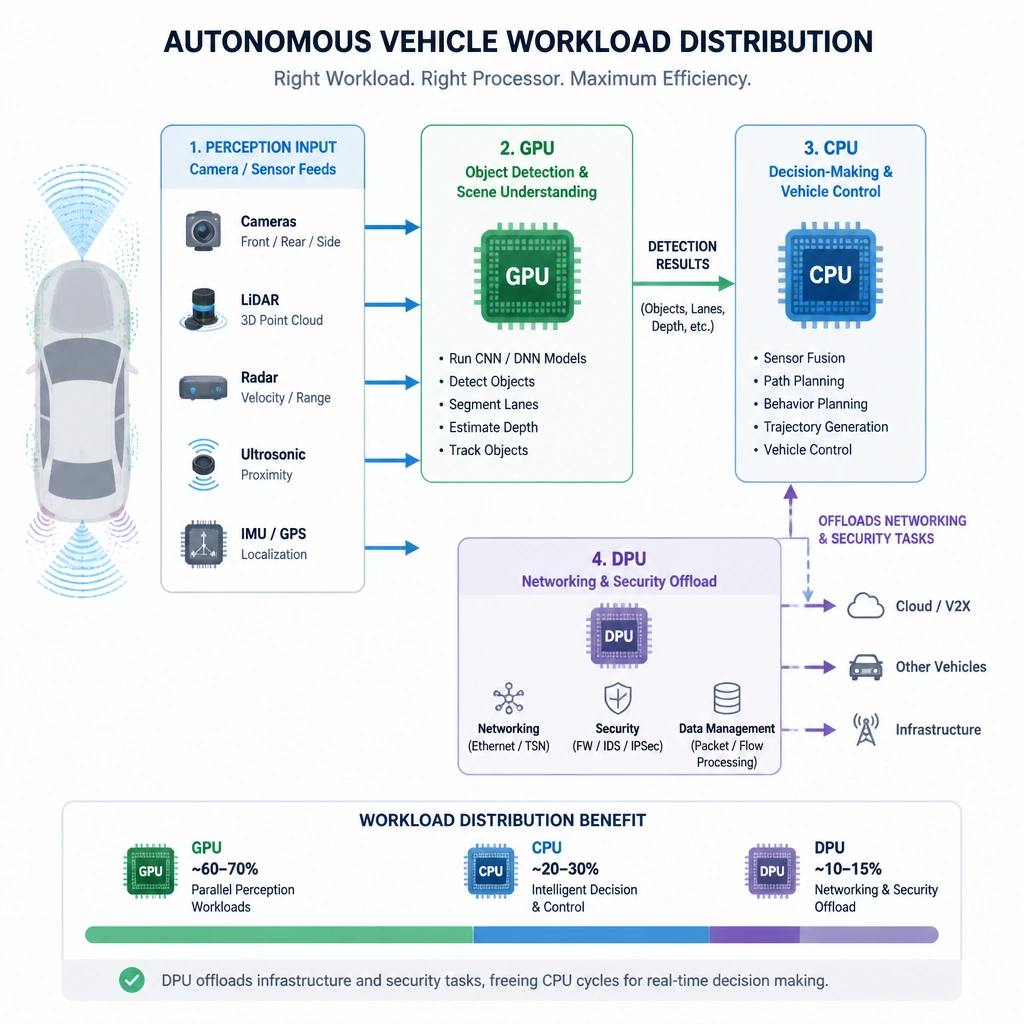
Okay, let's dive into this. In an autonomous vehicle, you have a ton of different tasks that all need to happen in milliseconds. You can't just throw everything at the CPU and hope for the best. Here's how we divide and conquer: the GPU is a beast at parallel processing, so we let it handle the heavy object detection models. The CPU is great at serial logic, so it runs the actual decision-making code—like 'should we steer left or right?' And the DPU? It's our traffic cop. It offloads all the networking, data transfers, and security stuff so the CPU doesn't get bogged down. That's a perfect division of labor.
Full explanation below image
Full Explanation
Efficient heterogeneous computing relies on mapping tasks to the hardware architecture best suited for them: 1. GPUs (Graphics Processing Units) excel at parallel computing workloads, making them ideal for running high-dimensional deep learning models such as real-time object detection and segmentation. 2. CPUs (Central Processing Units) are designed for fast serial processing and complex branch logic, making them the best choice for executing sequential decision-making systems (e.g., path planning, vehicle control logic, and state machines). 3. DPUs (Data Processing Units) are specialized processors designed to offload data-centric tasks such as network packet processing (e.g., virtual switching, routing), security (encryption, firewalls), and storage virtualization. Offloading these tasks to the DPU frees up critical CPU cycles, lowering latency and ensuring predictable system performance. - A is incorrect because DPUs offload networking and storage virtualization tasks from the CPU rather than the GPU, and the CPU does far more than just peripheral device management (it executes the vehicle's brain/logic). - C is incorrect because DPUs do not accelerate image preprocessing tasks (that is done by GPUs or dedicated ISPs), and GPUs, not DPUs, run deep learning inference models. - D is incorrect because CPUs are not optimized for running heavy parallel deep learning models, which would cause severe latency bottlenecks, and DPUs are not meant for model post-processing.