A distributed deep learning model running across multiple GPUs exhibits inconsistent training throughput. Telemetry reveals that GPU 0 and GPU 1 are consistently running at 99% utilization, while GPU 2 and GPU 3 remain at less than 15% utilization, causing significant synchronization delays during gradient updates. Which action is the most direct remedy for this bottleneck?
Select an answer to reveal the explanation.
Short Explanation and Infographic
Imagine your boss walks in and says your training job is bottlenecked, but when you look at the dashboard, half your GPUs are sleeping on the job while the other half are screaming at 99%! Adding more GPUs isn't going to fix this — the new ones will probably just sit idle too. And overclocking the quiet ones won't do a thing if they don't have any data to process! What you have is a data distribution problem. You need to implement dynamic load balancing or adjust your training parallelism (like pipeline or data parallelism). This ensures that the data is split up and fed to the GPUs evenly, so they all finish their work at the same time and don't keep each other waiting during synchronization. Nice and clean!
Full explanation below image
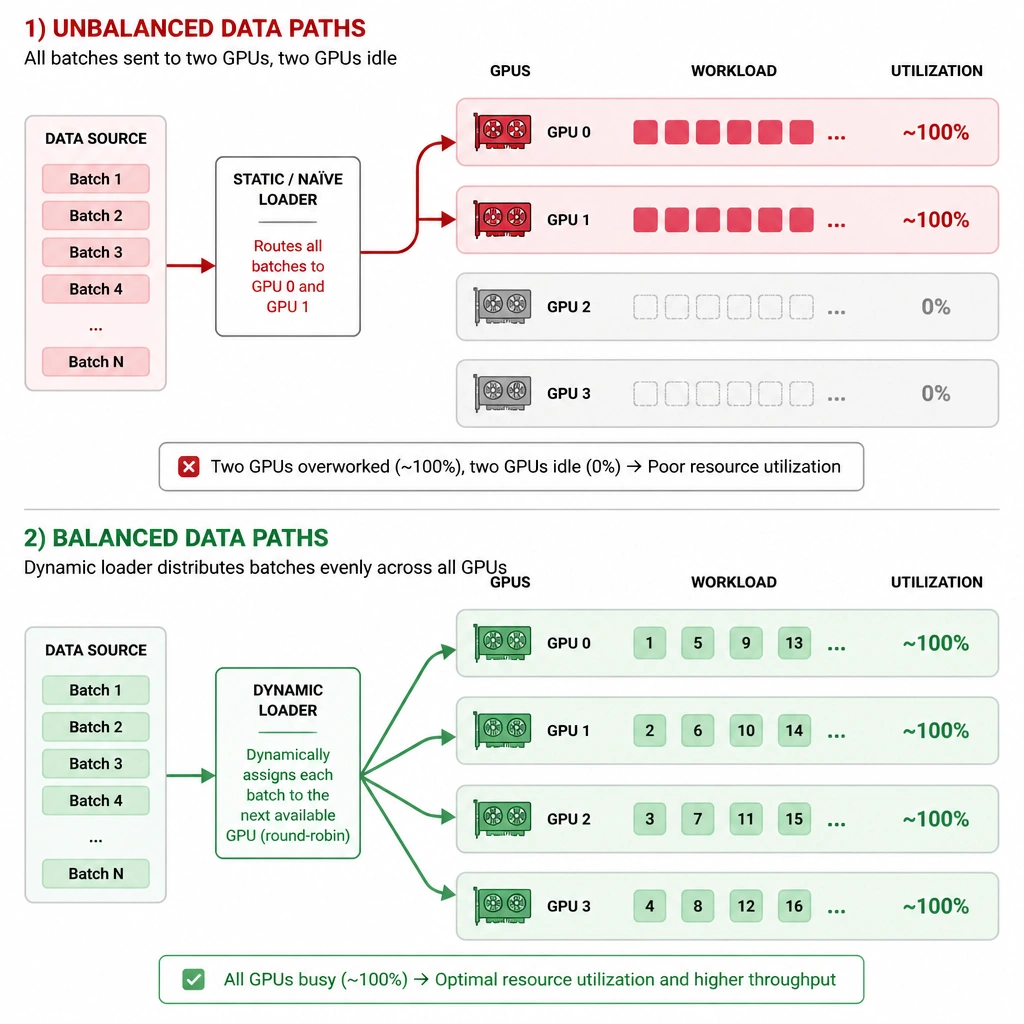
Full Explanation
Distributed deep learning relies on synchronizing weights and gradients across all participating GPUs (often using synchronous AllReduce operations). If the workload is not distributed evenly, the faster GPUs will sit idle waiting for the overloaded GPUs to complete their calculations, a phenomenon known as synchronization lag or bottlenecking. - Implementing dynamic load balancing (or adjusting parallelism strategies like pipeline, tensor, or data parallelism with balanced batch sizes) ensures that computational load matches the hardware configuration. This maximizes throughput by ensuring all GPUs process their partitions concurrently and reach synchronization points at the same time. - Overclocking GPUs does not address the underlying imbalance of work distribution and can lead to hardware instability or thermal throttling. - Reducing batch sizes reduces overall training efficiency and does not resolve the unequal distribution of the workload across the devices. - Adding more GPUs is costly and will worsen performance if the load balancing logic continues to leave resources underutilized or improperly partitioned.