You are optimizing a quantitative trading platform. The application executes complex, sequential mathematical formulas to evaluate options contracts (requiring high single-threaded precision) and concurrently performs real-time parallel analysis on millions of incoming market ticks. How should these tasks be distributed between host CPUs and GPU accelerators?
Select an answer to reveal the explanation.
Short Explanation and Infographic
Let's look at how CPUs and GPUs are built because they are completely different animals. A CPU is like a Ferrari—it has a few, highly powerful cores that can run sequential tasks incredibly fast. If you've got complex mathematical formulas that need to happen step-by-step with absolute precision, you want that Ferrari CPU handling it. A GPU, on the other hand, is like a massive fleet of dump trucks. It has thousands of smaller cores designed to do simple math all at the same time. If you need to crunch millions of incoming market data points in parallel, you don't want a Ferrari making a million trips; you want the fleet of dump trucks. By sending the sequential calculations to the CPU and the parallel data analytics to the GPU, you're using the right tool for the right job. Simple as that!
Full explanation below image
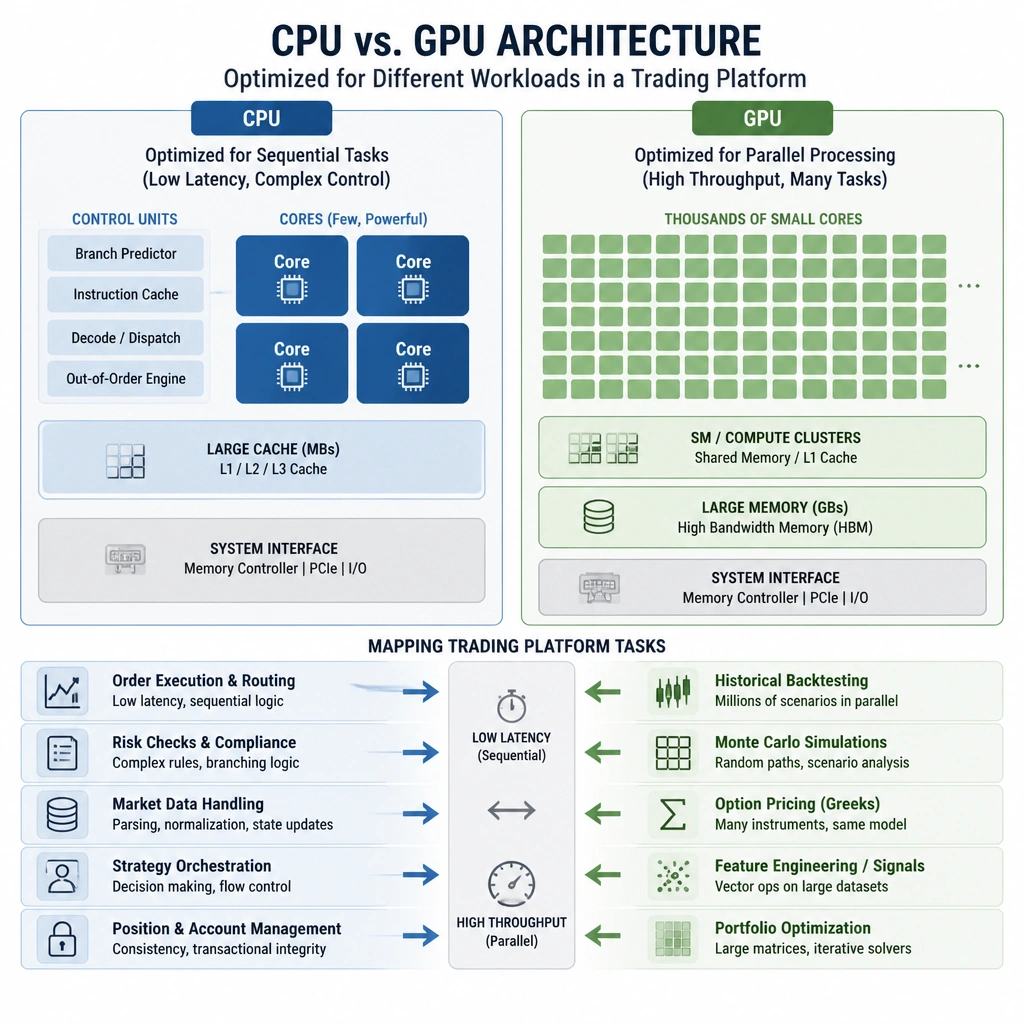
Full Explanation
Optimizing performance in accelerated computing requires understanding the fundamental architectural differences between CPUs and GPUs: - Central Processing Units (CPUs) are designed for general-purpose computing. They feature a small number of cores optimized for sequential, single-threaded execution. With sophisticated branch prediction, large caches, and high clock speeds, a CPU is highly efficient at processing complex logic and sequential mathematical algorithms where each step depends on the outcome of the previous one. - Graphics Processing Units (GPUs) are specialized processors featuring a highly parallel architecture consisting of thousands of smaller, simpler cores. They are designed to execute the same instruction on multiple data points simultaneously (SIMD/SIMT). This makes GPUs exceptionally well-suited for high-throughput, parallel workloads like data analytics, matrix multiplication, and deep learning, where millions of independent data points can be processed concurrently.
In this trading platform scenario: - The sequential options formulas involve complex mathematical logic that must be evaluated step-by-step. The CPU's high single-threaded performance is ideal for this. - The real-time parallel analysis of market ticks involves processing a high-volume stream of independent data points, which maps perfectly to the parallel execution model of the GPU.
Let's evaluate the incorrect options: - Executing parallel analytics on the CPU and sequential math on the GPU is the reverse of their design strengths, leading to poor throughput on both tasks. - Running sequential math on the GPU results in massive inefficiency because GPUs have relatively weak single-core performance and lack the advanced branch prediction needed for complex sequential tasks. - Using the GPU for I/O scheduling is incorrect, as GPUs are not designed to manage system input/output operations; that is the responsibility of the host CPU and operating system.