You are evaluating two regression models built to predict residential home values. Model X has a Mean Absolute Error (MAE) of $18,000, while Model Y has an MAE of $25,000. Which model is preferred based on this metric, and what does it tell you about the models' predictions?
Select an answer to reveal the explanation.
Short Explanation and Infographic
Here's the deal: when you're predicting home prices, you want your guesses to be as close to reality as possible. If Model X has an MAE of $18,000, it means that on average, its predictions are off by eighteen grand. If Model Y is off by twenty-five grand, it's clearly less accurate. Mean Absolute Error is just the average of the absolute differences between your predictions and the actual numbers. So, write this down: lower is better! It means your errors are smaller. Don't let the exam catch you overthinking this—lower MAE simply means closer predictions.
Full explanation below image
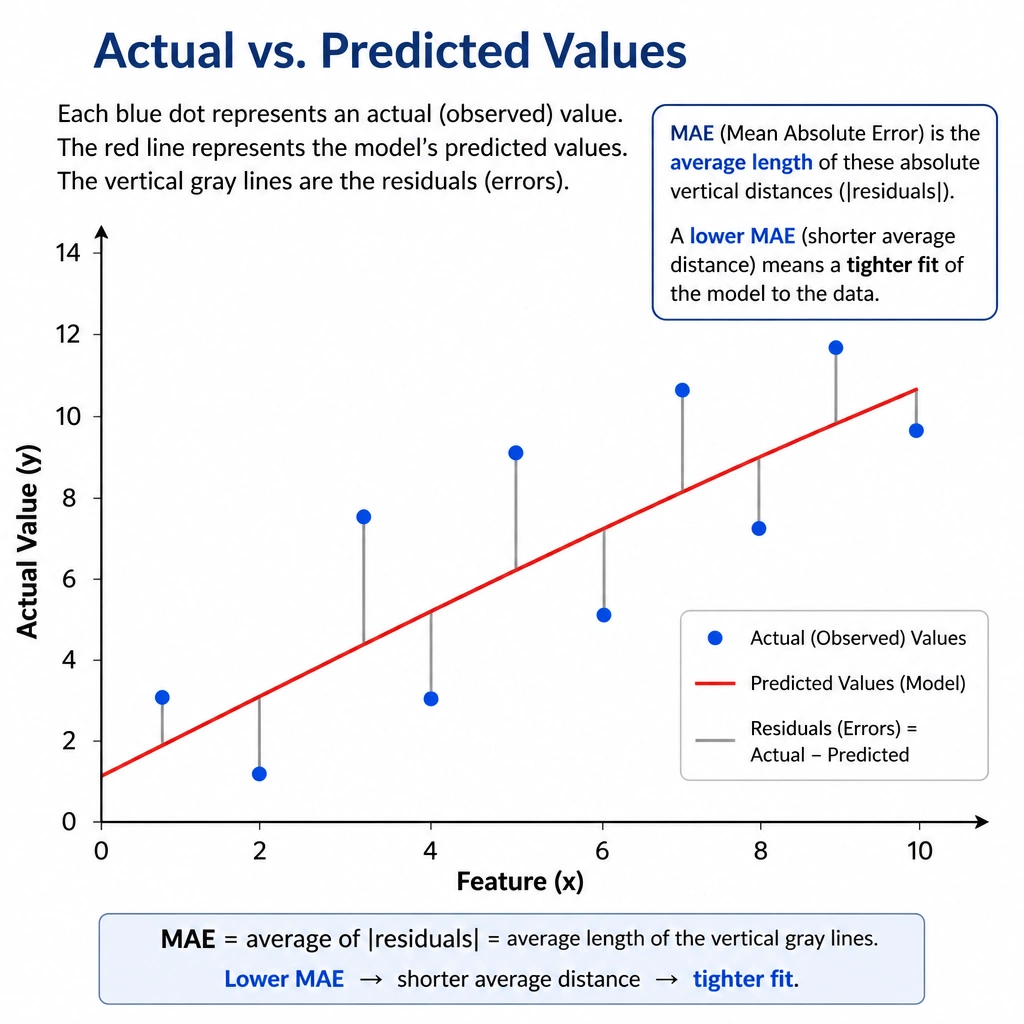
Full Explanation
In regression tasks, performance metrics assess how close a model's continuous predictions are to the actual target values. Mean Absolute Error (MAE) is one of the most straightforward and interpretable metrics used for this purpose.
Mathematically, MAE is calculated by taking the absolute difference between the predicted value and the actual value for each data point, summing these absolute differences, and dividing by the total number of data points. Because it uses absolute values, MAE measures the average magnitude of the errors without considering their direction (whether the prediction was too high or too low). It is expressed in the same units as the target variable (in this case, dollars), making it highly intuitive for business stakeholders.
Since MAE represents error, a smaller value is always preferred. A lower MAE indicates that, on average, the model's predictions deviate less from the true target values, signifying a more accurate model.
Let's address the distractors: - Option A is incorrect because a higher MAE indicates a larger average error, meaning the model's predictions are less accurate. - Option C is incorrect because a low MAE on validation/test data is a sign of good model performance, not underfitting. While a low training MAE combined with a high validation MAE indicates overfitting, MAE itself is not a 'symptom of underfitting.' - Option D is incorrect because MAE is specifically designed for regression tasks (predicting continuous variables) and cannot be applied to classification tasks (predicting discrete classes).
Therefore, Model X is the superior model based on its lower MAE.