When designing hardware infrastructure for enterprise AI, system architects must distinguish between the resources needed to build models versus those needed to run them. What is a primary difference in the hardware demands between model training and model inference?
Select an answer to reveal the explanation.
Short Explanation and Infographic
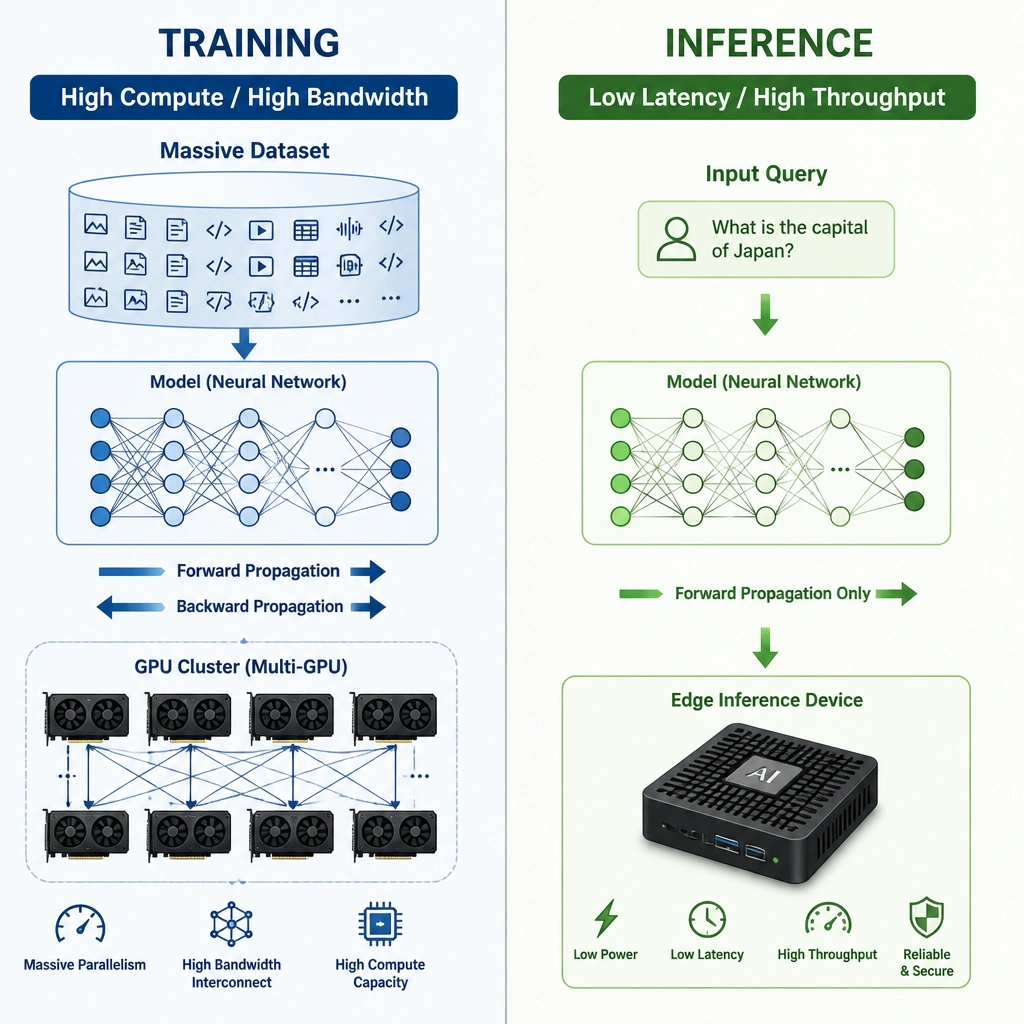
Here's the deal: training a model and running inference are two completely different beasts. Think of training like studying for a medical degree—it takes years of intense, heavy-duty brainpower (massive compute, huge datasets, multiple GPUs running backpropagation). Inference, on the other hand, is like a doctor writing a quick prescription during a checkup. The doctor already has the knowledge (the trained weights) and just needs to make a fast, accurate decision (low latency, high throughput) for a single patient. Keep this straight: training is about raw muscle power to build the model, while inference is about speed and efficiency to serve the user.
Full explanation below image
Full Explanation
The lifecycle of an AI model is divided into two primary execution phases: training and inference. Each phase imposes completely different workloads on hardware infrastructure.
Training is the process of building the model. It involves feeding massive datasets through the neural network, calculating the loss, and performing backpropagation to adjust millions or billions of weights. This is an iterative, mathematically intense process requiring double-precision or half-precision floating-point operations. Training architectures must scale across multiple nodes and GPUs (using high-speed interconnects like NVLink) to handle the massive compute and memory bandwidth required to process batches of data.
Inference is the process of using a trained model to make predictions on new, unseen data. In this phase, the weights are fixed (no backpropagation is performed), and data only flows forward through the network. The primary goals of inference architectures are minimizing response latency (the time it takes to return a prediction) and maximizing throughput (the number of predictions per second), often in real-time environments like web services or edge devices. Consequently, inference hardware often utilizes lower-precision data types (like INT8) to speed up execution and reduce power consumption.
Let's examine the incorrect choices: - Option A is incorrect because training involves both forward and backward passes across massive batches, requiring significantly more memory bandwidth and compute power than inference. - Option C is backwards; training is rarely done on low-power edge devices due to its massive computational demands, whereas inference is frequently deployed on edge hardware (like mobile phones or smart cameras). - Option D is also incorrect because distributed training requires high-bandwidth multi-node systems with interconnects like NVLink to synchronize gradients, whereas inference typically runs on single-GPU or CPU nodes.
Understanding this distinction allows architects to allocate expensive multi-GPU clusters for training while using lighter, cost-effective accelerators for inference deployment.