An e-commerce giant needs to redesign its real-time recommendation engine to handle a massive surge in active users and catalog size. The engine must support continuous online model updates and deliver personalized recommendations within milliseconds. Which architectural combination of processing units, networking interfaces, and container orchestrators will provide the necessary compute density, low-latency inter-node communication, and elastic scaling?
Select an answer to reveal the explanation.
Short Explanation and Infographic
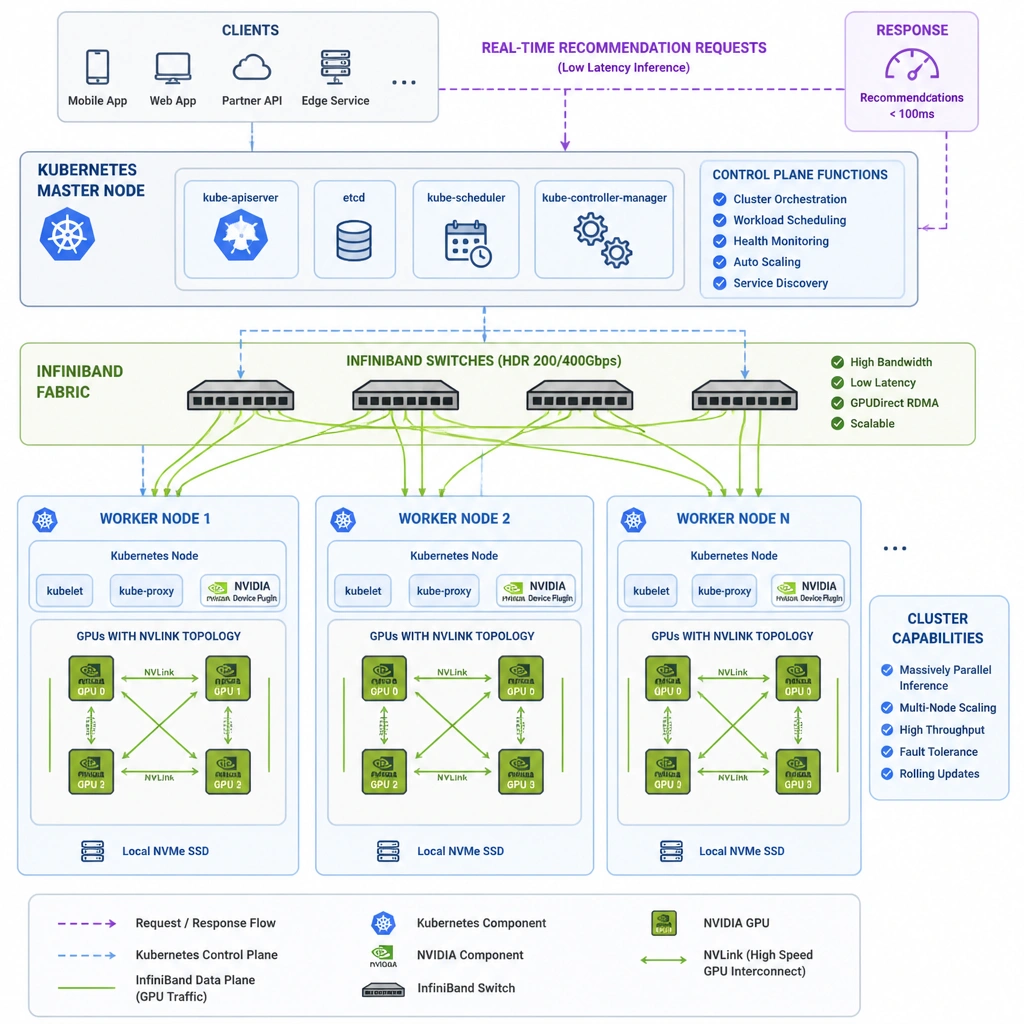
Here's the deal: if you want a real-time recommendation engine that keeps up with millions of clicking users and updates its model on the fly, you need serious horsepower and flexibility. One single GPU server won't cut it—that's a single point of failure and a massive bottleneck. You need multiple GPUs working as a team. But here's the catch: when you have multiple GPUs, they need to talk to each other fast, which is why high-speed interconnects like NVLink and InfiniBand are absolute lifesavers. Now, how do you manage all these servers and keep them scaling when traffic spikes? You use Kubernetes for container orchestration. It automatically scales your workloads, monitors their health, and schedules them across your GPU cluster. Going CPU-only is way too slow for deep learning at scale, and edge ARM devices are meant for low-power remote deployments, not high-volume backend recommendation systems. Got it? Sweet.
Full explanation below image
Full Explanation
Designing high-throughput, low-latency AI architectures for systems like real-time recommenders requires balancing compute capacity, inter-device communication bandwidth, and operational scaling.
First, deep learning models require accelerated parallel compute, which makes GPUs necessary. When scaling across multiple GPUs, the communication overhead between them can easily become the primary performance bottleneck. Standard PCIe buses often lack the bandwidth needed for fast parameter synchronization. High-speed interconnects like NVIDIA NVLink (for intra-node communication) and InfiniBand or RoCE (for inter-node communication) allow GPUs to share data directly at multi-hundred gigabytes per second, minimizing latency.
Second, to handle fluctuating traffic and ensure high availability, the infrastructure must be orchestratable. Kubernetes (K8s) provides the framework to automate deployment, scaling, and management of containerized AI applications. Utilizing features like the NVIDIA Device Plugin for Kubernetes, K8s can dynamically allocate GPU resources to containers, load balance traffic, and auto-scale pods based on custom metrics (like query latency or queue depth).
Let's review the incorrect options: - Option B: Edge devices with ARM processors are optimized for low-power, localized inference. They lack the memory bandwidth and raw compute power required to train or update a massive, centralized recommendation system in real time. - Option C: CPU-only instances lack the parallel computing units (Tensor Cores) required for rapid deep learning matrix operations, resulting in unacceptable inference latency and high operational costs at scale. - Option D: A standalone single GPU server lacks high availability, represents a single point of failure, and cannot scale horizontally to meet unpredictable user demand, while manual updates introduce substantial downtime.
Therefore, multi-GPU nodes with high-speed interconnects orchestrated by Kubernetes represent the industry-standard architecture for high-performance, real-time AI workloads.