You are training a large language model (LLM) on an NVIDIA GPU cluster. During training, you observe that GPU utilization is lower than expected and training is taking too long because the massive parameters and activations are saturating the memory bandwidth, leaving the Tensor Cores idle. Which of the following actions is most likely to improve GPU utilization and reduce training time?
Select an answer to reveal the explanation.
Short Explanation and Infographic
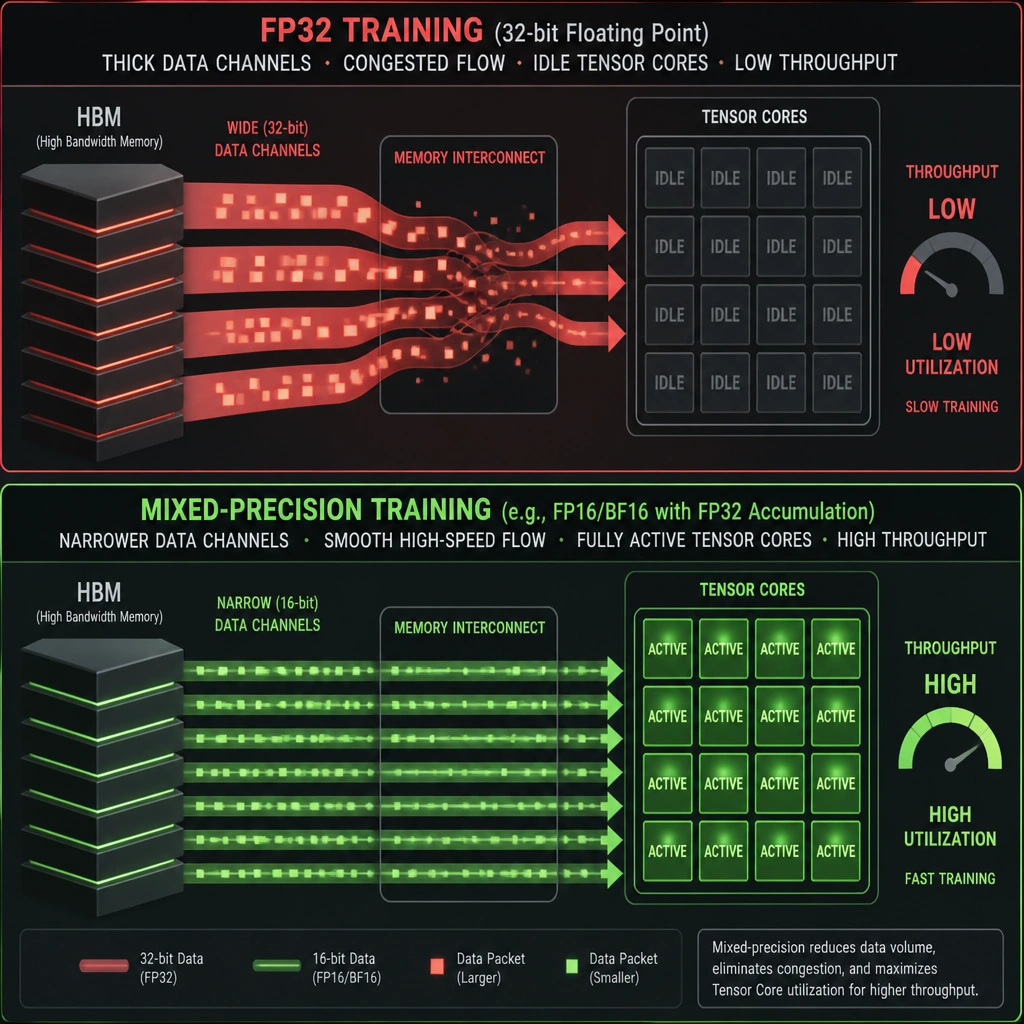
Check this out: training Large Language Models is a massive memory-bandwidth hog. If you're running everything in standard 32-bit float (FP32), your GPUs spend more time moving data in and out of memory than actually doing calculations. That's why your GPU utilization looks low—it's waiting on the memory bus! Here's the deal: by switching to mixed precision (like FP16 or BF16), you cut the memory traffic in half. This frees up the bottleneck and feeds the Tensor Cores at lightning speed. It's like upgrading from a congested two-lane road to a multi-lane highway. The math runs faster, your GPUs stay fully utilized, and your training time plummets. Don't go lowering your learning rate or shrinking your batch size—that won't fix the memory bottleneck!
Full explanation below image
Full Explanation
Large Language Models (LLMs) contain billions of parameters, resulting in massive memory footprints during training due to weight, gradient, and optimizer state storage. When training LLMs in full FP32 (32-bit single-precision floating-point), the primary bottleneck is often memory bandwidth. The GPU's high-speed memory (HBM) cannot feed the compute engines quickly enough, leading to low overall GPU utilization and sluggish training times. Mixed-precision training (incorporating FP16 or BF16 formats alongside FP32 master weights) directly mitigates this issue. Lowering precision halves the size of activations and gradients, which reduces the amount of data that must be transferred between GPU memory and the processing cores. Furthermore, modern NVIDIA GPU architectures feature dedicated hardware called Tensor Cores, which are specialized for performing mixed-precision matrix multiplications at extremely high throughput. By moving to mixed precision, the workload becomes compute-bound rather than memory-bandwidth-bound, enabling the Tensor Cores to operate at peak efficiency and raising GPU utilization. Let's look at the incorrect options: - Decreasing the learning rate (Option A) changes the optimizer's step size during convergence but has absolutely zero impact on hardware computational efficiency or memory transfer rates. - Decreasing the batch size (Option B) actually worsens GPU utilization because it reduces parallel work, meaning the GPU cannot saturate its execution units, even if it reduces peak memory usage. - Transitioning gradient aggregation to CPU-based parameter servers (Option D) introduces massive PCIe and network latency bottlenecks, severely slowing down distributed training instead of accelerating it. Additionally, when using mixed-precision training, developers often utilize automatic loss scaling to prevent underflow. Underflow occurs when very small gradient values in FP16 representable range are rounded to zero, which can halt convergence. Loss scaling multiplies the loss by a scaling factor before backpropagation, pushing gradient values into the representable range, and then scales them back down before weight updates. This preserves convergence while maximizing throughput. Thus, adopting mixed-precision training is the standard best practice for optimizing LLM training performance on NVIDIA GPU platforms.