NVIDIA's accelerated computing platform is changing the game across multiple industries, but one sector in particular has been completely revolutionized. We're talking about slash-and-burn reductions in product design cycles and the ability to run incredibly complex, high-fidelity safety simulations before physical prototypes are ever built. Which industry has seen this massive shift, especially driven by autonomous systems and safety modeling?
Select an answer to reveal the explanation.
Short Explanation and Infographic
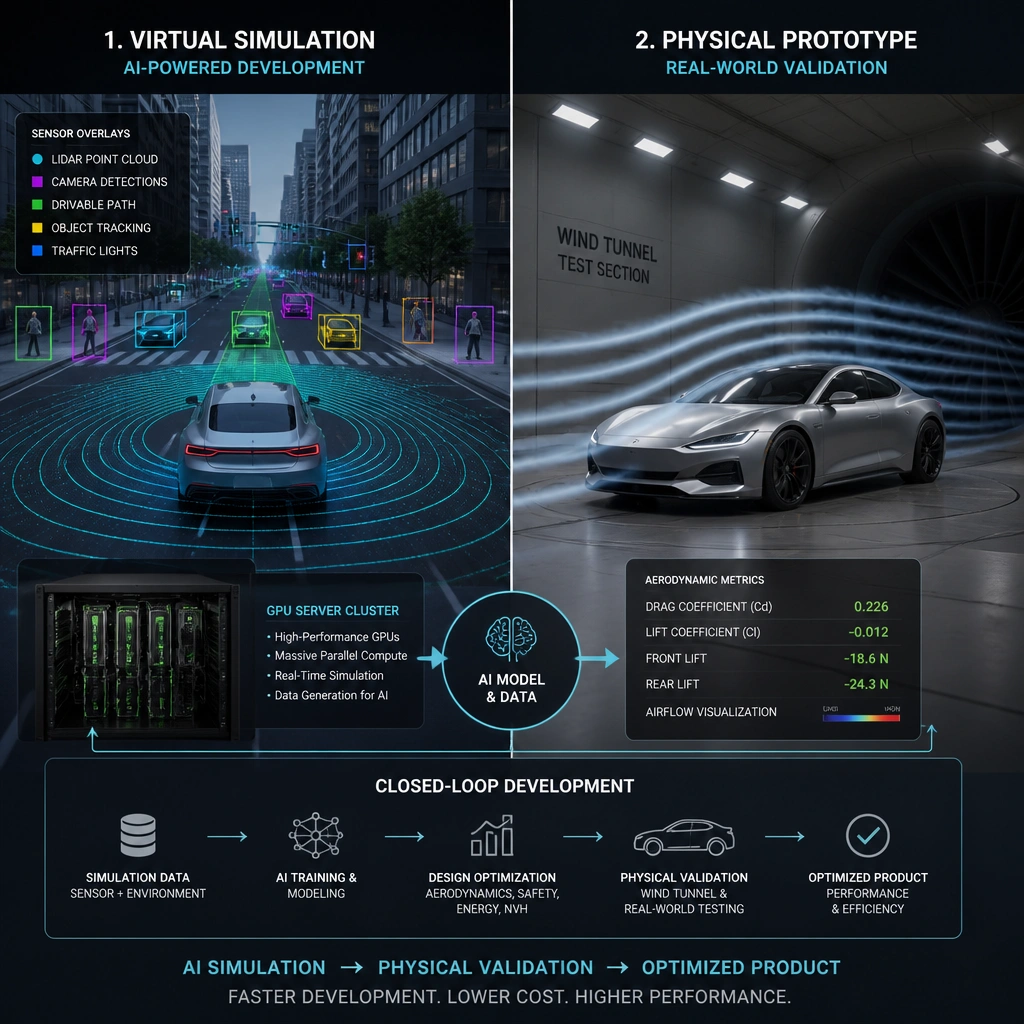
Check this out—while AI is making waves everywhere from bank fraud detection to retail inventory, the automotive sector has been completely transformed by NVIDIA's tech. Think of the sheer volume of data required to train a self-driving car. You can't just drive millions of physical miles on public roads to test every edge case—it's too slow, too dangerous, and way too expensive. Instead, engineers use massive GPU clusters to simulate millions of virtual miles in a digital sandbox, throwing rain, snow, and erratic pedestrians at the vehicle's AI. This collapses design cycles from years to weeks and makes cars much safer before they ever hit the asphalt. Keep this in mind: for simulations and autonomous training, the automotive industry is the big winner.
Full explanation below image
Full Explanation
High-performance computing (HPC) and artificial intelligence have enabled transformative changes across various sectors, but the automotive industry stands out for its deep integration of accelerated computing to shorten product development lifecycles and run predictive simulations.
Autonomous vehicle (AV) development is highly compute-intensive. To train safe self-driving systems, developers must expose AI models to millions of driving scenarios. Doing this exclusively in physical vehicles is impractical due to time constraints, safety hazards, and costs. NVIDIA's AI infrastructure—such as DGX clusters and specialized software suites like NVIDIA DRIVE Sim and NVIDIA Omniverse—allows engineers to build physically accurate virtual environments. Within these simulations, they can test sensor inputs, vehicle dynamics, and control algorithms against rare edge-cases (such as low-visibility weather or sudden pedestrian crossings) repeatedly and safely.
Furthermore, traditional vehicle design involves extensive aerodynamics and structural crash simulations. By accelerating these compute-heavy physics calculations on GPUs rather than traditional CPU clusters, automotive manufacturers have reduced design validation times from months to days, lowering engineering costs and accelerating time-to-market.
Let's review the other sectors: - The finance industry (Option A) uses AI for transaction monitoring, risk assessment, and market prediction, but these do not involve physical product design cycles or safety-critical spatial simulations. - Retail (Option B) leverages AI for consumer behavior profiling and inventory optimization, which are business process improvements rather than engineering design accelerations. - Manufacturing (Option C) utilizes computer vision for quality control and assembly robotics, but the profound shift in design-cycle simulation is most pronounced in automotive development.
Consequently, the automotive sector represents the most profound application of accelerated computing for physical simulation and autonomous agent training.