
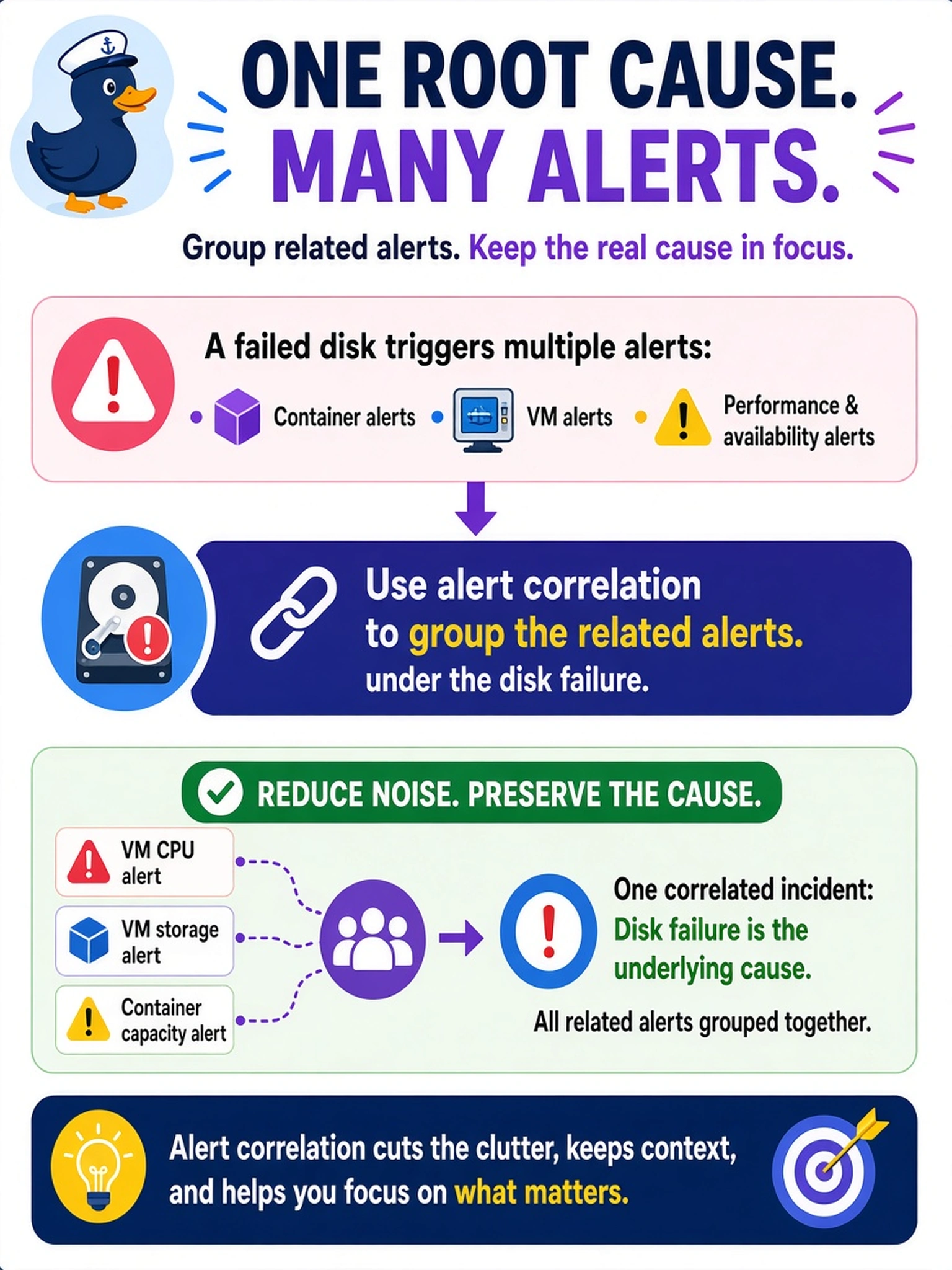
During routine monitoring, a failed disk triggers multiple Prism alerts that reference impacted VMs and containers. You want to avoid opening each alert as if it were a separate incident. What should you use to reduce noise while preserving the disk failure as the underlying cause?
Select an answer to reveal the explanation.
Short Explanation
Think of alert correlation like a group chat for symptoms: one disk failure can make a lot of noise, but you don't have to reply to every message. If you acknowledge each VM and container alert separately, you're just chasing echoes instead of the source. Use correlation to see the root cause and keep the alert queue honest.
Full Explanation
Alert correlation groups multiple notifications that arise from a shared dependency so the operator sees one underlying incident instead of many symptoms. The disk event is the primary fault, while VM and container alerts are downstream consequences. Correlating them preserves the original alert as the root cause and reduces duplicate triage work. This approach supports accurate incident ownership because the primary hardware alert drives the remediation timeline, while secondary alerts inherit its status. Acknowledging each affected object separately is wrong because it treats dependent notifications as independent incidents, increasing noise and obscuring the common cause. Suppressing all disk-related notifications is wrong because it can hide legitimate hardware or storage events and does not create a structured relationship between the alerts. Running NCC health checks and creating a separate alert policy for every affected container is also wrong because health checks diagnose cluster conditions, while per-container policies add management overhead without grouping dependent alerts. Exam caveat: on NCP-MCI items, choose the workflow that preserves root-cause visibility while reducing repeated alerts. Operational check: verify the primary disk alert remains actionable and the related VM or container alerts are clearly associated with it.