
You manage a production AHV VM on a multi-node Nutanix cluster. The VM must remain available if any single node fails, and you must choose a storage policy. Which storage policy should you apply?
Select an answer to reveal the explanation.
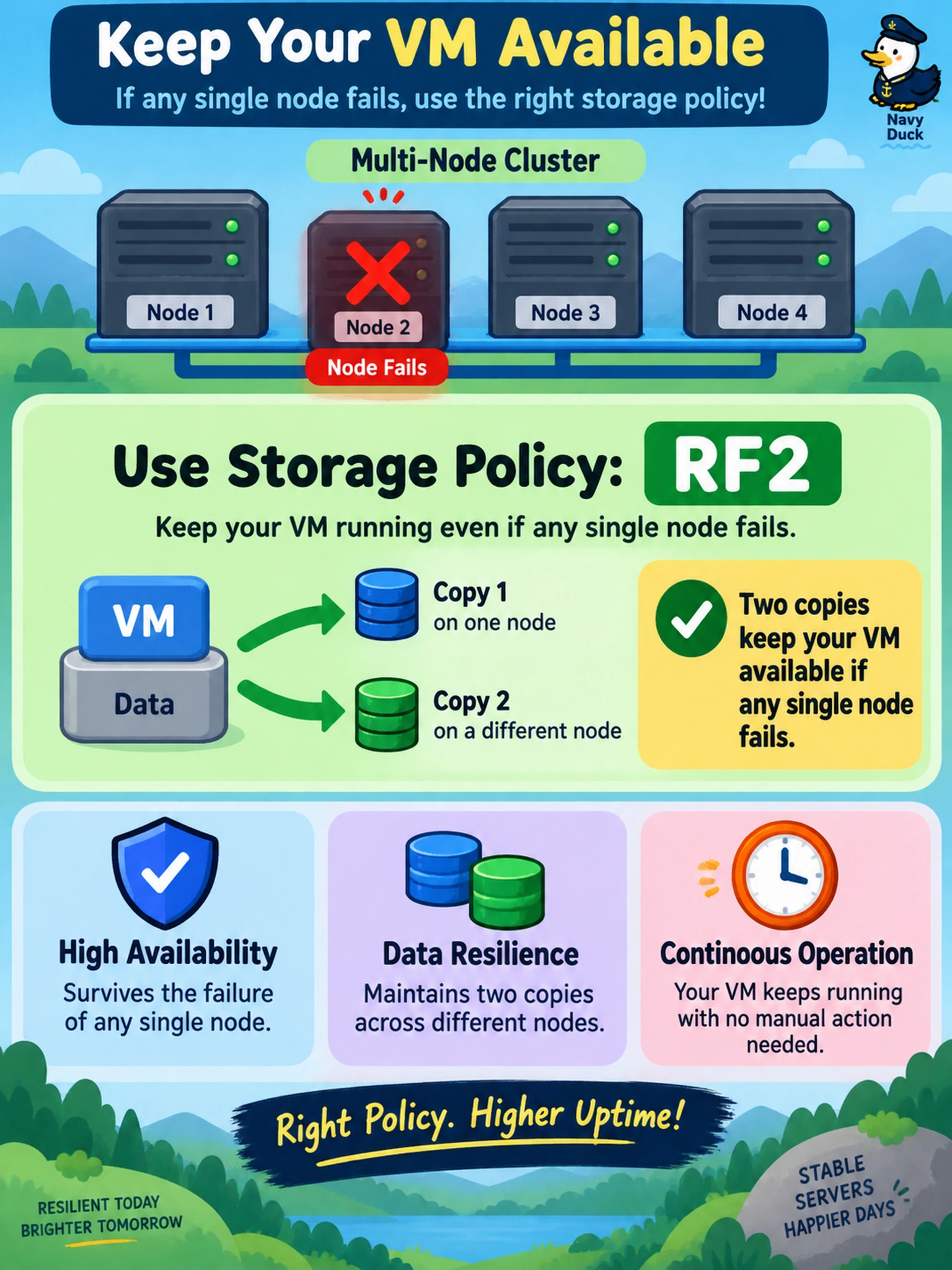
Short Explanation
Think of RF2 like keeping two copies of your file: if one node falls over, the other copy is still there. You don't pick compression or EC-X just because they sound efficient; availability comes from redundancy. For a production VM that has to survive a node failure, you set RF2.
Full Explanation
Replication factor controls how many independent copies of a VM's data blocks exist across the cluster. RF2 writes each block twice, typically on two nodes, so a single node failure leaves a full copy available for Stargate to serve reads and writes without waiting for rebuild. This is the minimum redundancy expected for production availability on AHV when the requirement is surviving one node loss. RF1 stores only one copy, so losing the node holding that copy makes the data unavailable and can cause VM outage, even though it saves capacity. Erasure coding is a space-efficiency technique that splits and protects data with parity, but it is not the same as simple node-failure redundancy for a general VM storage policy and can introduce rebuild and read/write tradeoffs. Compression reduces stored bytes after data is written; it does not create a second copy and therefore cannot keep a VM online when a node fails. Exam caveat: RF2 is the standard answer for single-node-failure availability unless a question explicitly specifies EC-X, capacity constraints, or a different RF requirement. Operational check: review the VM's storage policy in Prism Element or Prism Central, confirm RF2, then validate that the cluster has enough nodes and capacity for two copies before applying it to production workloads.